

The core practice areas that protect animal health and your bottom line are biosecurity, species-appropriate housing, feeding and water quality, preventive veterinary care, low-stress handling, record-keeping, and manure management, all run on repeatable routines rather than one-off fixes. Prevention beats reaction every time, which is the operating principle behind both the WSAVA Principles of Wellness and Michigan’s GAAMPs guidance. Before anything else: line up a vet, quarantine new arrivals, secure clean water, and walk your fence line.
TL;DR:
- Establish a fixed quarantine period of at least two to three weeks for new or returning animals, and only integrate them into the main herd after wellness is confirmed.
- Prioritize weatherproofing, proper ventilation, and dry bedding over increasing space, as these factors have a bigger impact on animal health and stress levels.
- Maintain a comprehensive, regularly updated record system for animal health, treatments, and breeding data to improve traceability and decision-making.
- Ensure perimeter fencing is strong and well-maintained using expert design services, as a secure fence line is fundamental to biosecurity and operational safety.
Table of Contents
- Biosecurity and Quarantine: Your First Line of Defense
- Housing and Space: What Animals Actually Need
- Feeding and Water: Building a Routine You Can Actually Track
- Preventive Veterinary Care: The Foundation of Herd Health
- Low-Stress Handling and Staff Safety
- Record-Keeping and Traceability That Actually Gets Used
- Manure and Waste Management That Protects Your Land
- A Simple Framework: Baseline, Common, and Aspirational Practices
- Behavioral Enrichment and Social Needs Management
- Emergency Preparedness and Response Protocols
- Training and Education Programs for Staff
- Breeding Management and Genetic Considerations
- What Actually Separates Good Operations From Great Ones
- Where Fencefast Fits Into Your Containment Plan
- Sources
- FAQ
Biosecurity and Quarantine: Your First Line of Defense
Every disease outbreak on a farm traces back to a breach in one of three places: new animals, visiting people, or shared equipment. Quarantine new or returning animals for at least two to three weeks in a separate space with its own tools, boots, and water source. Watch for appetite changes, discharge, or lethargy before you fold them into the main herd or flock.
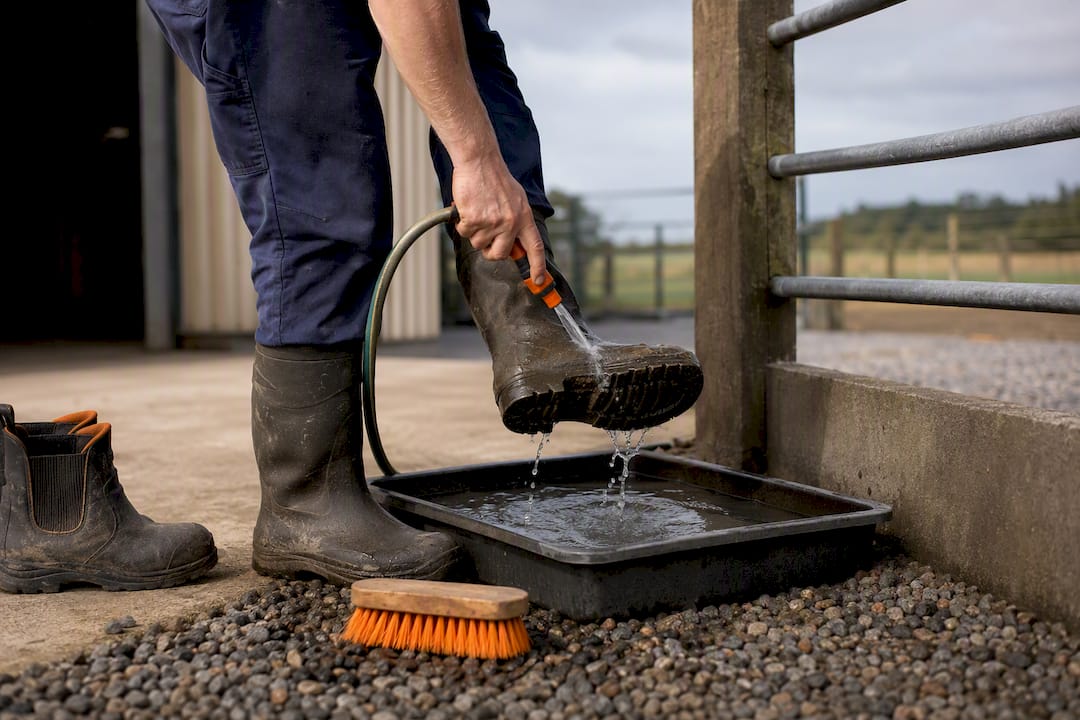
Cleaning matters more than most people budget for it. High-touch surfaces, feed troughs, and trailer beds need regular disinfection, and anyone moving between groups of animals should change boots or step through a boot bath first.
- Set a fixed quarantine length and stick to it, even under pressure to integrate a new animal faster.
- Keep a dedicated set of tools for sick or new animals, never shared with the general population.
- Require boot baths or clean footwear at every building entrance.
- Escalate to lab testing when symptoms persist past 48 hours or spread to more than one animal.
Pro Tip: Keep a simple logbook by the quarantine pen. Write down the date an animal entered, what you observed, and when it cleared. It takes thirty seconds and saves hours of guesswork later.
A boot bath and perimeter setup is one of the cheapest biosecurity upgrades a farm can make, and it pays for itself the first time it stops a pathogen at the gate.
Housing and Space: What Animals Actually Need
Space requirements are not one-size-fits-all, and getting them wrong shows up fast in stress behavior and disease rates. A concrete benchmark: laying hens need roughly 3 to 3.5 square feet per bird inside the coop, with more room in an attached run. Cattle, pigs, and horses each scale differently by weight and production stage, so check species-specific charts rather than eyeballing it.
Ventilation and drainage often matter more than square footage. A cramped but dry, well-ventilated space beats a spacious one that stays damp. Bedding should stay dry enough that ammonia smell isn’t noticeable when you walk in.
- Prioritize weatherproofing and draft control before anything else.
- Add cross-ventilation or vents before increasing floor space.
- Choose bedding (straw, shavings, sand) based on drainage, not just cost.
- Predator-proof entry points with secure latches and buried fencing where digging predators are a risk.
Once the basics are solid, enrichment upgrades come next, and a pasture and containment review is a good next step for outdoor housing.
Feeding and Water: Building a Routine You Can Actually Track
Nutrition planning starts with matching rations to life stage and production goal, not a generic feed bag label. A lactating cow, a growing calf, and a dry cow all need different formulations, and nutrition guidelines from the NRC work best as a starting point you adapt with a nutrition consultant as your operation changes seasonally.
Water is the most underrated welfare indicator on most farms. Twenty hens drink roughly one gallon per day in cool weather, and that number climbs sharply in heat. A sudden drop in water intake almost always shows up before visible illness does.
- Log daily water consumption for at least one representative group, not just total tank levels.
- Check troughs and waterers twice daily during extreme heat or cold.
- Review feed rations seasonally, especially around breeding, calving, or lambing.
- Flag any intake drop of more than 20% for same-day investigation.
Statistic Callout: Twenty hens consuming under a gallon of water daily in cool weather is a useful early-warning benchmark. If your flock falls noticeably short of that, something is already wrong.
Preventive Veterinary Care: The Foundation of Herd Health
Vaccination and parasite control cost far less than treating an outbreak after the fact, which is why the WSAVA’s wellness principles put prevention ahead of every other health strategy. Line up a veterinary relationship before animals arrive on your property, not after the first emergency call.
Parasite control works best when it’s targeted. Fecal egg counts tell you which animals actually need deworming, rather than dosing the whole herd on a calendar schedule that breeds resistance over time.
Build a daily observation habit: check posture, appetite, and manure consistency at feeding time. Any animal standing apart from the group, moving stiffly, or skipping a meal deserves a closer look immediately.
- Schedule a baseline vet visit within the first month of any new operation.
- Run fecal egg counts before deworming, not on a fixed calendar.
- Vaccinate on a schedule set by your vet, adjusted for regional disease pressure.
- Record temperature, appetite, and behavior for any animal flagged during daily checks.
Low-Stress Handling and Staff Safety
Animals that are handled calmly stay healthier and injure fewer people. Forceful restraint raises cortisol, and stressed animals are measurably more likely to spread infectious disease through a group, a link well documented in shelter medicine research.
- Approach animals from an angle they can see, and move slowly enough that they can choose to comply.
- Use facility design, not force. Single-file runs, curved chutes, and visual shields reduce balking far more reliably than pressure.
- Train new staff on flight zones and point of balance before they handle animals alone.
- Require non-slip flooring in all handling areas, especially near loading ramps.
- Keep basic PPE (gloves, closed-toe boots, eye protection) stocked and visible at every handling station.
Pro Tip: Time how long it takes to move a group through a chute calmly versus with pressure. Calm almost always wins on speed too, once animals learn the routine.
Record-Keeping and Traceability That Actually Gets Used
Every animal needs one profile: identification, baseline health data, event history, and any withdrawal periods from medication. GAAMPs guidance frames this kind of structured documentation as core to operating within your actual capacity for care, not a paperwork afterthought.
Fast entry at the point of care matters more than a fancy system. A clipboard by the chute beats a spreadsheet you update once a month.
- Capture date, animal ID, observation, and action taken for every health event.
- Track feed intake anomalies and disease incidence as simple monthly counts.
- Set decision triggers in advance: what manure consistency, what temperature, what behavior means “call the vet now.”
- Review records monthly to catch slow-building patterns individual observations miss.
Manure and Waste Management That Protects Your Land
A manure management plan exists to keep animals healthy, keep water and soil clean, and keep odor and pests under control, exactly the framing Michigan’s GAAMPs standards use for farm compliance. Storage location and timing of field application are the two decisions that matter most for preventing runoff.
- Store manure away from wells, ditches, and waterways, with a roof or cover where possible.
- Time field application for dry conditions, never right before heavy rain.
- Compost bedding waste to cut fly pressure and odor before it becomes a neighbor complaint.
- Check local regulations annually since manure storage and application rules shift by region.
Fold waste checks into your existing daily walk-through rather than treating them as a separate task.
A Simple Framework: Baseline, Common, and Aspirational Practices
Animal care manuals split practices into three tiers, a structure the AZA’s animal care handbook uses to help managers prioritize limited budgets without losing sight of long-term goals.
- Baseline is the legal and welfare minimum: adequate shelter, clean water, and basic veterinary access. Skipping this isn’t optional.
- Common is what most well-run operations already do: scheduled vaccinations, documented handling protocols, and seasonal housing upgrades.
- Aspirational is where measurable improvement lives: rotational grazing, enrichment rotation, or upgraded fencing that reduces daily stress on both animals and staff.
Run a short gap analysis twice a year against these three tiers, and track two or three KPIs (disease incidence, feed conversion, injury rate) to see whether aspirational investments are actually paying off.
Behavioral Enrichment and Social Needs Management
Animals kept in isolation or under-stimulated conditions show more repetitive behaviors, more aggression, and slower recovery from illness. Enrichment isn’t a luxury tier reserved for zoos. It’s a practical lever that lowers stress hormones and, by extension, disease transmission within a group, a connection shelter medicine researchers have documented repeatedly.
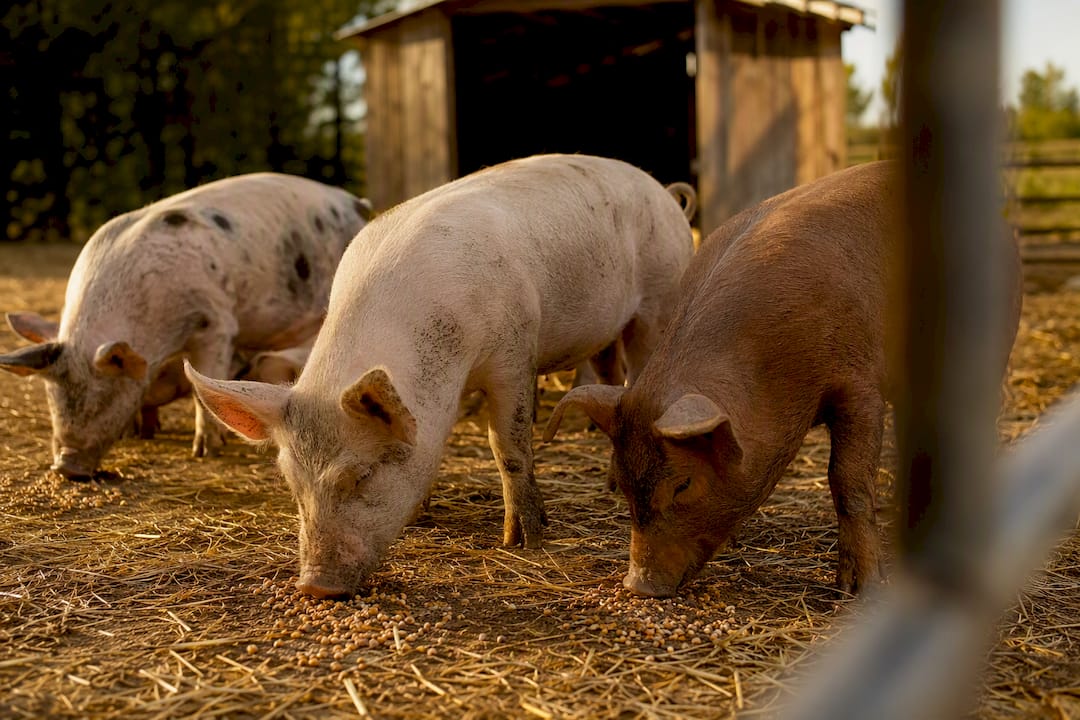
Social structure matters as much as physical space. Herd and flock animals need to see, hear, or interact with others of their kind, and isolating a social animal for anything longer than a short medical quarantine tends to backfire behaviorally. Pigs root, chickens dust-bathe and forage, cattle graze in loose social groups, and horses need turnout time with visual contact to other horses at minimum.
Rotating novel objects, scattering feed instead of trough-dumping it, and varying pasture access all count as low-cost enrichment. For confined animals, even a change in bedding texture or a scratching post can measurably reduce stereotypic behavior over a few weeks.
Watch for the warning signs of under-stimulation: feather-pecking in poultry, tail-biting in pigs, cribbing in horses, or excessive pacing in any confined species. These behaviors are the animal telling you something about its environment before it shows up as a health problem. Address the environment first, not just the symptom.
Build enrichment into your routine schedule rather than treating it as a special occasion. A five-minute pasture rotation check or a weekly toy swap costs almost nothing and compounds over months into calmer, healthier animals.
Emergency Preparedness and Response Protocols
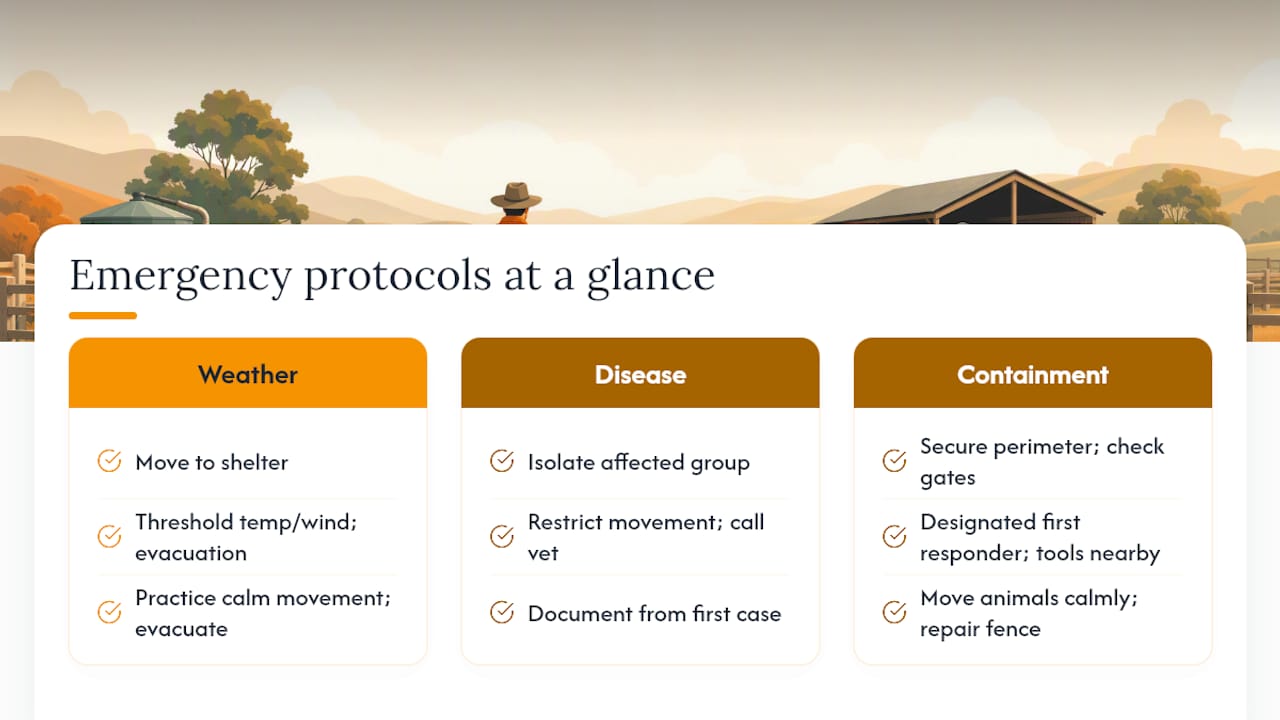
Every operation needs a written plan for the three emergencies that actually happen: severe weather, disease outbreak, and containment failure. Waiting until the storm warning hits or an animal is already loose is how small problems become expensive ones.
Start with a contact list posted somewhere visible: your veterinarian, a backup vet, the nearest large-animal emergency clinic, and your local extension office. Include account numbers and medical histories for animals with known conditions so anyone on your team can act without waiting for you to arrive.
Weather emergencies need a pre-decided threshold. Know at what temperature or wind speed you move animals to shelter, and know your evacuation route if flooding or fire is a risk in your region. Practice moving animals under calm conditions so the process is familiar under pressure.
Disease outbreak response should mirror your quarantine protocol but scaled up: isolate the affected group immediately, restrict movement on and off the property, and call your vet before symptoms spread further. Document everything from the first sick animal onward, since that record becomes critical if a reportable disease is suspected.
Containment failure, meaning a fence break or gate failure, deserves its own quick-reference plan: who checks the perimeter first, what tools are kept near the exit points, and how animals get moved back safely without panic on either side. A reliable containment setup reduces how often this scenario happens in the first place.
Training and Education Programs for Staff
Untrained staff are the most common source of preventable injuries, both to themselves and to animals. A short, structured onboarding program beats hoping new hires figure it out by watching.
Cover four things in week one: animal behavior basics (flight zones, body language, warning signs), your facility’s specific handling routes, PPE requirements, and who to call in an emergency. Everything past that can be trained on the job, but these four gaps cause the most accidents when skipped.
Cross-train at least two people on every critical task, feeding, medication administration, and emergency shutoff procedures included. A one-person knowledge bottleneck is a liability the day that person is sick or unreachable.
Refresh training annually, not just at hiring. Handling techniques drift over time, and a quick refresher catches bad habits before they become the new normal. Shelter medicine guidelines consistently point to documented protocols and staff access to current procedures as a measurable factor in reducing negative outcomes.
Keep training records the same way you keep animal records: dated, specific, and reviewed. If an incident happens, you want to know exactly what training that staff member had completed, not guess after the fact.
Breeding Management and Genetic Considerations
Breeding decisions made carelessly compound for years, since a poor genetic choice doesn’t just affect one animal, it affects every offspring downstream. Start with clear breeding goals tied to your operation’s actual purpose: milk production, meat quality, temperament, or disease resistance.
Avoid inbreeding by tracking pedigree information, even informally, for any closed herd or flock. Small operations are especially vulnerable to unintentional line breeding within a few generations if animals aren’t tracked carefully.
Select for traits that matter beyond appearance. Structural soundness, fertility, mothering ability, and disease resistance often matter more long-term than color or size, and selecting only for the traits that show well at sale can quietly erode herd health over several generations.
Time breeding to match your facility’s capacity. A calving season that overlaps with your busiest fencing repairs or harvest work sets everyone up for missed problems. Stagger or tighten your breeding window so peak labor demands don’t collide.
Keep genetic and breeding records inside the same system as your general animal profiles, not a separate notebook. Sire, dam, birth date, and any known health issues in the line should be one lookup away when you’re making the next breeding decision, not buried in an old file somewhere.
What Actually Separates Good Operations From Great Ones
Most of what gets written about animal management reads like a compliance checklist, and that’s exactly the problem. Meeting minimums keeps you legal. It doesn’t keep animals thriving, and it definitely doesn’t reduce your workload.
The operations that run smoothly aren’t the ones with the most equipment or the biggest budget. They’re the ones where routines are so consistent that problems get caught while they’re still small and cheap to fix. A water intake drop noticed on day one is a five-minute conversation with a vet. The same drop noticed on day four is an emergency call and a sick animal.
Fencing gets treated as an afterthought far too often, and that’s a mistake worth naming directly. A weak perimeter undoes biosecurity, wastes feeding routines when animals wander, and turns a calm handling protocol into a chase. Fix containment first, and half of the other categories in this piece get noticeably easier to manage.
Patterns hold up regardless of species or scale across a wide range of farming and ranching operations.
— Juiced
Where Fencefast Fits Into Your Containment Plan
Half the categories above (biosecurity, housing, handling, even manure runoff control) come down to one underlying factor: whether your perimeter actually holds. Fencefast is the resource ranchers turn to when the plan on paper needs to become a fence line in the ground.
Fencefast’s design and consultation service helps you map out containment before you buy a single post, matching fence type to your terrain, species, and biosecurity zones. For quarantine pens and perimeter upgrades, the electric fencing lineup covers both permanent installations and the portable options suited to rotational grazing or temporary isolation areas. If you’re managing cattle across large or variable terrain, Gallagher eShepherd virtual fencing adds GPS-based boundary control without a single wire strung.
None of this replaces the daily routines this article walks through. It just makes the containment piece less of a weak link. Start with a design consultation and get a perimeter plan built around how your operation actually runs.
Sources
- WSAVA Principles of Wellness (2025)
- Management Guide for the Backyard Flock | CAES Field Report (2023)
- Michigan GAAMPs: Care of Farm Animals (2023)
FAQ
What Are the Five Freedoms of Animal Welfare?
The Five Freedoms are freedom from hunger and thirst, freedom from discomfort, freedom from pain and disease, freedom to express normal behavior, and freedom from fear and distress. They form the backbone of most modern welfare frameworks, including the baseline, common, and aspirational tiers used by organizations like the AZA.
What Are the Best Management Practices for Pets and Livestock?
The strongest practices center on prevention: quarantine new animals, keep a veterinary relationship active before problems start, and track feed and water intake daily. Species-appropriate housing and consistent handling routines round out the core set, echoing the prevention-first framing in the WSAVA principles.
What Is the 28-Hour Rule?
Transport regulations limit how long livestock can be confined in a vehicle without unloading for food, water, and rest, with specific thresholds and exemptions that vary by animal type and situation. Specific thresholds and exemptions vary by animal type and situation, so check current transport regulations for your jurisdiction before long hauls.
What Are the Four R’s of Animal Welfare?
Definitions of the “Four R’s” vary depending on the source and context, and no single canonical version applies universally across species and industries. Rather than force-fit an acronym, focus on the practices this guide covers directly: prevention, routine, records, and response.
How Does Fencing Fit Into Animal Management Best Practices?
Reliable containment underpins biosecurity, safe handling, and predator protection, since a fence breach can undo progress in every other category at once. Fencefast supplies electric fencing and virtual fencing systems built around this exact priority, and current pricing is available directly on the site.

