

TL;DR:
- Fencing influences animal behavior, stress, and ecological dynamics by acting as both physical and psychological barriers. Virtual fences promote rapid learning with audio cues, while traditional fences depend on visual boundaries that affect animal movement and stress levels. Proper design that considers behavior and ecology enhances containment, animal welfare, and environmental integrity.
Animal behavior and fencing are inseparable. Fences are not just physical barriers. They are psychological and ecological signals that shape how animals move, feed, socialize, and experience stress. Understanding this relationship is the foundation of effective livestock management and sound conservation practice. Whether you run cattle in Alberta or manage a wildlife corridor in British Columbia, the fence you build changes how every animal on both sides of it behaves.
How do different fencing types influence animal behavior and stress?
Fence design directly determines animal stress levels, escape attempts, and long-term behavioral patterns. The two primary categories are traditional physical fencing and virtual fencing, and each produces distinct behavioral responses.
Traditional physical fencing, including high-tensile wire, board fencing, and electric wire, creates a visible and tangible boundary. Animals learn its location through direct contact or observation. Fence height and visibility act as psychological cues. A fence that is too low invites jumping. A fence that is too high or too opaque can cause anxiety and pacing in horses and cattle. The material and spacing of fence lines also affect how animals perceive the boundary, with solid panels reducing visual stimulation and woven wire allowing animals to see and respond to activity on the other side.
Virtual fencing takes a fundamentally different approach. Systems like the Gallagher eShepherd use GPS-enabled neckbands to deliver audio warnings and, when ignored, mild electric stimulation. The RSPCA confirms that cattle learn virtual boundaries within hours to days, typically requiring only 1 to 6 electric shocks during initial training. That rapid learning curve means the aversive phase is short, but it does require careful monitoring for anxiety during the first days of exposure.
The key behavioral difference between physical and virtual fencing is the feedback loop. Physical fences are passive. Virtual fences are active communicators that reinforce boundaries through associative learning, the same cognitive process animals use to learn from natural consequences in their environment.
- Solid barriers reduce visual stimulation and can calm nervous animals in high-traffic areas
- Open wire or rail fencing allows animals to see beyond the boundary, which reduces frustration in social species like horses
- Electric fencing delivers a clear aversive signal that most livestock learn to respect quickly
- Virtual fencing removes the physical structure entirely, relying on audio and mild stimulation to define space
Pro Tip: When selecting a fencing type, match the design to the species and its primary stress triggers. Horses respond well to visible, open fencing. Cattle in rotational grazing programs adapt quickly to virtual systems. Pigs and poultry require solid lower barriers to prevent rooting and squeezing through gaps.
What ecological impacts does fencing have on wildlife movement and predator-prey dynamics?
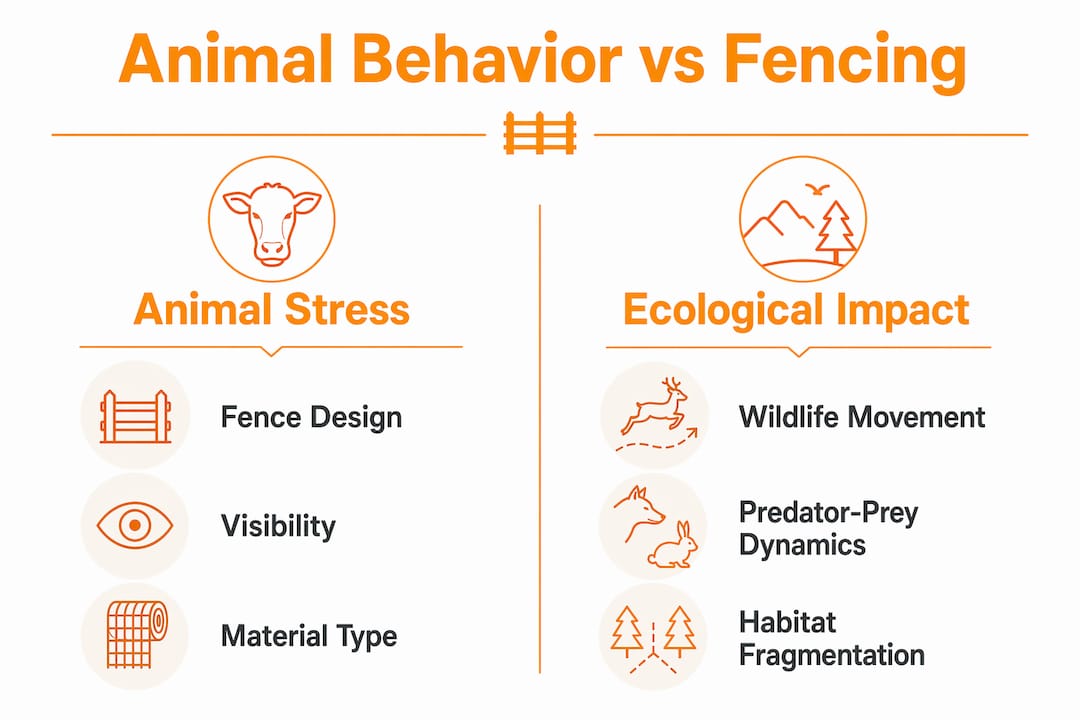
Fences reshape entire ecosystems, not just individual animals. They act as ecological filters, selectively blocking or channeling the movement of different species based on size, behavior, and sensory perception.
A study of 60 African wildlife parks found that fencing causes herbivores to avoid boundary areas while predators often use fence lines as travel corridors. This asymmetry is significant. Herbivores lose access to forage near boundaries, compressing their effective range. Predators gain a navigational advantage, concentrating predation pressure in predictable zones. The result is a spatial reorganization of the entire predator-prey dynamic within the fenced area.
In North America, research on bison shows a parallel pattern. While fencing has supported population recovery in species like the American bison, it disrupts their natural movement scales and ecological functions. Bison historically moved across vast landscapes in response to seasonal forage and fire cycles. Fenced populations cannot replicate those movements, which limits their ecological role as grazers and seed dispersers.
The concept of “hard edges” captures this problem well. Human-made barriers reshape biodiversity and concentrate human-wildlife conflict at fence lines. Animals that cannot cross a fence to access water or seasonal range will push against it repeatedly, increasing injury risk and fence damage simultaneously.
| Wildlife response | Behavior at fence | Management implication |
|---|---|---|
| Herbivores (deer, elk, bison) | Avoid boundary zones, compress range | Increase interior forage quality; use wildlife-friendly fence designs |
| Large predators (wolves, cougars) | Use fence lines as travel corridors | Monitor fence lines for predator activity near livestock |
| Small mammals and birds | Pass through or under fences freely | Lower wire spacing reduces small wildlife passage |
| Migratory species | Detour or abandon movement paths | Install wildlife crossings or lift bottom wire in low-risk zones |
Farmers managing land adjacent to wildlife habitat benefit from wildlife-friendly fence design that reduces injury to deer and elk while maintaining livestock containment. Raising the bottom wire and using smooth top wire instead of barbed wire are two changes that significantly reduce wildlife mortality without compromising containment.
Why do livestock challenge fences and how does behavior influence containment success?
Livestock challenge fences for specific, predictable reasons. Recognizing those reasons is the first step to building a fence that holds. Research identifies six primary motivations: pursuit of better forage, water access, social behavior, curiosity, environmental stress, and poor fence structure. Each driver requires a different management response.
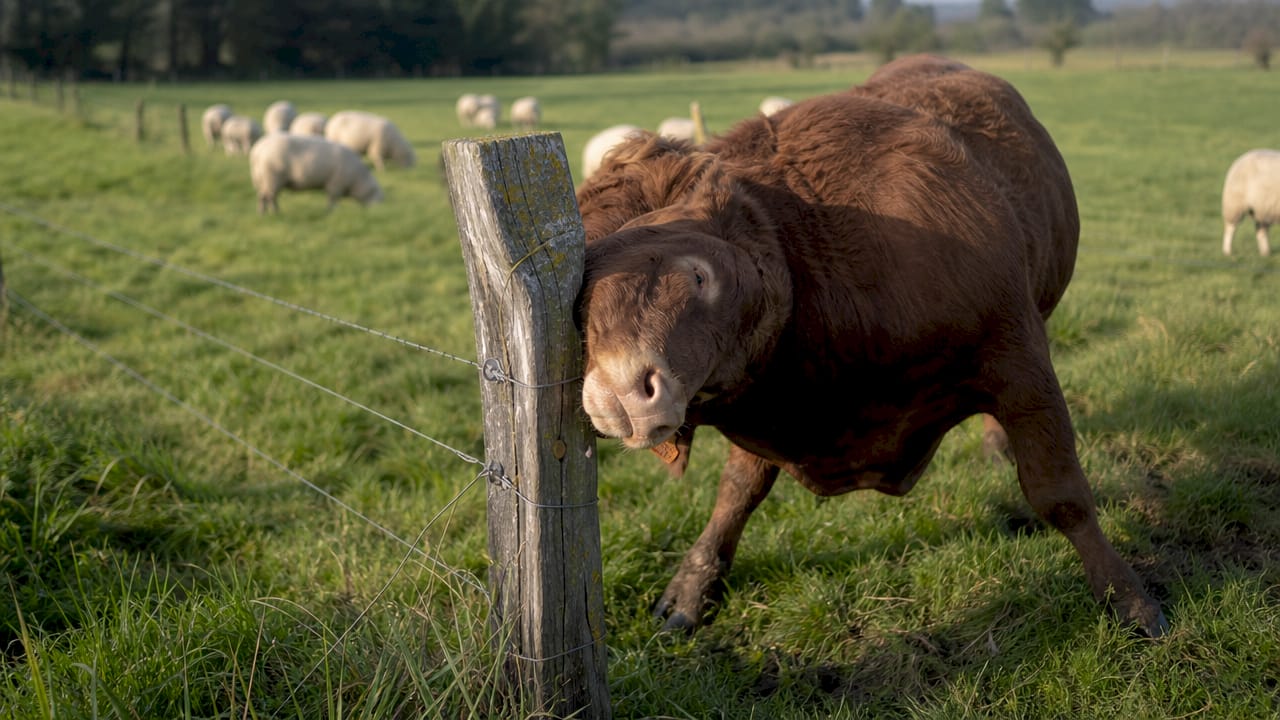
Forage pressure is the most common cause. When pasture quality inside the fence drops below what animals can smell or see outside, they will test every weak point. Water access drives the same urgency. An animal that is thirsty will push through a fence that a well-watered animal ignores. Social behavior, particularly the desire to rejoin separated herd members, produces some of the most determined fence challenges. Cattle and horses are highly social, and isolation creates a stress response that overrides normal boundary respect.
The herd learning effect amplifies every breach. Once one animal finds a weak point, others observe and follow. Animals quickly learn and remember fence weaknesses, and herd behavior spreads that knowledge rapidly. A single unrepaired gap can result in systematic escape failures across the entire herd within days.
Pro Tip: Walk your fence line after every significant weather event. Frost heave, fallen branches, and soil erosion create structural weaknesses that animals detect before you do. Catching a weak post or sagging wire early costs minutes. Ignoring it can cost hours of mustering and potential animal injury.
Effective containment depends on matching fence design to behavioral drivers:
- Audit pasture quality regularly and rotate grazing before animals feel pressure to seek forage elsewhere
- Place water sources away from fence lines to reduce congregation and pressure on boundary areas
- Repair any fence damage within 24 hours of discovery to prevent herd learning from reinforcing the breach
- Use fence escape prevention strategies that address both structural integrity and the behavioral triggers behind escape attempts
- Increase fence visibility in areas where animals consistently test boundaries, using flagging tape or additional rails during high-pressure periods
- Monitor for environmental stressors like extreme heat, predator presence, or sudden herd changes that spike fence pressure temporarily
How do animals perceive and interact with fences as boundaries?
Animals do not experience fences the way humans design them. They process fences as a combination of visual, tactile, and auditory signals, and their behavioral response depends on how those signals register against their instincts and prior experience.
Cattle rely heavily on vision, but their wide-angle monocular sight means they perceive depth differently than humans. A fence that appears solid and clear to a person may look like a flickering, ambiguous barrier to a cow approaching at an angle. Horses are flight animals with a strong startle response. A fence that rattles in the wind or reflects light unpredictably can trigger anxiety and pacing even when the animal has no intention of escaping. Understanding how animals perceive fences as sensory objects, not just physical walls, changes how you select materials and placement.
- Visual signals: High-contrast fencing (white rail, orange electric tape) is more visible to livestock and reduces accidental contact
- Tactile signals: Animals that have received an electric shock from a fence line treat even non-electrified wire with caution, demonstrating conditioned avoidance
- Auditory signals: Virtual fencing systems use audio tones as the primary warning before any stimulation, training animals to respond to sound alone over time
- Spatial signals: Narrow lanes and tight corners create a sense of entrapment, increasing stress and resistance during handling
Wildlife respond to gates and crossings with particular caution. Research shows that wildlife avoid or hesitate at gates due to the lack of clear sightlines, which paradoxically increases their risk of road collision when they detour around crossing points. This is a design failure, not an animal failure. Gates and underpasses that provide clear sightlines and familiar footing dramatically increase wildlife use.
Virtual fencing adds a new dimension to animal perception. The Gallagher eShepherd system communicates with cattle through audio cues that animals learn to associate with the boundary zone. Over time, the audio warning alone is sufficient to redirect movement, with the electric stimulation becoming rarely needed. That shift from aversive to associative learning represents a genuine improvement in animal welfare compared to repeated physical contact with a wire fence.
Key Takeaways
Effective fencing requires understanding animal behavior first, because fence design that ignores behavioral drivers produces containment failures, elevated stress, and ecological damage regardless of material quality.
| Point | Details |
|---|---|
| Fence design affects stress | Height, visibility, and material directly influence animal anxiety and escape behavior. |
| Virtual fencing uses associative learning | Cattle learn virtual boundaries within days, with minimal aversive stimulation required long-term. |
| Herd learning amplifies breaches | One unrepaired weak point spreads through a herd quickly; fix damage within 24 hours. |
| Fences reshape wildlife ecology | Herbivores avoid fence boundaries while predators use them as corridors, altering predator-prey dynamics. |
| Sensory design matters | Animals process fences as visual, tactile, and auditory signals, not just physical walls. |
The fence line is where behavior meets infrastructure
After years of working with farmers and ranchers across Canada, the pattern I see most often is this: producers invest in quality materials and then lose containment anyway, because the fence was designed without considering why the animal wants to leave in the first place.
A high-tensile wire fence built to specification will still fail if the pasture inside is overgrazed and the animals can smell green grass on the other side. A virtual fence will still cause unnecessary stress if the training protocol is rushed and animals never get the chance to learn the audio cue before receiving stimulation. The infrastructure is only as good as the behavioral understanding behind it.
What I find genuinely exciting about where the industry is heading is the integration of data into fencing decisions. Systems like the Gallagher eShepherd, available through Fencefast, give producers real-time information about where animals are spending time, which areas they are avoiding, and when fence pressure is building. That data turns a reactive maintenance approach into a proactive management strategy.
The challenge I hear most from producers integrating virtual fencing alongside traditional barriers is the transition period. Animals that have spent years respecting a physical wire do not automatically transfer that respect to an audio cue. Parallel systems, where both physical and virtual boundaries overlap during training, produce the best behavioral outcomes. Fencefast’s eShepherd virtual fencing resources address exactly this transition in practical terms.
The bottom line is that fencing is a behavioral management tool first and a physical structure second. Producers who understand that distinction build better fences, spend less on repairs, and raise calmer, healthier animals.
— Juiced
Fencefast fencing solutions built around animal behavior
Fencefast supplies Canadian farmers and ranchers with fencing systems designed to work with animal behavior, not against it.

From traditional electric fencing components to the Gallagher eShepherd GPS virtual fencing system, Fencefast carries the full range of tools needed to build containment that accounts for how animals actually think and move. As an authorized Gallagher dealer with a 26-year partnership, Fencefast also provides setup guidance, design consulting, and access to government funding programs including OFCAF and BMP grants for virtual fencing adoption. Whether you are managing cattle on a rotational grazing program or protecting livestock from predator pressure, Fencefast has the products and knowledge to match your operation’s specific behavioral and containment needs.
FAQ
What is the relationship between animal behavior and fencing?
Fences act as physical, psychological, and ecological boundaries that directly shape how animals move, feed, socialize, and experience stress. Effective fence design requires understanding the behavioral drivers specific to the species being managed.
How quickly do cattle learn virtual fence boundaries?
Cattle typically learn to respond to virtual fence audio cues within hours to days, requiring only 1 to 6 electric shocks during initial training before the audio warning alone redirects their movement.
Why do livestock keep pushing through fences?
The six primary drivers are pursuit of better forage, water access, social behavior, curiosity, environmental stress, and structural fence weaknesses. Addressing the underlying cause is more effective than simply reinforcing the fence.
How does fencing affect wildlife behavior differently than livestock?
Wildlife respond to fences as ecological filters. Herbivores tend to avoid boundary zones while predators use fence lines as travel corridors, which concentrates predation pressure and reshapes predator-prey dynamics across the entire fenced area.
What fence design features reduce animal stress?
High-contrast, visible fencing reduces accidental contact. Open rail or wire designs allow social species to see beyond the boundary, reducing frustration. Avoiding tight corners and narrow lanes minimizes the sense of entrapment during handling.

