

TL;DR:
- Effective wildlife exclusion fencing requires species-specific design principles to prevent animal injuries and habitat fragmentation.
- Replacing barbed wire with plain or electric wires and incorporating visibility markers greatly enhances safety for wildlife.
Effective fencing for wildlife exclusion is one of the most misunderstood investments a landowner can make. Most people picture a fence as a simple barrier. In practice, the wrong fence can injure the very animals you’re trying to redirect, fragment migration corridors, and still fail to keep your crops and livestock safe. Over 70 Australian species are documented victims of conventional fence design, and the patterns hold across North America too. This guide breaks down what actually works, what hurts wildlife unnecessarily, and how to build a fence that solves your problem without creating new ones.
Table of Contents
- Key Takeaways
- Fencing for wildlife exclusion: what it actually means
- Comparing fencing materials for wildlife exclusion
- Design and installation strategies that actually work
- Balancing exclusion with habitat connectivity
- Real-world applications across different species and situations
- My take on what most landowners get wrong
- Get the right fence built right with Fencefast
- FAQ
Key Takeaways
| Point | Details |
|---|---|
| Avoid barbed wire on top strands | Top-strand barbed wire causes most wildlife entanglement injuries; plain wire or electric wire is safer. |
| Fence height is species-specific | Deer exclusion typically requires 8 feet or higher; smaller species need tighter wire spacing below. |
| Gate placement determines passage success | Corner-placed Liberty Gates yield 80% safe passage for deer vs. 0% for straight-run gates. |
| Electric fencing works best in combination | Polywire electric systems paired with community early warning dramatically cut crop losses from large wildlife. |
| Permeability beats total exclusion | Fences designed with deliberate passage points reduce habitat fragmentation and meet conservation guidelines. |
Fencing for wildlife exclusion: what it actually means
Wildlife exclusion fencing is not simply a taller version of your stock fence. The goal is to prevent specific species from entering defined areas such as crop fields, orchards, calving paddocks, or feed storage while allowing your livestock and equipment to move freely. The design has to account for the target species, its behavior, its size, and the time of year it poses the greatest threat.
Most conventional fences were designed with livestock containment in mind, not wildlife exclusion. That distinction matters more than people realize. A standard three-strand barbed wire fence keeps cattle from wandering but does almost nothing to stop deer, and it actively harms nocturnal animals like bats and gliders that cannot see the wire until they are already tangled in it.
The species you are trying to exclude will dictate every design decision you make:
- Deer and elk jump high and will test fence lines at weak points near gates and corners
- Coyotes and foxes dig under or push through low-tension bottom wires
- Bears are strong enough to break poorly anchored posts and will investigate any gap near food sources
- Small mammals like rabbits and groundhogs can squeeze through spacing that looks too tight to be a problem
Pro Tip: Before buying any materials, walk your property perimeter and note where wildlife is actually entering. Fresh tracks, disturbed vegetation, and rub marks on existing posts tell you more about animal pressure than a perimeter survey alone.
The foundation of smart wildlife barrier fencing is knowing what you’re excluding, from where, and why. That clarity shapes every material and design choice that follows.
Comparing fencing materials for wildlife exclusion
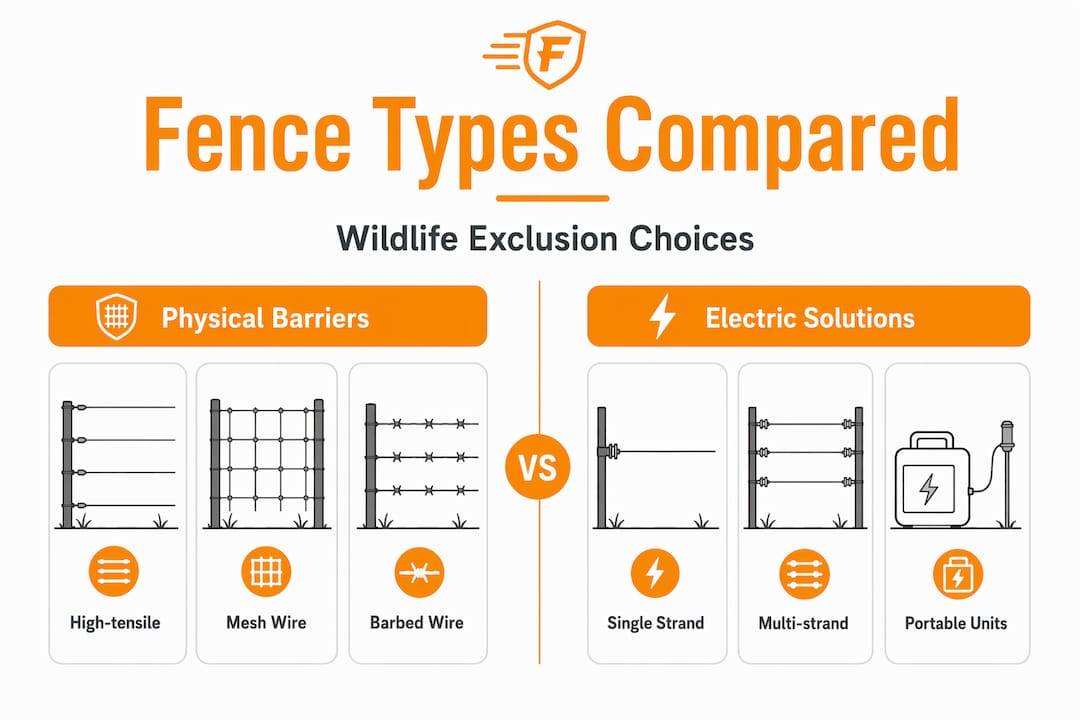
Not all fencing materials are created equal when wildlife is involved. Here is how the most common options stack up:
| Fence Type | Best For | Wildlife Risk | Key Limitation |
|---|---|---|---|
| High-tensile plain wire | General exclusion, deer | Low when installed correctly | Requires proper tensioning equipment |
| Woven wire mesh | Small mammals, ground nesters | Very low | Higher cost per meter |
| Barbed wire (top strand) | Livestock perimeter | High entanglement risk | Not recommended for top strand |
| Polywire electric | Bears, elephants, large ungulates | Low if properly flagged | Needs regular maintenance checks |
| Rigid mesh panels | Gardens, high-value crops | Very low | Expensive for large areas |
High-tensile plain wire is the workhorse of most animal exclusion fence options on Canadian farms. It holds tension well across long runs, resists animal pressure, and can be configured with multiple strands to match the species you are targeting. The key is getting the wire height and spacing right, which we cover in the next section.
Electric fencing has earned serious credibility as an effective fencing for pest control tool, especially for larger animals. Farmers in Zambia’s Chobe borderlands use polywire electric fences alongside community early warning systems to dramatically reduce elephant crop damage. The fence alone is not the solution. It works because it is part of a coordinated response.
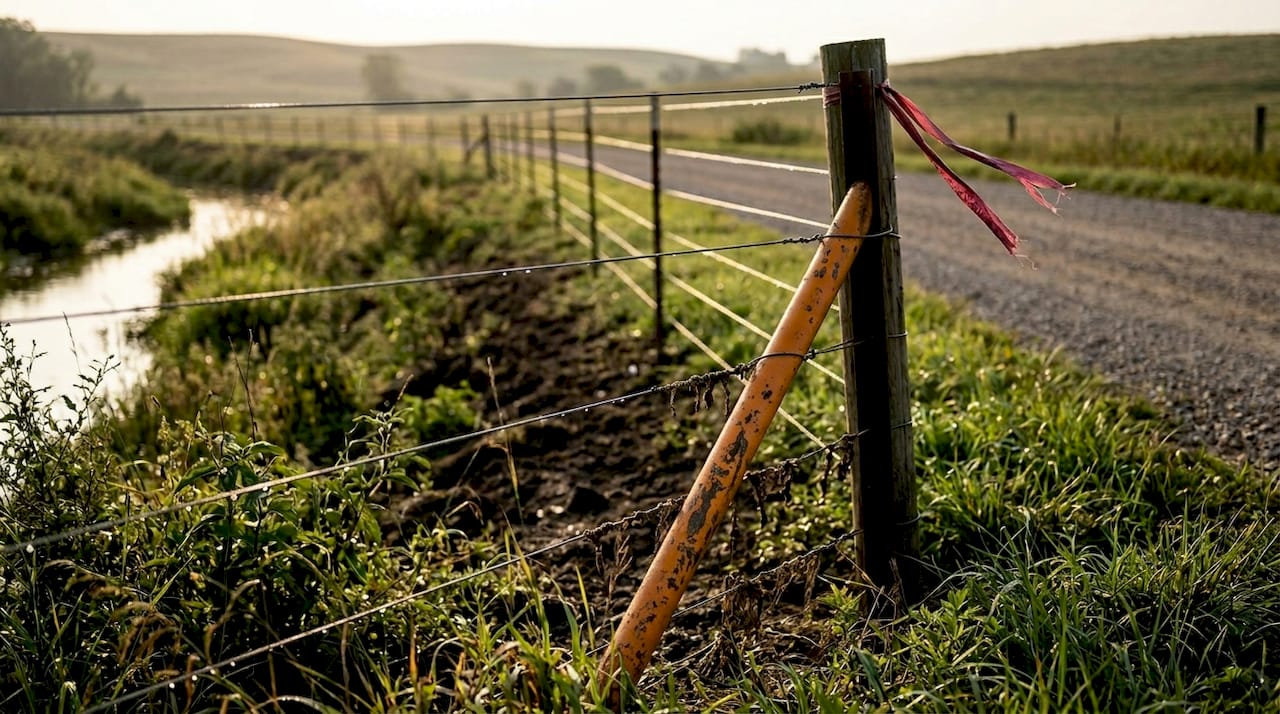
Barbed wire deserves a specific caution. Most wildlife injuries from conventional fences occur on the first two strands of barbed wire, particularly when it is placed at the top of a fence where animals try to jump over. If you already have barbed wire in place, you can significantly reduce harm by adding visibility markers such as metal tags, survey tape flags, or sections of poly-pipe every 30 cm along the wire.
Pro Tip: If you are replacing or upgrading an existing fence, prioritize removing or replacing the top barbed strand first. That single change prevents the majority of entanglement incidents without requiring you to rebuild the entire fence line.
For a detailed look at wildlife-friendly fencing options suited to Canadian farm conditions, Fencefast has put together a practical resource that covers materials across a range of budgets and terrain types.
Design and installation strategies that actually work
Getting the materials right is only half the job. How you design and install the fence determines whether it excludes the right animals, allows safe passage where needed, and holds up over time without becoming a liability.
Here are the core design specifications that apply to most wildlife exclusion scenarios:
- Set fence height based on your primary target species. Deer regularly clear fences under 6 feet; the best fencing for deer prevention requires a minimum of 8 feet, or a double-fence design with a gap that disrupts their approach.
- Keep the bottom wire loose and elevated. The NSW Government recommends a loose bottom wire no more than 30 cm above the ground so smaller animals can pass underneath without getting trapped.
- Avoid barbed wire on the top strand entirely. Replace it with plain high-tensile wire or a hot wire. Your fence will be just as effective for exclusion and far less dangerous to wildlife.
- Add visibility elements to all existing wire. Tags, flagging tape, or sections of colored poly-pipe at 30 cm intervals dramatically reduce nighttime entanglement for bats, gliders, and birds.
- Position gates at corners, not midway along fence runs. Research from Idaho’s highway funnel fencing program found that corner-placed Liberty Gates allowed deer to pass safely 8 out of 10 times. Straight-run gate placement delivered zero percent success.
Fence maintenance is where most installations quietly fail. Alberta Beef Producers note that reinforced fencing around feed and calving sites combined with consistent monitoring and neighbor coordination significantly cuts seasonal wildlife damage. Walk your fence lines after snow melt and after the rut each fall. Those are the two periods when animal pressure peaks and damage concentrates.
For step-by-step guidance on building wildlife exclusion fences from the ground up, including post spacing and anchor configurations, Fencefast has a practical construction guide written specifically for farm conditions.
Balancing exclusion with habitat connectivity
Here is where many landowners get stuck. You want to protect your property, but you also do not want to be the person who cuts off a migration corridor that has existed for generations. These goals are not mutually exclusive, but they require deliberate planning.
LA County’s wildlife-friendly fence guidelines recommend that top horizontal elements stay below 42 inches and that bottom elements clear at least 18 inches off the ground. The intent is to keep fences permeable for smaller mammals and ground-nesting birds while still serving their primary purpose. That principle translates directly to farm settings where complete exclusion is not always the goal.
Consider these questions before committing to a continuous perimeter fence:
- Does your fence line cross an established wildlife movement route?
- Are you excluding species that pose real economic threats, or just species that are present on your property?
- Could targeted exclusion around specific high-value areas accomplish the same result with less ecological disruption?
IUCN guidelines recommend applying short-term fencing in degraded areas to allow vegetation recovery, then reconsidering the fence footprint once the area stabilizes. This kind of phased approach is useful for landowners who are restoring native plant communities alongside their farming operations.
“Designing fences that allow selective passage rather than total exclusion is not just better for wildlife. It is often more practical and cost-effective for the landowner too.” — from principles outlined in IUCN Conservation Planning Specialist Group resources
The concept of wildlife permeability does not mean letting every animal through every part of your fence. It means building in deliberate, species-appropriate crossing points in locations that serve wildlife movement while keeping your critical assets protected.
Real-world applications across different species and situations
Theory matters, but what closes the deal for most landowners is seeing what has worked on properties with comparable pressure.
Deer exclusion is the most common need across agricultural Canada. An 8-foot single fence with high-tensile plain wire, woven mesh on the lower half to deter jumping and crawling, and no barbed wire on the top strand is the standard effective setup. For orchards and market gardens, a double-fence configuration spacing two 4-foot fences about 3 feet apart exploits the deer’s reluctance to jump into an uncertain landing zone. It sounds simple. It works reliably.
Bear exclusion around apiaries and livestock feed areas is best handled with electric fencing. A five-strand electric setup with alternating hot and ground wires, baited with peanut butter on the first hot strand, conditions bears quickly and with minimal infrastructure cost.
| Species | Recommended approach | Key design feature |
|---|---|---|
| White-tailed deer | 8-ft high-tensile or double fence | No barbed wire top strand |
| Black bear | 5-strand electric with bait conditioning | Alternating hot/ground strands |
| Coyote/fox | Woven wire with buried or angled apron | Apron extends 12 inches outward underground |
| Groundhog/rabbit | Hardware cloth, lower 24 inches | Mesh bent outward at base |
| Elk | High-tensile wire 8 ft minimum | Reinforced corner posts |
Large-scale wildlife pressure from species like elk or feral hogs calls for community-level coordination alongside physical barriers. Idaho’s highway funnel fencing program demonstrated that behavior-informed fence geometry reduces vehicle-wildlife collisions significantly when the fencing system works with natural animal movement patterns rather than against them.
Pro Tip: Contact your provincial wildlife office before installing a continuous perimeter fence on properties larger than 100 acres. Some jurisdictions require notification or approval when fencing crosses recognized wildlife movement corridors.
My take on what most landowners get wrong
I’ve seen a lot of fencing projects that looked good on paper and failed in the field within two seasons. The pattern is consistent. Landowners focus intensely on materials and height, then completely underestimate the management side.
A fence is not a set-it-and-forget-it solution. Wildlife learn. They probe for weak points. They share that information across generations in ways we don’t fully appreciate. I’ve watched herds of deer systematically test a fence line over a matter of weeks, identifying the one corner where post spacing is slightly wider or tension is lower after a hard frost.
The other thing most guides skip over is landscape context. A fence that works perfectly on flat open ground will fail where terrain creates a natural ramp on the outside of the fence, or where seasonal flooding lifts bottom wires just enough for animals to slip through. You have to think like the animal you’re excluding, not like a fencing contractor.
My honest recommendation: treat fencing for wildlife exclusion as a system, not a product. The wire, the posts, the gate placement, the visibility markers, and the seasonal maintenance schedule are all one system. Pull any piece out and you reduce the effectiveness of everything else. The best wildlife exclusion fence design accounts for animal behavior, terrain, seasonal pressure, and your own capacity to maintain it over time.
— Juiced
Get the right fence built right with Fencefast
Fencefast supplies landowners and ranchers across Canada with the fencing components needed to build effective, wildlife-sensitive exclusion systems. From high-tensile plain wire and woven mesh to complete electric fence systems and Gallagher-powered energizers, the product range covers every major wildlife exclusion scenario. Fencefast also provides design support to help you select the right configuration for your species pressure, terrain, and budget. Whether you are starting from scratch or upgrading an existing fence line, visit Fencefast to explore products and get expert guidance on building a fence that protects your property without compromising the land around it.
FAQ
What height does a deer exclusion fence need to be?
Effective fencing for deer prevention requires a minimum height of 8 feet for a single-fence design. A double-fence configuration using two 4-foot fences spaced 3 feet apart can also work by disrupting the deer’s approach and landing zone.
Is barbed wire safe to use in wildlife exclusion fencing?
Barbed wire on top strands causes the majority of wildlife entanglement injuries and should be replaced with plain or electric wire. If removal is not immediately possible, adding visibility markers every 30 cm significantly reduces harm to nocturnal animals.
How does electric fencing work for wildlife exclusion?
Electric fencing delivers a short, memorable shock that conditions animals to avoid the fence line. It works best when combined with proper energizer sizing, regular voltage checks, and in some cases community early warning systems as demonstrated in large-animal scenarios in Zambia.
Where should gates be placed on a wildlife exclusion fence?
Gates placed at fence corners align with natural animal movement and yield significantly higher safe-passage success than gates placed mid-run. Research from Idaho’s funnel fencing program found corner-placed Liberty Gates allowed deer to pass safely 80% of the time.
Do wildlife exclusion fences need to block all animal movement?
No. Well-designed fences include deliberate passage points suited to non-target species. Maintaining a loose bottom wire approximately 30 cm off the ground and keeping top elements free of barbed wire allows smaller animals to move through safely while still excluding your target species.
Recommended
- Animal fencing basics: Essential solutions for Canadian farms – FenceFast Ltd.
- Wildlife friendly fence design guide for Canadian farmers – FenceFast Ltd.
- Animal species fencing requirements: The Canadian farmer’s guide – FenceFast Ltd.
- Understanding Wildlife Exclusion Fencing: A Guide – FenceFast Ltd.

