

TL;DR:
- Wildlife-friendly fencing allows safe animal passage while securing livestock, improving land health.
- Proper design specs include 16-18 inch bottom wire height and smooth, tensile wires.
- Using flexible, adaptable fencing solutions and cooperating regionally enhances effectiveness.
Protecting your livestock and letting local wildlife move freely across your land are not competing goals. Wildlife-friendly fencing for Canadian farmers and ranchers primarily involves high-tensile smooth wire fences with specific spacing that allow safe passage for deer, elk, and pronghorn while keeping cattle and horses where they belong. The right fence design lets you meet both regulatory and ethical standards without sacrificing security. This guide breaks down the proven options, design principles, and practical steps you need to make it work on your operation.
Table of Contents
- Why wildlife friendly fencing matters
- Core principles of wildlife friendly fencing
- Wildlife friendly fencing options by need and region
- Practical design and installation tips
- Common challenges and solutions in wildlife friendly fencing
- A new perspective: Why flexibility, not rigidity, defines true wildlife friendly fencing
- Find the right tools for easier wildlife friendly fencing
- Frequently asked questions
Key Takeaways
| Point | Details |
|---|---|
| Balance livestock safety and wildlife | The right fence design protects both your herd and key local wildlife. |
| Follow proven design principles | Wire placement, height, and material choices are central to wildlife friendly outcomes. |
| Match fence type to your needs | Choose fencing options based on your livestock, target predators, and local wildlife species. |
| Access funding and adapt | Tap into available grants, and adjust designs for Canada’s diverse climates and terrain. |
| Prioritize flexibility | Seasonal and site-specific adaptations sustain results and keep costs manageable. |
Why wildlife friendly fencing matters
Fences do more than mark property lines. On the Canadian landscape, they cut across migration corridors that wildlife have used for generations. When those corridors get blocked, the consequences are real and measurable.
“Impermeable barriers like fences can reduce migratory ungulate survival by significant margins. Caribou populations show 20% lower survival when movements are altered by barriers, while permeable fence designs consistently improve outcomes.”
That is not just an ecological concern. When wildlife pile up against impassable fences, you get fence damage, injured animals on your property, and stressed livestock. The cost adds up fast.
Switching to wildlife friendly designs also reduces direct animal injury. Smooth bottom wires reduce wildlife injuries by up to 80% compared to barbed wire at the same height. That matters whether you are worried about a deer getting tangled or a pronghorn breaking a leg trying to crawl under a low strand.
Here is why this is also a smart business decision:
- Reduced fence repair costs from wildlife collisions and entanglement
- Lower livestock stress when wildlife can move through rather than pile up against barriers
- Improved land stewardship reputation which matters for lease agreements and conservation partnerships
- Potential access to government incentive programs tied to sustainable land management
- Alignment with provincial wildlife regulations that increasingly favor permeable designs
Farms that focus on protecting farms and ecosystems together tend to see fewer long-term headaches than those treating the two as separate problems. Landscape connectivity keeps predator-prey dynamics balanced, which indirectly reduces pressure on your livestock from opportunistic predators. Think of wildlife friendly fencing not as a concession but as a tool that makes your whole operation run more smoothly.
Core principles of wildlife friendly fencing
Good wildlife friendly fencing is not about guessing. There are specific, tested design specs that work, and they are worth following closely.
Key design specifications:
| Feature | Recommended spec |
|---|---|
| Bottom wire height | 16-18 inches above ground |
| Spacing between bottom wires | 12 inches |
| Top wire height | 42 inches maximum |
| Wire strands | 3-4 smooth strands |
| Wire type | Smooth, not barbed |
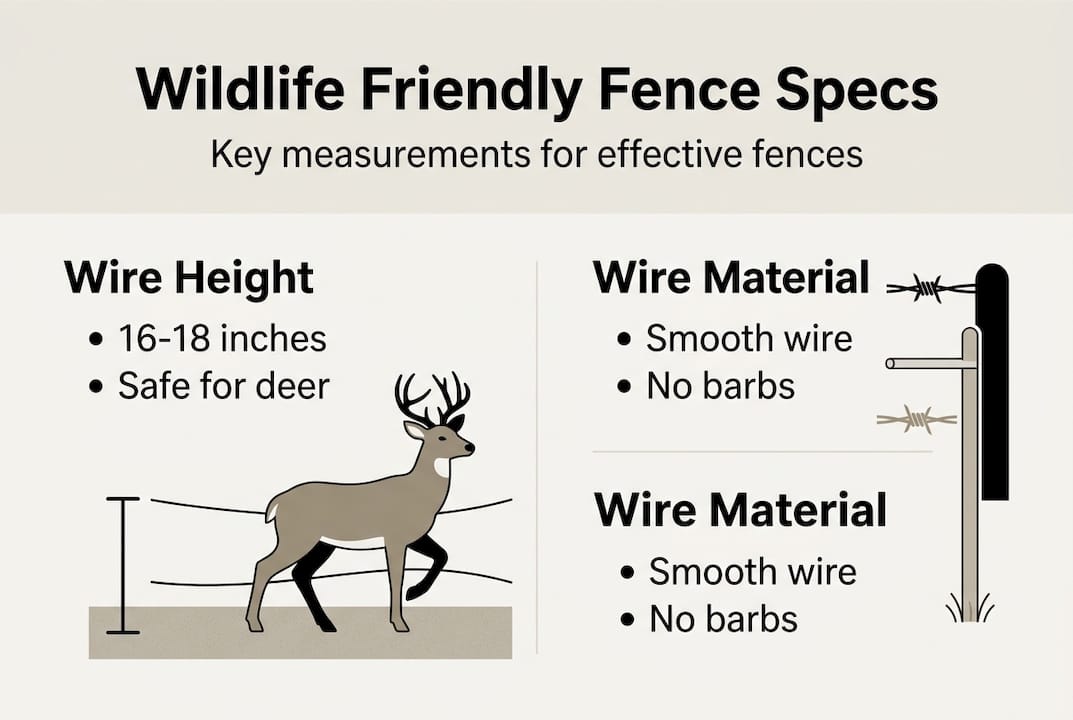
These key design specs are not arbitrary. The 16-18 inch bottom clearance lets pronghorn, deer fawns, and other crawling species slip underneath safely. The 42-inch top cap keeps most livestock in without creating a jump hazard that injures deer trying to clear it.
Here is how to prioritize your design choices:
- Replace barbed bottom wire first. This single change delivers the biggest safety gain for crawling wildlife.
- Raise the bottom strand to at least 16 inches if you are in pronghorn or mule deer country.
- Use high-tensile smooth wire for durability without the injury risk of barbed wire.
- Install let-down sections at known wildlife crossing points so you can lower a section seasonally.
- Space posts farther apart (up to 80-100 feet) to reduce the visual barrier effect and save materials.
The results from the field back this up. In Alberta, volunteers have modified over 700 km of fence since 2009 by replacing barbed bottom wire with smooth wire raised to at least 18 inches, specifically to allow pronghorn to crawl underneath safely.
Pro Tip: When choosing durable solutions for your operation, high-tensile smooth wire is both the safest option for wildlife and one of the most cost-effective long-term choices. It stretches less, lasts longer, and requires fewer repairs than barbed alternatives.
Wildlife friendly fencing options by need and region
Not every farm faces the same wildlife pressure, and not every region has the same species moving through. Here is a practical comparison to help you match fence type to your situation.
Fence type comparison by use case:
| Fence type | Best for | Wildlife compatibility |
|---|---|---|
| High-tensile smooth wire | Cattle, horses, deer/elk corridors | High |
| Electric multi-strand | Predator control, sheep, goats | Medium to high |
| Small mesh exclusion | Poultry, turtles, amphibians | Specialized |
| Woven wire with smooth bottom | Mixed livestock | Medium |
For large grazers like deer, elk, and pronghorn, high-tensile smooth wire with proper spacing is your best all-around option. It contains cattle effectively while allowing wildlife to pass underneath or jump over without injury.
Electric fencing is a strong choice when predators are your primary concern. Electric fencing at 5-10kV with 4-7 strands effectively deters coyotes, wolves, and bears while remaining compatible with wildlife passage when strand heights are properly set. One Alberta study tracked sheep losses drop from 147 to just 26 over three years after switching to electric perimeter fencing.
For farms near wetlands, rivers, or forest edges, small animals like turtles and amphibians face serious fence-related mortality. Small mesh exclusion fencing with wrap-around designs reduces turtle mortality by 62-91%, while standard chain-link does almost nothing to protect these species.
- Choose anti-predator fence options for sheep and goat operations in wolf or coyote territory
- Use smooth wire designs near known pronghorn or deer migration routes
- Install small mesh barriers near ponds or wetland edges on your property
- Review local wildlife and livestock management practices before finalizing your design
Pro Tip: Talk to your provincial wildlife office before installing new fencing near a known migration corridor. They often have maps of high-traffic wildlife zones and may connect you with cost-sharing programs.
Practical design and installation tips
Knowing your best fence options, it is time to discuss practical ways to implement them on your farm.
- Zone your fencing priorities. Put your most secure systems around calving areas and high-value livestock zones. Use more permeable designs on outer pastures where wildlife pressure is lower.
- Align fences parallel to migration routes rather than cutting across them. Where you must cross a corridor, install a let-down section or gate.
- Mark top wires with flagging or wildlife markers in areas with high bird activity to prevent collision.
- Schedule seasonal maintenance checks in spring and fall when wildlife movement peaks and fence stress is highest.
- Document crossing points on your property map so you can track where wildlife regularly move and adapt your design over time.
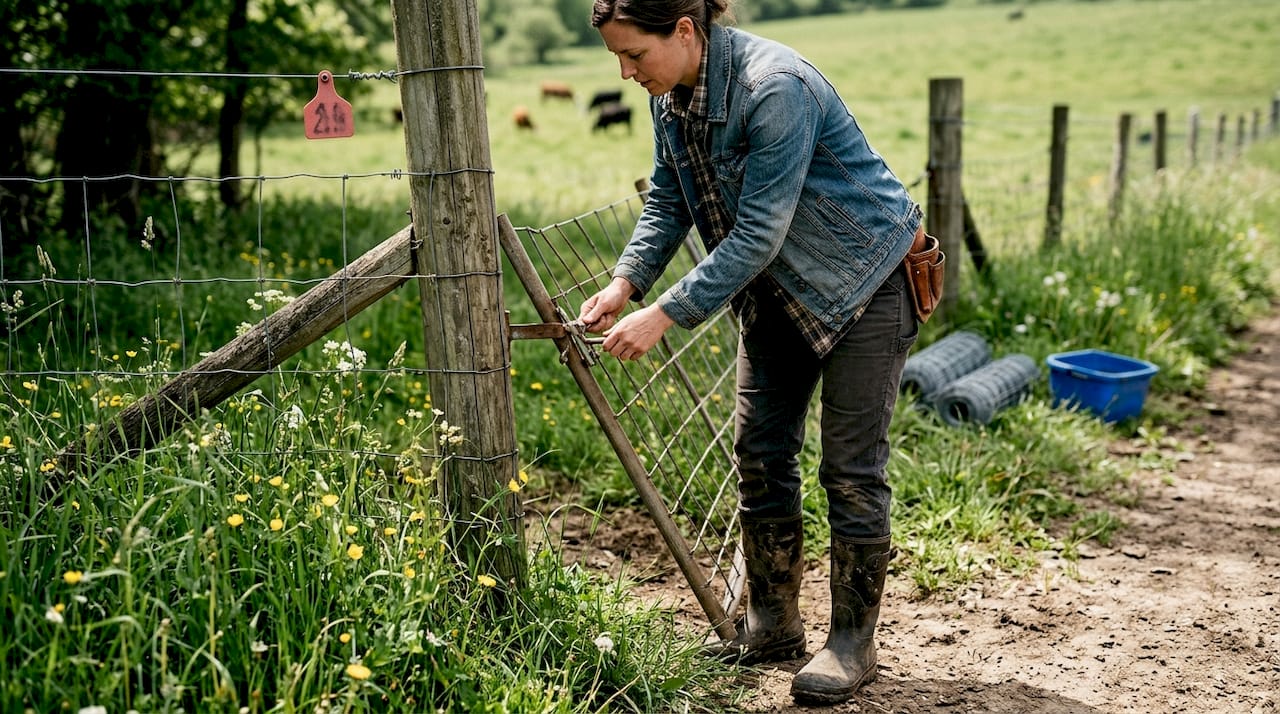
Let-down gates and sections on known wildlife trails allow seasonal passage and actually reduce long-term maintenance by preventing animals from pushing through or over fixed barriers. They take about 30 minutes to install and can save hours of repair work each season.
On the cost side, do not overlook available programs. The Manitoba government offers up to 75% cost-sharing with a maximum of $40,000 for predator-resistant fencing around calving areas and pastures. Other provinces have similar programs worth researching before you finalize your budget.
Pro Tip: Check installation steps for Canadian farms before you start your project. Getting the post spacing and wire tension right from the beginning saves significant rework later.
Common challenges and solutions in wildlife friendly fencing
Even with the best plans, challenges arise. Here is how to handle the most common ones.
Predator adaptation is a real issue. Over time, coyotes and wolves learn to work around single-layer electric fences. The solution is not always a taller or more electrified barrier. Integrated approaches that combine fencing with livestock guardian animals and strategic grazing management outperform strict exclusion over the long term. Large-scale exclusion fencing is actually discouraged because it increases habitat fragmentation and pushes predator pressure onto neighboring properties.
- Snow buildup in winter can short out electric fences and bury bottom wires. Install fence lines with drainage in mind and check tension after freeze-thaw cycles.
- Rocky or uneven terrain makes consistent bottom-wire height difficult. Use terrain-following installation techniques and add extra posts in dips to maintain clearance.
- Wildlife behavior shifts happen as populations change. A fence that worked well for deer five years ago may now be on a new elk route. Annual walkthroughs help you catch these changes early.
- Vegetation growth on lower wires reduces electric charge and can trap small animals. Clear a strip along the fence line each spring.
Pro Tip: When evaluating eco-friendly fencing materials, remember that durability and sustainability often go hand in hand. A fence that lasts 30 years uses fewer resources than one replaced every decade. Take time to compare fencing materials before committing to a design.
A new perspective: Why flexibility, not rigidity, defines true wildlife friendly fencing
Here is something most fencing guides will not tell you: the toughest fence is rarely the best fence. Rigid, impermeable barriers feel like security, but they create problems that compound over time. Wildlife pressure builds at fixed points, posts shift in freeze-thaw cycles, and maintenance costs climb every year.
The most effective wildlife friendly fencing we see in the field shares one trait: it is designed to adapt. Seasonal let-downs, adjustable strand heights, and zone-based systems let you respond to what is actually happening on your land rather than fighting a fixed design that no longer fits.
There is also a community dimension that rarely gets discussed. Fencing decisions on one property affect wildlife movement across an entire region. Farmers who share crossing-point data, coordinate let-down schedules, and collaborate on predator management get better results than those working in isolation. Moveable fence ideas and modular systems make this kind of coordination far more practical than it used to be. Your fence is part of a larger landscape system, and treating it that way is what separates good land managers from great ones.
Find the right tools for easier wildlife friendly fencing
Ready to make the change? Getting the right tools from the start makes wildlife friendly fencing faster to install and easier to maintain over time.
At FenceFast.ca, we stock professional-grade supplies built for Canadian farm conditions, from smooth high-tensile wire and electric fence components to specialized installation tools. The Hayes fencing tool is a go-to for smooth-wire tensioning and crimping, making it easier to hit those precise strand heights that wildlife passage requires. Whether you are retrofitting an existing fence or starting a new installation, FenceFast has the products and expertise to help you get it right the first time, with nationwide shipping across Canada.
Frequently asked questions
What is the most wildlife friendly fence for Canadian farms?
Smooth high-tensile wire fences with proper spacing and height offer the best balance between wildlife passage and livestock security for most Canadian operations.
How high should the bottom wire be for wildlife passage?
Set the bottom smooth wire at 16-18 inches above ground to allow species like deer and pronghorn to safely crawl underneath without injury.
Are electric fences compatible with wildlife passage?
Yes. Electric fencing at 5-10kV deters predators effectively while allowing wildlife to move underneath when strand heights are properly adjusted for the target species.
What funding programs are available for wildlife friendly fencing in Canada?
Some provinces offer significant support. Manitoba provides up to 75% cost-sharing with a maximum of $40,000 for predator-resistant fencing in key livestock areas.
Do wildlife friendly fences cost more to install?
Not necessarily. Avoiding wildlife damage, reducing repair frequency, and accessing incentive programs for seasonal passage designs can make these fences more cost-effective than conventional options over the long term.

