

TL;DR:
- Electric fencing for goats teaches livestock boundaries through high-voltage pulses rather than physical barriers. Proper installation includes selecting the right components, correct wire spacing, and effective training to ensure containment. Regular maintenance and adequate grounding are essential to prevent failures and keep goats safely enclosed.
Electric fencing for goats is defined as a psychological barrier system that uses high-voltage pulses to teach livestock where their boundaries are, rather than physically blocking them. Knowing how to build an electric fence for goats correctly means choosing the right fence height, wire spacing, energizer output, and training method. Done right, electric fencing costs 50–70% less than woven wire or board fencing while delivering equal or better containment. Goats are relentless testers of every fence line, so a weak setup fails fast. This guide walks you through every step, from materials to maintenance.
What equipment do you need to build a goat electric fence?
Every successful electric fence installation for goats starts with the right components. Skipping or downgrading any one of them creates a weak link your goats will find.
Energizer types and joule output
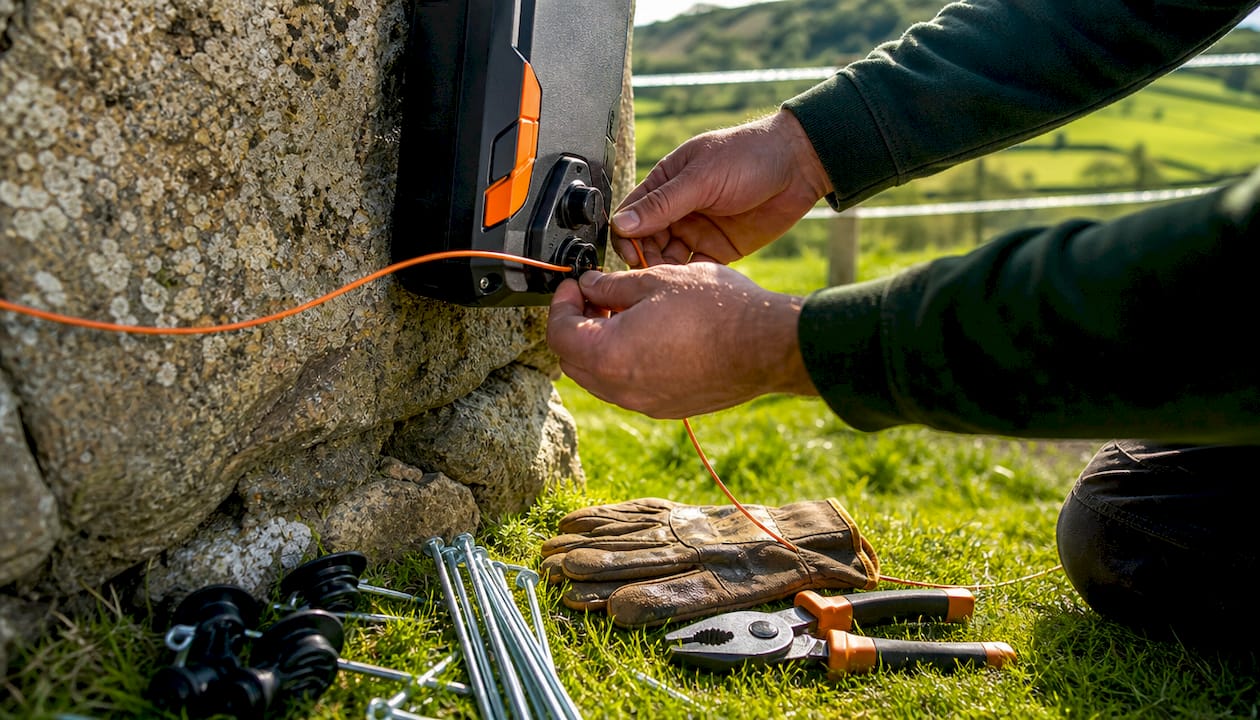
The energizer is the engine of the whole system. Three types exist: AC plug-in units for permanent pastures near a power source, DC battery units for remote areas, and solar units for off-grid locations. For goat fencing, minimum 0.25 joules per mile of fence wire is the standard starting point. Always round up your joule rating. Vegetation touching the wire drains voltage fast, and a fence running at half power will not hold goats.
Wire, netting, and post options
- High-tensile smooth wire: Best for permanent fences. Holds tension well and lasts decades.
- Polywire or polytape: Lightweight and visible. Good for temporary or rotational setups.
- Electric netting: The fastest option for portable goat enclosures. Models with plastic vertical struts offer better rigidity and resist tangling compared to string-only versions.
- Posts: Fiberglass or wood corner posts for permanent lines; step-in plastic posts for portable netting.
- Insulators: Match insulator type to your post material. Screw-in insulators for wood posts; clip-on types for T-posts.
Pro Tip: For smaller breeds like Nigerian Dwarfs, choose electric netting with tight horizontal spacing of 2–4 inches at the bottom. Standard netting gaps let kids slip through.
Grounding rods and gate hardware
Improper grounding causes most fence failures. Install at least three 6–8 foot galvanized ground rods spaced 10 feet apart. Place them in moist soil, near a water trough or shaded area, for the best conductivity. For gates, use insulated gate handles and underground cable to carry current under the gate opening without interruption.
| Component | Permanent Fence | Portable Setup |
|---|---|---|
| Energizer | AC plug-in, high joule | Solar or DC battery |
| Wire type | High-tensile smooth wire | Polywire or electric netting |
| Posts | Wood or fiberglass | Step-in plastic posts |
| Insulators | Screw-in or nail-on | Clip-on or built-in |
| Grounding | 3+ galvanized rods | 1–2 rods minimum |
What is the best fence design for containing goats?
Fence design is where most beginners cut corners and pay for it later. Goats are not just jumpers. They are explorers who test every inch of a fence before attempting an escape. A single wire at hip height will not stop them.
Height and wire count
The minimum fence height for goats is 40–42 inches, using 5–6 wire strands. For athletic breeds or areas with predator pressure, raise that to 48 inches. The wire spacing matters as much as the height. Standard spacing runs at 6, 12, 18, 24, 32, and 42 inches from the ground up. The tighter spacing at the bottom stops kids from slipping under. The wider spacing near the top stops adults from pushing through or jumping over.
Pro Tip: Set your lowest wire at exactly 6 inches from the ground. Any higher and young kids will crawl under before they ever learn to respect the fence.
Spacing adjustments by breed
| Breed Type | Recommended Height | Bottom Wire Spacing |
|---|---|---|
| Standard dairy or meat breeds | 40–42 inches | 6 inches |
| Athletic or large breeds | 48 inches | 6 inches |
| Nigerian Dwarf or small breeds | 42 inches with tight netting | 2–4 inches |
| Mixed herd with kids | 48 inches | 6 inches |
A mesh electric fence for goats works especially well for small breeds and mixed herds because the tight grid pattern eliminates gaps at every height, not just the bottom.
How to install an electric goat fence step by step
Good installation follows a fixed sequence. Skipping steps creates problems that are hard to fix after the fence is live.
Site preparation and layout
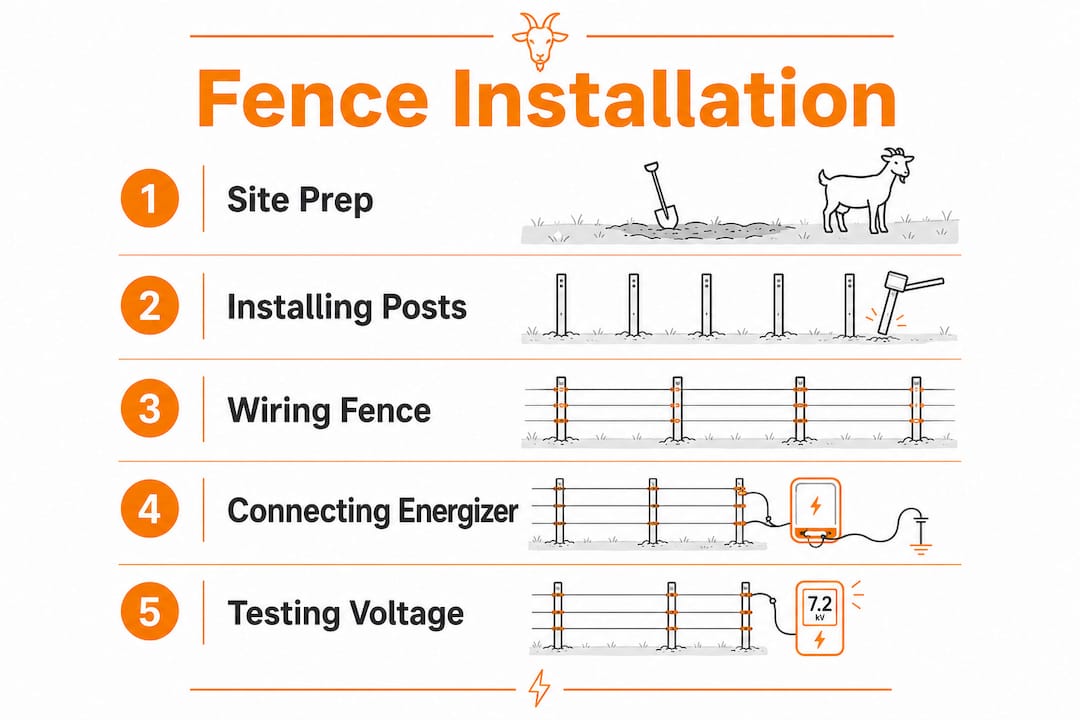
Clear the fence line of brush, tall grass, and debris before you set a single post. Vegetation touching the wire drains voltage and causes false shorts. Walk the full perimeter and mark corner locations with flags. Corners take the most mechanical stress, so plan them carefully.
Setting posts and stringing wire
- Install corner and brace posts first. These anchor the entire fence. Use H-brace assemblies at every corner and end post.
- Set line posts at 12–15 foot intervals for permanent fences, or use the built-in posts on electric netting for portable setups.
- Attach insulators to every post before stringing wire. The insulator keeps the live wire from grounding out against the post.
- String wire from the bottom up. Start at 6 inches and work upward. Keep tension firm but not so tight that posts lean inward.
- Connect all wire ends to the energizer’s live terminal using appropriate connectors.
Permanent high-tensile fences require strong corner braces and tight wire tension. A sagging wire loses both physical and psychological deterrent value.
Grounding and energizer connection
- Drive all three ground rods at least 6 feet deep in moist soil.
- Connect rods together with ground wire and attach to the energizer’s ground terminal.
- Connect the live terminal to the fence wire.
- Keep the energizer in a dry, sheltered location.
Pro Tip: Test your fence voltage at multiple points along the line, not just near the energizer. A reading that drops below 4,000 volts at any point means you have a short or a grounding problem to fix.
Voltage targets and gate wiring
Maintain 4,000–5,000 volts on the fence line to contain goats reliably. For predator deterrence, aim for 5,000 volts or above. For gates, run underground cable in conduit beneath the gate opening to carry current to the far side without a break in the circuit. Use insulated gate handles so you can open the gate without getting shocked.
How do you train goats to respect an electric fence?
Electric fence success is half technical and half behavioral. A perfectly built fence still fails if your goats never learn to respect it. Training is not optional.
The most effective method uses a small training pen. Set up a temporary physical fence, then run a live electric wire inside it about 6 inches from the physical barrier. Place feed near the electric wire to encourage goats to approach it. When a goat touches the wire and gets a shock, the physical fence prevents a panic escape. The goat learns the lesson without getting loose.
- Start training with adult goats first. They teach younger animals through observed behavior.
- Train young goats early. Kids learn faster and carry that respect for life.
- Supervise the first few sessions to watch for any goat that gets tangled.
- Introduce new goats to the herd inside the training pen before releasing them to the main pasture.
- Never rush the process. Two to three days in the training pen is enough for most goats.
Training with a small pen lined with live electric wire inside a physical fence teaches goats the shock safely and prevents panic escapes. Feeding on the wire side accelerates learning significantly.
Pro Tip: Place a small amount of grain right next to the electric wire during training. Curiosity pulls goats in, and one good shock at feeding time is more memorable than a dozen random contacts.
How do you maintain an electric goat fence?
A fence that worked perfectly on day one can fail silently within weeks if you ignore maintenance. Voltage drops gradually, and goats notice before you do.
Electric fence failures often result from poor grounding and vegetation touching wires. Walk the fence line at least once a week and trim any grass or weeds making contact with the wire. A single weed touching a bottom wire can drop voltage by 1,000 volts or more across the entire line.
- Test voltage weekly using a digital fence voltmeter at several points along the line.
- Check insulators for cracks or breaks after storms or heavy wind.
- Inspect wire tension monthly. Sagging wires lose deterrent value and can touch each other, causing shorts.
- Check ground rods during dry spells. Dry soil reduces conductivity. Water the area around ground rods during drought conditions.
- Inspect netting for sagging sections or broken struts if you use portable electric netting.
Pro Tip: Keep a simple fence log. Record your voltage readings at three or four fixed points each week. A pattern of dropping voltage tells you exactly where to look for a problem before your goats find it first.
For goat-proof fencing tips that go beyond basic maintenance, regular audits of your full setup catch problems early and keep your herd where it belongs.
Key Takeaways
A reliable electric fence for goats requires proper voltage, correct wire spacing from the ground up, solid grounding, and deliberate behavioral training to work long-term.
| Point | Details |
|---|---|
| Voltage target | Maintain 4,000–5,000 volts along the full fence line to contain goats and deter predators. |
| Wire spacing | Start the lowest wire at 6 inches from the ground and use 5–6 strands up to 40–48 inches total height. |
| Grounding | Install at least three 6–8 foot galvanized ground rods in moist soil, spaced 10 feet apart. |
| Energizer sizing | Choose a joule rating above the minimum to offset voltage loss from vegetation contact. |
| Behavioral training | Use a small training pen with a live wire and feed bait to teach goats to respect the fence before full release. |
What I’ve learned after years of watching electric fences fail
Most electric fence problems I’ve seen come down to two things: bad grounding and skipped training. Farmers spend money on quality wire and a good energizer, then drive one short ground rod into dry clay soil and wonder why their goats walk through the fence like it isn’t there. The ground circuit is half the system. Without it, the energizer is just making noise.
The other mistake is expecting the fence to do all the work on its own. Goats are genuinely intelligent animals. A goat that has never been shocked will test a fence methodically until it finds a gap or a low-voltage section. A goat that learned the fence hurts will avoid it even when the power is off. That conditioned respect is worth more than an extra strand of wire.
My honest recommendation for hobby farmers starting out: use portable electric netting for your first season. It is forgiving, fast to set up, and lets you adjust your layout as you learn how your herd moves. Once you understand your goats’ behavior and your land’s terrain, build your permanent fence with confidence. The movable electric fence options available today are far better than what existed even five years ago, and they make rotational grazing genuinely practical for small herds.
One more thing: do not undersize your energizer to save money. Vegetation load, fence length, and dry summers all drain voltage. Buy more joules than you think you need. You will use them.
— Juiced
Fencefast has the gear to get your goat fence built right
Building a reliable goat fence takes the right components from the start. Fencefast carries energizers, high-tensile wire, electric netting, insulators, ground rods, and gate hardware selected for livestock fencing across Canadian farms and hobby properties.

Whether you are setting up a permanent perimeter or a portable rotational system, the Fencefast product catalog has what you need, with expert advice available if you want help sizing your energizer or planning your layout. Fencefast ships nationwide and has supported Canadian farmers and rural property owners for over 26 years as an authorized Gallagher dealer. Browse the full selection and get your fence built with confidence.
FAQ
What voltage do I need for a goat electric fence?
Maintain 4,000–5,000 volts along the fence line to contain goats reliably. For areas with predator pressure, target 5,000 volts or above.
How many wires does a goat electric fence need?
Use 5–6 wire strands with the lowest wire set at 6 inches from the ground and the top wire at 40–48 inches. Tighter spacing at the bottom prevents kids from slipping under.
How do I stop my goats from escaping the electric fence?
Train goats in a small pen with a live electric wire before releasing them to the main pasture. A goat that has experienced a controlled shock learns to respect the fence boundary.
What is the best energizer for a small goat herd?
Choose an energizer rated above 0.25 joules per mile of fence wire and round up to account for vegetation drain. Solar units work well for remote pastures; AC plug-in units suit permanent setups near a power source.
How often should I check my electric goat fence?
Walk the fence line and test voltage at multiple points at least once a week. Trim vegetation touching the wire and inspect insulators after any storm to catch problems before your goats do.

