

TL;DR:
- Canadian livestock fencing laws vary by province, requiring producers to understand boundary and enclosure standards to avoid liability. Proper documentation, species-specific standards, and regular inspections are essential for compliance and livestock safety. Working with experts and staying informed about updates can help producers meet legal requirements effectively.
If you think a sturdy fence is just a sturdy fence, Canadian livestock law will correct that assumption fast. Fence regulations in this country are not national, not uniform, and not simple. Each province runs its own statutes, standards, and dispute processes, and the rules that govern your boundary fence with a neighbor are completely separate from the rules that govern your ability to contain your animals safely. Getting this wrong can mean fines, liability for escapes, costly neighbor disputes, and in the worst cases, real harm to your livestock and your neighbors’ property.
Table of Contents
- Why livestock fence regulations matter: Risks, responsibilities, and misconceptions
- Canadian livestock fence laws by province: Overview and comparison
- Compliance details: Species-specific rules and technical standards
- Electric fencing: Compliance, benchmarks, and safety requirements
- How to stay compliant: Steps, checklists and practical advice
- What most guides miss about fence regulations: Hard-won lessons for livestock owners
- Upgrade your livestock fencing with expert help
- Frequently asked questions
Key Takeaways
| Point | Details |
|---|---|
| Check your province’s laws | Livestock fence regulations differ significantly across Canada, so consult up-to-date provincial rules before building. |
| Compliance is species-specific | Fence height, strength, and cost-sharing are often based on the type of livestock you keep. |
| Electric fences require standards | Some provinces mandate CSA-approved controllers and technical benchmarks for electric fencing. |
| Maintenance is key | Producers remain responsible for animal escapes and safety if fences are poorly managed. |
Why livestock fence regulations matter: Risks, responsibilities, and misconceptions
Many producers assume that if a fence keeps animals in, it’s good enough. That’s a costly misconception. Fencing laws in Canada actually operate on two separate tracks: boundary or line fence law, which governs what gets built between neighboring properties and who pays for it, and animal enclosure law, which governs whether your fence is adequate to contain the species you’re running.
These two tracks have different rules, different authorities, and different consequences when something goes wrong. A fence that satisfies your neighbor agreement may still be legally inadequate if a sheep or horse pushes through it. Across Canadian jurisdictions, livestock fence compliance is not only about boundary or line fence law. Fencing must also be adequate for the animals’ enclosure needs, and producers can be responsible for escapes and animal welfare or safety impacts when fencing is inadequate or poorly maintained.
Here are the most common misconceptions producers run into:
- “My neighbor and I agreed, so I’m covered.” A verbal agreement doesn’t override provincial line fence legislation.
- “I’ve always done it this way.” Regulations change. What was acceptable a decade ago may not meet today’s standards.
- “One fence type works for all my animals.” Species-specific standards exist in several provinces and can affect your legal liability.
- “Escapes are just bad luck.” Courts and regulators often view recurring escapes as evidence of inadequate fencing.
“A fence is not just a physical barrier. Under Canadian law, it is a legal responsibility, and its adequacy is judged against both your neighbor’s rights and your animals’ containment needs.”
Pro Tip: Separate your fencing files into two categories: boundary fence records (agreements, cost-sharing, fence-viewer reports) and enclosure records (species on the property, fence specs, inspection dates). This simple habit can protect you in a dispute.
Canadian livestock fence laws by province: Overview and comparison
Canada’s provincial patchwork of fence law means the rules in Saskatchewan look very different from those in Ontario or British Columbia. Understanding which statutes govern your operation is the first step toward compliance. Here’s a practical breakdown of the major provincial frameworks, followed by a comparison table to help you map requirements to your location.
Ontario relies on the Line Fences Act, which governs boundary fences between adjoining properties and provides a formal dispute resolution process using fence-viewers, who are appointed local officials who assess what fence should be built, maintained, or repaired, and how costs should be shared between neighbors. The process has strict steps and timelines, and ignoring a fence-viewer’s award can result in legal enforcement.
Saskatchewan approaches livestock fencing through the Animal Production Act, which sets producer responsibility for fencing and animal enclosure. This legislation focuses specifically on whether animals are properly contained, making it an enclosure-focused statute rather than a boundary-focused one. Saskatchewan’s rules are about your animals staying on your land, not just what your fence looks like from the property line.
Alberta uses the Line Fence Act, which defines when it applies to fences designed to keep livestock out of adjoining land. Alberta’s approach also links cost-sharing to the type of livestock being kept, which means the species you run directly influences what you’re legally required to build and who pays for what portion of the boundary fence.
Manitoba provides detailed technical guidance for electric fencing through its agricultural resources, including recommendations on wire gauge, spacing, and system maintenance that producers are expected to follow in practice. British Columbia focuses on safety, particularly for electric systems, with documentation specifying compliance standards for equipment used on farms.
| Province | Key legislation | Primary focus | Dispute process | Cost-sharing rules |
|---|---|---|---|---|
| Ontario | Line Fences Act | Boundary fences | Fence-viewers | Shared, negotiated |
| Saskatchewan | Animal Production Act | Enclosure adequacy | Regulatory inspection | Producer bears responsibility |
| Alberta | Line Fence Act | Boundary and containment | Municipal/legal | Species-linked |
| Manitoba | Agriculture guidelines | Electric fence safety | Informal/technical | Not legislated |
| British Columbia | Safety regulations | Electric system safety | Inspection-based | Not legislated |
To determine which regulations apply to your situation, ask yourself these questions:
- Is the fence a boundary between my property and a neighbor’s? If yes, provincial line fence legislation applies.
- Is the fence solely for containing my animals on my own land? If yes, enclosure and animal welfare laws govern adequacy.
- Are you using electric fencing? If yes, separate safety and technical standards also apply.
- What species are you containing? Species type can change the required fence standard entirely.
The fencing requirements comparison across provinces is more nuanced than most guides suggest, and the Canadian fencing codes that govern safety and construction deserve a close read before you break ground.
Compliance details: Species-specific rules and technical standards
Not all livestock push a fence the same way, and the law recognizes that. A wire configuration that works for beef cattle on open pasture is not going to hold horses, and it definitely won’t contain sheep or pigs. For Alberta and Saskatchewan, the fence standards and even cost-sharing can depend on the livestock species and the “height, strength and structure” needed for that species. This is one of the most overlooked aspects of livestock fence compliance.
Saskatchewan goes further than most provinces. Its Animal Production Regulations include detailed provisions for animal fencing and enclosures, covering specific farm types and fencing requirements in contexts like trails, loading areas, and high-stress zones where animals congregate.
Here is a general overview of how species requirements can differ:
| Species | General height range | Key structural concern | Special considerations |
|---|---|---|---|
| Beef cattle | 1.2 to 1.5 m | Strength under pressure | Barbed wire often acceptable |
| Horses | 1.4 to 1.6 m | Visibility to avoid injury | Wire mesh or boards preferred |
| Sheep | 0.9 to 1.2 m plus lower strand | Closeness of strands | Woven wire needed for lambs |
| Pigs | 0.9 to 1.2 m | Rooting behavior at base | Bottom strands very close to ground |
| Dairy cattle | 1.2 to 1.5 m | Lower stress on fence | Similar to beef but consistency matters |
To apply species-specific logic to your fence planning, follow these steps:
- Identify every species currently on your property, including any you may add in the next season.
- Pull up the provincial regulation for your province using the relevant statute or agricultural guidance document.
- Map required height, strand spacing, and construction type to each species you identified.
- Check cost-sharing implications if any part of the fence is a shared boundary with a neighbor, since species on your side may determine your obligation.
- Document your choices in writing, including why you selected a particular fence design for each species and enclosure zone.
Pro Tip: If you run mixed species on the same property, design your fence to meet the most demanding species’ requirements across the entire perimeter. It’s far cheaper to overbuild once than to retrofit after a complaint or escape.
The fence height requirements by province and species are a practical starting point when you’re planning new construction or assessing existing fencing.
Electric fencing: Compliance, benchmarks, and safety requirements
Electric fencing is one of the most effective containment tools available to Canadian producers, but it comes with its own regulatory layer. Manitoba provides practical technical guidance for electric fencing, including wire gauge recommendations and placement examples, through its government livestock resources. This guidance isn’t just advisory for best results. It reflects what responsible, adequate containment looks like in practice.
British Columbia takes a more safety-focused stance. The province’s government electric fencing documentation includes safety and technical requirements such as using controllers approved by the Canadian Standards Association (CSA) for plug-in electric fence systems. Using a non-CSA-approved controller in BC doesn’t just risk a fine. It could void your insurance coverage if an incident occurs.
Common compliance mistakes with electric fencing include:
- Using generic or uncertified components without checking whether they meet provincial safety standards.
- Incorrect wire gauge for the span or species being contained, which reduces effectiveness and may not meet technical benchmarks.
- Inadequate grounding, which causes voltage loss and an unreliable fence that fails under pressure.
- Skipping regular connectivity checks, which are especially critical after storms, freeze-thaw cycles, and heavy vegetation growth.
- Improper signage, since many provinces and municipalities require visible warning signs on electric fences near public areas or rights-of-way.
Pro Tip: Test your electric fence voltage at multiple points along the line at least once a month, not just at the energizer. A fence that reads strong at the box but weak at the far corner is a containment failure waiting to happen.
The basic electric fence setup guide walks through the fundamental decisions, from energizer sizing to grounding rod placement, that affect both performance and compliance.
How to stay compliant: Steps, checklists and practical advice
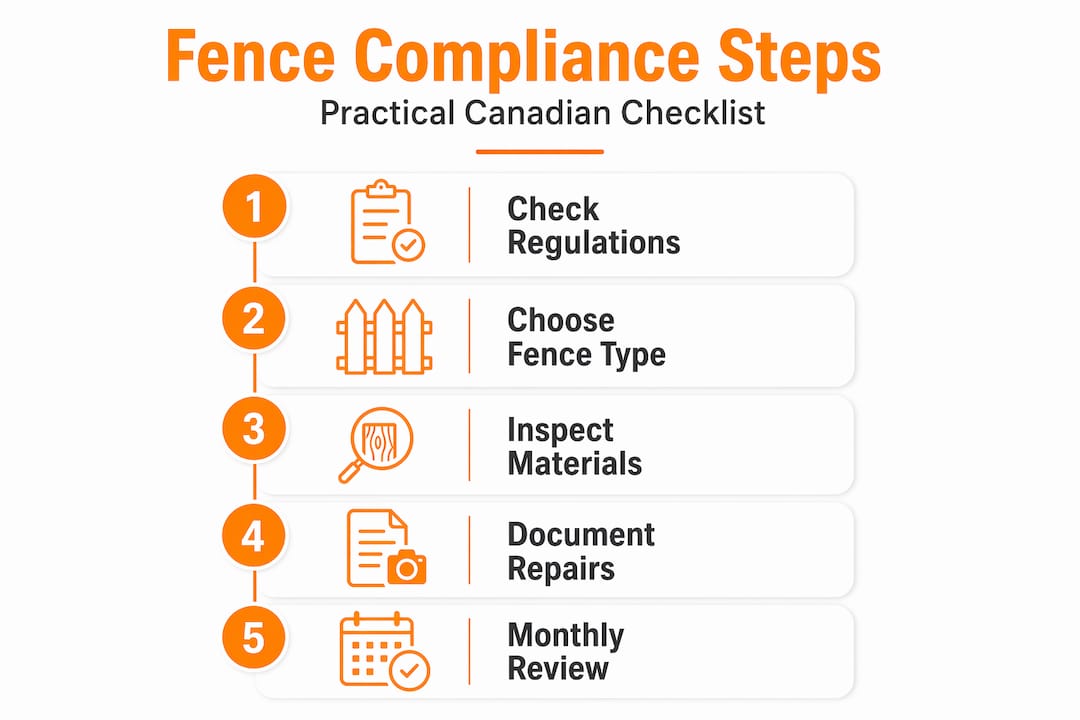
Translating legal requirements into daily practice is where most producers struggle. Regulations are written in legal language, not farm language. Here is a practical checklist and step-by-step process to help you stay on the right side of the rules.
Before building or modifying any fence, answer these questions:
- Is this a boundary fence between properties, or a containment fence solely on my land?
- What species will this fence contain, and what provincial standards apply to those species?
- If this is a shared boundary, have I followed the correct process for notifying my neighbor and involving fence-viewers if needed?
- If electric, is my energizer CSA-certified and do my components meet provincial technical benchmarks?
- Have I documented the existing fence condition before making changes?
Step-by-step: Determining what rules apply to your fence:
- Classify the fence. Is it a line fence (boundary between you and a neighbor) or an enclosure fence (contained within your own property)? Treat these as legally separate projects.
- Identify your province’s governing statute. In Ontario, that’s the Line Fences Act. In Saskatchewan, start with the Animal Production Act. In Alberta, refer to the Line Fence Act.
- Review species-specific enclosure requirements in your province’s agricultural regulations or guidance documents.
- Check electric fence rules if applicable, including equipment certifications and installation standards.
- Consult a fence-viewer or agricultural inspector if you are unsure about boundary disputes or shared-cost obligations. These officials exist specifically to help resolve ambiguity.
- Document everything. Record fence specs, inspection dates, neighbor communications, and any regulatory guidance you received.
The compliance checklist for livestock fencing is a good reference to keep printed and accessible in your shop or office. Remember that treating line and boundary fence rules as separate from livestock containment rules is foundational to getting compliance right.
Pro Tip: Set a calendar reminder every spring and fall to physically walk your perimeter fence and document any weak spots, corrosion, or settlement. A written inspection log is your best defense if a neighbor or regulator ever questions your maintenance standards.
What most guides miss about fence regulations: Hard-won lessons for livestock owners
Here’s the uncomfortable truth that most compliance guides skip over: meeting the minimum legal standard is not the same as being protected. Inspectors, insurers, and courts look at whether your fence was appropriate for your context, not just whether it technically met a measurement requirement. A fence that passes a tape measure test but sits in a high-traffic zone where your cattle constantly pressure it is still a liability if those animals get out regularly.
We’ve seen situations where a single minor enclosure oversight, a gate latch that wasn’t secured properly, a ground rod that corroded through, a bottom wire too high for the lambs actually on the property, led to livestock escaping onto a roadway. The legal and financial fallout from a vehicle collision with escaped livestock is far more damaging than any fence upgrade would have cost. The lesson isn’t just “maintain your fence.” It’s “understand what adequacy actually means for your animals and your land.”
One practical habit that separates compliant, protected producers from those who get caught out: document every fence spec, every inspection, and every neighbor conversation in writing. If you have a fence-viewer visit, keep that report. If you and your neighbor agree to share costs verbally, follow up with a written record. Documentation turns your good intentions into legal protection.
Neighborliness is also a genuine compliance tool. Most fence disputes that escalate to formal processes, fence-viewers, court filings, could have been resolved with a direct conversation and a handshake agreement documented in writing. Regulations give you a framework, but relationships solve problems faster and cheaper. A neighbor who trusts you is far less likely to file a formal complaint when your fence needs a repair that takes two weeks.
Finally, treat regulations as a moving target. Provinces update their statutes, issue new technical guidance, and change cost-sharing rules. What fencing codes say today may not be what they say in three years. Build a habit of checking for regulatory updates every time you plan a significant fencing project.
Upgrade your livestock fencing with expert help
Understanding the regulations is step one. Step two is building or upgrading fencing that actually meets them, and doing it with the right materials the first time.
At FenceFast, we work with Canadian producers every day to translate complex provincial requirements into practical fencing solutions. From CSA-compliant electric fence energizers and certified components to woven wire, high-tensile options, and Gallagher eShepherd virtual fencing systems, our catalog is built around what Canadian livestock operations actually need. We also offer design consulting to help you match your fence build to your species, your province, and your regulatory obligations. Whether you’re starting from scratch or bringing an existing fence up to standard, we can help you get there efficiently.
Frequently asked questions
Who is legally responsible for a boundary fence between farms?
In most provinces, boundary fence responsibility is shared between neighbors, with cost-sharing procedures set out in provincial Line Fence Acts. In Ontario, the Line Fences Act governs boundary fences between adjoining properties and provides a formal process through fence-viewers for disputes about construction, maintenance, and cost allocation.
Do electric fences have special legal requirements in Canada?
Yes, some provinces require CSA-approved controllers and specify wire gauge and placement for electric fences. British Columbia’s documentation requires CSA-approved controllers for plug-in systems, while Manitoba’s government guidance covers wire gauge and placement examples for electric fencing.
Can I use one fence design for all livestock?
No, many provinces require fences to be suitable for the specific species, with different standards for cattle, sheep, horses, and other animals. For Alberta and Saskatchewan, fence standards and cost-sharing depend on the species and the height, strength, and structure needed to contain them.
What happens if my livestock escape due to a poorly maintained fence?
You may be legally responsible for damages or animal welfare consequences when fencing is inadequate or poorly maintained. Across Canadian jurisdictions, producers are responsible for escapes and the welfare or safety impacts that result from inadequate enclosure fencing.
Where can I find official provincial regulations?
Each province publishes its statutes and guidance online, including the Ontario Line Fences Act, the Alberta Line Fence Act, and the Saskatchewan Animal Production Act, all available through CanLII or the relevant provincial government websites.

