

TL;DR:
- Canadian livestock fence requirements vary by province and municipality, necessitating careful research before building. Different species demand specific fence heights and materials to ensure safety and compliance, with flexible laws accommodating regional and animal behavior differences. Accurate documentation, local consultation, and adaptable fencing choices help farmers avoid disputes and maintain effective containment.
Many Canadian livestock owners assume there is a standard legal fence height that applies across the country. There isn’t. Whether you’re running cattle in Alberta, keeping horses in Ontario, or managing a mixed flock in British Columbia, the rules governing how tall your fence must be can change depending on your province, your municipality, and even the species on your land. Getting this wrong means potential fines, neighbor disputes, and animals that find their way onto public roads. Getting it right means peace of mind, legal protection, and fencing that actually does its job.
Table of Contents
- Understanding fence height laws in Canada
- How livestock species affect fence height and design
- Comparing fencing types: matching material and height to containment needs
- How to confirm you’re compliant: Practical steps for Canadian livestock owners
- Why the “one-size-fits-all” approach fails Canadian livestock fencing
- Find the right tools and expertise for your next fencing project
- Frequently asked questions
Key Takeaways
| Point | Details |
|---|---|
| Check local bylaws | Fence height rules change by province and municipality, so always confirm the specifics with your local office. |
| Species determine needs | Cattle, sheep, and other animals often require different fence heights and structures as recognized by provincial law. |
| Choose materials wisely | The ideal material and height combination will match your livestock type, containment goals, and local regulations. |
| Document compliance | Keep good records of your fence build and legal checks in case of neighbor disputes or inspections. |
| Review often | Laws, animals, and fencing technology change—periodically review your fencing plan to stay effective and legal. |
Understanding fence height laws in Canada
Canada does not have a single federal standard for livestock fence heights. Fencing law is almost entirely a provincial matter, and provinces often delegate further authority to municipalities. This layered system catches a lot of farmers off guard, especially those who move between provinces or who buy land in a new region without researching local rules.
In Ontario, lawful fence height under the Line Fences Act is directly tied to municipal by-laws. If your municipality has a by-law that prescribes a specific fence height and description, any fence award made under the Act must conform to that by-law. That means the same provincial statute can produce different legal fences in two townships just a few kilometers apart.
Alberta takes a slightly different approach. The Line Fence Act in Alberta considers the type of livestock, the parcel’s use, and the specific needs arising from the species when determining what counts as an adequate line fence. Height and strength specifications are not handed down uniformly but are assessed in context. This makes the law flexible, but it also means assumptions are dangerous.
Here are some key legal dynamics every Canadian livestock owner should understand:
- Provincial legislation sets the framework for line and boundary fence disputes
- Municipalities frequently specify the “lawful fence” height and materials through by-laws
- Provinces like Alberta build livestock species into the legal definition of adequate fencing
- Rural municipalities and urban fringe areas may have dramatically different requirements
- Zoning classifications (agricultural, rural residential) can also affect which rules apply
Important: Because Canadian fence requirements vary by province and by municipality for boundary fences, the safest approach is always to confirm both your provincial line-fence law and any municipal by-law that specifies allowable height and description before you build.
For a broader breakdown of how fencing law works across the country, our fencing law guide covers provincial differences in plain language.
How livestock species affect fence height and design
Once you understand the legal framework, the next layer is the practical one: different animals have completely different behavior patterns, strength levels, and escape tendencies. A fence that works beautifully for beef cattle is completely inadequate for goats. One that keeps horses in comfortably might not stop a determined boar for five minutes.
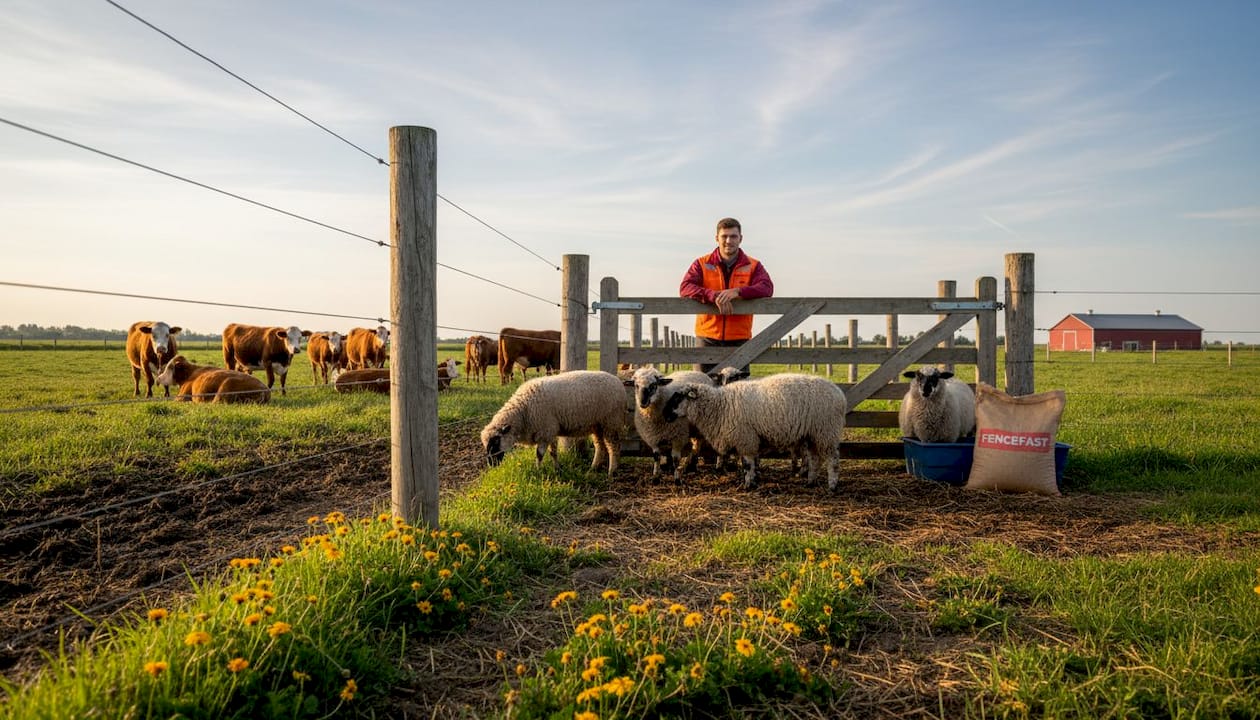
In Alberta, the fence height and cost-sharing rules explicitly account for the species on each parcel, meaning that if you keep a species with special containment needs, you may have a stronger legal case for requiring your neighbor to contribute to a more robust fence. This species-based approach is practical and legally meaningful.
Here are common fence height guidelines by species used widely across Canadian farms:
| Livestock species | Recommended minimum height | Common material |
|---|---|---|
| Beef cattle | 48 to 54 inches | Barbed wire, high-tensile |
| Dairy cattle | 48 to 54 inches | Board fence, woven wire |
| Horses | 54 to 60 inches | Board rail, no-climb wire |
| Sheep | 48 inches | Woven mesh, electric |
| Goats | 48 to 52 inches | Woven mesh (4 ft minimum) |
| Pigs | 36 to 48 inches | Hog panel, electric |
| Poultry | 48 to 72 inches (covered) | Poultry netting |
These numbers are not just suggestions. Under-fencing is one of the most common causes of livestock-related road accidents, neighbor conflicts, and livestock loss. The Alberta Line Fence Act specifically frames cost-sharing and fence specifications around what each species demands, so matching fence height to your herd is both a practical and legal responsibility.
A few additional species-specific factors to keep in mind:
- Horses are flight animals. They can panic and hit a fence at full speed, which means height and material strength matter as much as each other. Sharp wire is a particular hazard.
- Goats are climbers and problem solvers. They will test every weak point. A fence that is too short or has wide openings will fail.
- Bulls require significantly more robust fencing than cows. Plan for a minimum of five strands of barbed wire or equivalent high-tensile systems.
- Sheep with young lambs may need extra bottom-wire tension to prevent lambs from slipping under.
Pro Tip: If you have multiple species sharing adjacent pastures, always build to the most demanding species’ requirements. The extra material cost upfront is a fraction of what it costs to deal with an escape or an injury.
Our livestock fencing solutions guide goes deeper on species-specific containment, and if you’re specifically working with beef operations, the cattle fencing ideas resource covers height, spacing, and material options suited to Canadian ranches.
Comparing fencing types: matching material and height to containment needs
Knowing the right height is only part of the equation. The material you choose determines whether that height is actually effective. A 54-inch electric wire fence for horses performs very differently from a 54-inch woven wire fence. Both may be “legal” in your municipality, but one may be far better suited to your animals and pasture conditions.
Under the Ontario Line Fences Act, municipalities can specify not just height but the type of fence that qualifies as “lawful,” which means the material you choose may be subject to local approval in addition to provincial rules.
Here is a comparison of the most common fencing materials used on Canadian livestock operations:
| Fencing type | Typical height range | Best for | Key tradeoff |
|---|---|---|---|
| Barbed wire | 48 to 54 inches | Cattle, large pastures | Risk of injury, not for horses |
| High-tensile smooth wire | 48 to 60 inches | Cattle, horses | Requires tensioning equipment |
| Woven/page wire | 48 to 60 inches | Sheep, goats, mixed | Higher cost, durable |
| Wood board rail | 54 to 72 inches | Horses, show animals | High maintenance, premium cost |
| Electric fence | 36 to 54 inches | All species, rotational | Requires power source, monitoring |
| Hog panel/cattle panel | 34 to 52 inches | Pigs, goats, calves | Less flexible, heavier to install |
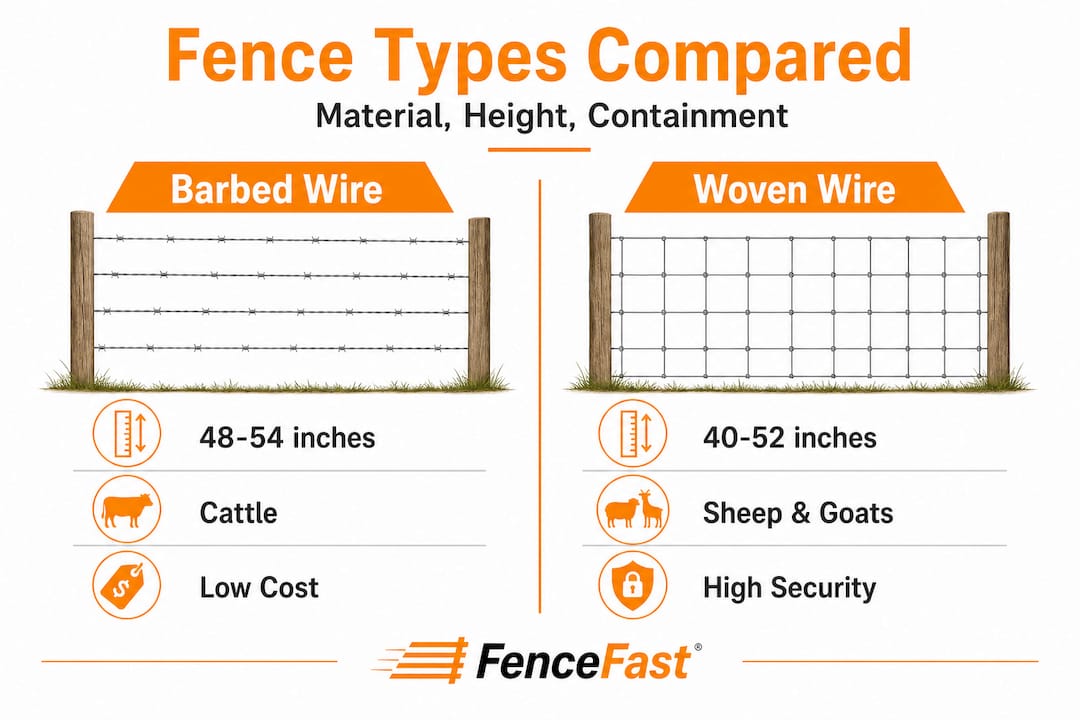
Each material has a place on a well-run farm, and many operations combine them. For example, a cattle operation might use high-tensile smooth wire at 52 inches for general pasture perimeters, then switch to woven mesh with electric top wire near the road or near areas with predator pressure.
Key factors to weigh when choosing material:
- Terrain: Rocky or hilly ground makes some fence types much harder to install and maintain.
- Winter conditions: Canadian winters cause frost heave, which affects post-set depth and fence tension significantly.
- Predator pressure: Coyotes, wolves, and bears are real threats in many parts of Canada, and a fence that keeps animals in must also be evaluated for keeping predators out.
- Rotational grazing: If you move animals through multiple paddocks, you need systems that are quick to set up and move.
Pro Tip: When predation is a concern, add an outward-facing electric offset wire at 8 to 10 inches above ground level. This simple addition stops most canine predators without requiring you to build a taller or more expensive perimeter fence.
For a side-by-side breakdown of fence materials and where they perform best, the compare fencing materials resource is a good reference. The livestock fence tips article and our durable agricultural fencing guide round out the picture with installation and longevity considerations specific to Canadian conditions.
How to confirm you’re compliant: Practical steps for Canadian livestock owners
Understanding the rules is one thing. Actually confirming your fence is compliant is another. Here is a step-by-step process you can work through before you build, and when reviewing existing fences.
- Identify your provincial line-fence statute. Every province has one. Start there to understand the baseline rules for boundary and line fences, including who bears cost and what counts as an adequate fence.
- Contact your rural municipality or county. Ask specifically whether a fence by-law exists that sets height, materials, or type for livestock operations in your zoning area.
- Match requirements to your livestock species. Based on Ontario and Alberta statutes, lawful fence height is determined by a combination of provincial law, municipal by-law, and livestock species needs. Make sure all three align.
- Document everything. Write down the by-law reference numbers, the provincial statute sections, and your specific fence specifications. Take dated photos of your completed fence from multiple angles.
- Talk to your neighbors before you build. Many fence disputes escalate because of assumptions. A simple conversation about where the fence line runs and what you plan to build can prevent months of legal headache.
- Contact your provincial agricultural extension office. They can confirm current local standards and often have guidance sheets that summarize what’s required by species and zone.
- Schedule regular fence inspections. Fence compliance isn’t just about what you build. It’s about what you maintain. A fence that was legal and effective at installation can become neither after a hard winter or a downed tree.
Documentation note: Keep a fencing file that includes your municipal by-law reference, the date your fence was completed, the contractor or supplier used, and your fence specifications (height, post spacing, wire gauge or rail size). This protects you in any future dispute or insurance claim.
For ideas on keeping your animals safe within your fence perimeter, see our farm security ideas resource. If predators are a specific concern in your area, the anti-predator fence options guide covers layered protection strategies. And for operations using rotational or temporary setups, our portable fencing solutions article shows how to stay flexible without sacrificing containment.
Pro Tip: Keep a printed copy of your local fence by-law in your farm records alongside your fence documentation. If a bylaw changes after your fence is built, having proof of when you built and what rules applied at the time can matter significantly in a dispute.
Why the “one-size-fits-all” approach fails Canadian livestock fencing
Here is something we see often: a producer builds a solid-looking fence, uses reasonable materials, installs it at a height that feels right, and assumes it meets the standard. It often doesn’t. Not because they were careless, but because they assumed uniformity that does not exist in Canadian fencing law.
We have talked to ranchers in Alberta who built to their neighbor’s spec and then faced a cost-sharing dispute because the fence did not meet the species-specific standard for their livestock type under the Line Fence Act. We have seen Ontario operations that copied an older fence layout and ran into trouble when the municipality updated its by-law after the fence was built.
The law is not standardized, even within a single province. Two rural municipalities in Ontario can have legally different fence requirements for the same species. Two ranches in Alberta can have different cost obligations for a shared line fence depending solely on what each party keeps on their land. That’s not a quirk of the system. That’s the system working as designed, because local conditions genuinely vary.
What actually works, in our experience, is treating fence compliance the same way you’d treat any other farm input decision: research it, document it, revisit it periodically, and talk to the people around you. Choosing adaptable fencing basics that can be adjusted as regulations or herd composition changes is a smarter investment than locking yourself into a rigid system based on what was “always done” in the area.
The hidden cost of overbuilding is real too. Installing a 6-foot wood board fence in a municipality that specifies a 54-inch woven wire standard does not make you more compliant. It makes you less cost-efficient and potentially non-conforming in a different way. Best practice is always to confirm the exact legal specification, build precisely to it, then layer in practical animal management upgrades above and beyond compliance as your budget allows.
Find the right tools and expertise for your next fencing project
Building a fence that meets Canadian legal standards and keeps your animals safe requires more than good intentions. It requires the right materials, the right tools, and access to people who understand both the regulations and the physical demands of agricultural fencing across Canadian climates.
At FenceFast Canada, we supply professional-grade fencing components, electric fence systems, and livestock management tools specifically selected for Canadian farm and ranch conditions. Whether you’re tensioning high-tensile wire across a large cattle pasture or setting up rotational paddocks for sheep, having quality tools makes the job faster and the result more reliable. The fencing and crimping tool from Hayes is a great example of the kind of equipment that pays for itself quickly on any serious fencing project. And for those long days on the fence line, practical gear like the Barbwire Hat keeps you comfortable while you work. Our team is also available to help you navigate product selection and point you toward current compliance considerations for your region.
Frequently asked questions
What is the minimum legal fence height for cattle in Ontario?
Ontario fence height for cattle is set by municipal by-law under the Line Fences Act, and typically falls between 48 and 54 inches, but you must verify with your local municipality since requirements vary.
Do laws really differ by livestock species?
Yes. In Alberta, fence specifications and cost-sharing under the Line Fence Act are explicitly tied to the livestock species on each parcel, meaning a fence for horses may need to meet different standards than one for beef cattle.
How can I avoid fencing disputes with neighbors?
Confirm both your provincial and municipal fence requirements before building, document your fence specifications and the rules you followed, and communicate with your neighbor early in the planning process.
Is higher always better for livestock fencing?
Not always. Excessively tall fences can exceed what local by-laws specify as a “lawful fence,” add unnecessary cost, and may create other issues such as snow load or wind resistance. Aim for the species-appropriate height within your legal limits, then focus on material quality and proper installation.

