

TL;DR:
- Canadian fencing laws vary across federal, provincial, and municipal levels, requiring comprehensive understanding.
- Proper fencing must meet specific material standards, height, and construction rules tailored to each province.
- Fences should be designed with durability and local risks in mind to minimize liability and animal escapes.
Farmers and ranchers across Canada often assume their fences are good enough. After all, if the fence looks solid and holds the animals in, what could go wrong? Quite a lot, it turns out. Farmers may be liable for escaped livestock and resulting property damage even when their fence meets the average standard for the district. Provincial laws, municipal bylaws, and federal rules on Crown land all overlap in ways that catch even experienced producers off guard. This guide covers the key federal and provincial livestock fencing laws, how they interact with animal welfare rules and local bylaws, and what you can do right now to stay compliant and protect your operation.
Table of Contents
- How livestock fencing is regulated across Canada
- Key provincial regulations: what every Canadian producer should know
- Liability, disputes, and practical compliance tips
- Choosing fence materials and designs to meet regulations
- What most guides miss about fencing compliance in Canada
- Looking for expert livestock fencing solutions?
- Frequently asked questions
Key Takeaways
| Point | Details |
|---|---|
| Laws vary by province | Fencing rules and cost sharing differ widely across Canadian provinces and even local municipalities. |
| Liability is high | Farmers are usually responsible if livestock escapes, regardless of fence type or age. |
| Choose durable materials | Selecting electric or high-tensile fences improves compliance and reduces long-term risks. |
| Check local bylaws | Municipal rules for height and materials can be stricter than provincial standards. |
How livestock fencing is regulated across Canada
With the need for clarity established, let’s break down how fencing regulations are structured at different government levels.
Fencing law in Canada is not a single, unified system. Responsibility is split across three levels of government, and each level has a different role. The federal government primarily regulates fencing on Crown land and along railway corridors. Beyond those specific zones, the bulk of practical fencing law falls to the provinces.
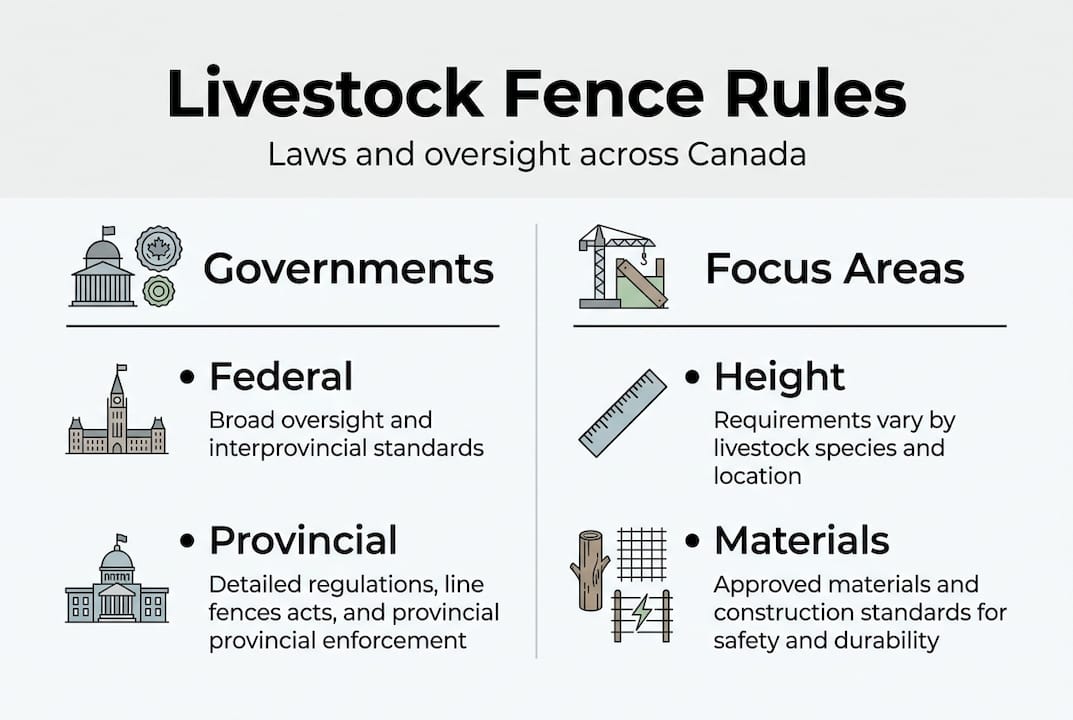
Ontario, Saskatchewan, and British Columbia each regulate fencing through different acts and codes. Ontario uses the Line Fences Act to govern boundary fences between neighboring properties. Saskatchewan relies on the Animal Production Act to set livestock enclosure standards. British Columbia coordinates through the Ministry of Forests and works with industry bodies like the BC Cattlemen’s Association. Manitoba takes a different approach, focusing on predator-resistant fencing programs tied to funding eligibility rather than strict legislative minimums. Understanding provincial fencing law differences is essential before you build or repair any fence.
Here is a quick overview of the regulatory landscape by province:
| Province | Primary legislation | Enforcement focus |
|---|---|---|
| Ontario | Line Fences Act | Boundary disputes, cost-sharing |
| Saskatchewan | Animal Production Act | Enclosure codes, stray control |
| Manitoba | Livestock Programs | Predator-resistant funding |
| British Columbia | MOF Qualified Contractor Docs | Material specs, project standards |
| Alberta | Stray Animals Act | Livestock escape liability |
Most fines and legal problems do not come from proactive government inspections. They come from animal escapes, property damage, and neighbor disputes. That means you can operate for years without issue and then face serious liability the moment something goes wrong.
Municipal bylaws add another layer. Many municipalities set fence height minimums and specify approved materials that go beyond what provincial law requires. A fence that satisfies Saskatchewan’s Animal Production Act might still violate a rural municipality’s bylaw on wire type or post spacing. Always check both levels before starting any fencing project.
“Fencing compliance is not just about satisfying one law. It requires producers to understand how federal, provincial, and municipal rules stack on top of each other for their specific location.”
Key provincial regulations: what every Canadian producer should know
Now that the legal landscape is clear, let’s compare the most important provincial rules and what they mean in practice.
Provincial rules vary more than most producers realize. The differences are not just technical. They affect your costs, your legal exposure, and the materials you are allowed to use. Here is a summary of the most important highlights:
| Province | Min. height | Cost-sharing | Species notes | Material standard |
|---|---|---|---|---|
| Ontario | 4 ft (some bylaws) | 50/50 for line fences | Higher standard for bison | Varies by bylaw |
| Saskatchewan | Varies by code | Not mandated | All livestock | Wire/enclosure codes |
| Manitoba | Not fixed | Up to 75% reimbursement | Predator-risk areas | Predator-resistant spec |
| British Columbia | Not fixed | Project-based | Cattle focus | 5-strand, 12.5 gauge |
In Ontario, the 30-day notice requirement for cost-sharing means you cannot simply build a fence and then ask your neighbor to split the bill afterward. You must follow the formal process, including giving written notice, before work begins. The 50/50 cost-sharing rule applies only to line fences, which are boundary fences between two private properties. It does not apply to fences along highways or Crown land.
Saskatchewan’s approach is more technical. The Animal Production Act sets out specific fence and enclosure codes, including wire selection standards for fences near trails and public access areas. Producers there need to know which code applies to their specific land use and livestock type.
Manitoba stands out for its funding generosity. The province reimburses up to 75% of costs for compliant predator-resistant fencing. That is a significant subsidy, but it comes with conditions. The fence must meet predator-resistance specifications, not just general livestock containment standards. Height and material minimums alone will not qualify you.
British Columbia sets the clearest material standards. BC projects require 5-strand barbed wire, 12.5 gauge, with a minimum 900-pound breaking strength. These specs are among the most detailed in the country and reflect the rugged terrain and predator pressure that BC cattle producers face.
When comparing options, reviewing fencing material comparisons for your region helps you match the right product to both the legal requirement and the physical demands of your land.
Key takeaways by province:
- Ontario: Follow the 30-day notice process before starting shared fence work
- Saskatchewan: Match your wire and enclosure type to the applicable code for your land use
- Manitoba: Apply for predator-resistant funding before purchasing materials
- BC: Use 5-strand, 12.5 gauge barbed wire for qualifying projects
Liability, disputes, and practical compliance tips
Understanding the rules is just the beginning. Here is what happens if fences fail and how to stay out of legal trouble.
When livestock escape and cause damage, the legal responsibility falls on the owner. Farmers are liable under the Pounds Act and common law for escaped animals, even if the fence met the typical standard for the district. That last part surprises many producers. “Average” is not a legal defense. If your cattle get onto a neighbor’s crop or cause a vehicle accident on a highway, you are responsible for the damages.
Neighbor disputes around fencing usually center on shared boundary fences. Cost-sharing obligations and fence work requirements only apply to these line fences. If your fence borders a highway, Crown land, or federal property, you carry the full cost and responsibility yourself. Livestock with higher escape risk, like bison, may also face higher fence standards under provincial rules.
“Containment is an animal welfare issue as much as it is a legal one. Producers who take fencing seriously protect their animals, their neighbors, and their business.”
Here are three practical compliance tips that legal and agricultural experts consistently recommend:
- Document your fence maintenance. Keep dated records of inspections, repairs, and upgrades. If a dispute goes to a fence viewer or court, documentation shows you acted responsibly.
- Serve formal written notice before shared fence work. In provinces like Ontario, skipping this step voids your right to cost-sharing, even if the fence is clearly needed.
- Check municipal bylaws before you build. Provincial minimums are just the floor. Your municipality may require taller fences, specific post spacing, or approved wire types.
Pro Tip: Electric and high-tensile fences hold up best in Canada’s freeze-thaw climate. They require less maintenance than barbed wire over a 10-year period and are less likely to fail during the spring thaw when escape risk is highest. Review fence selection tips and practical fence installation guidance before committing to a design.
Choosing fence materials and designs to meet regulations
With rules and liabilities clear, choosing the right fence type is your last and most controllable step.
Not all fencing materials are equal under Canadian regulations, and not all materials suit every species or region. Electric and high-tensile fences are preferred for durability, while barbed wire remains common but is considered unsafe for horses due to injury risk. Predator netting adds a third option for producers in wolf or coyote territory.
Here is a breakdown of the main options:
- Barbed wire: Low cost, widely accepted under provincial codes for cattle. Not suitable for horses. Check gauge and strand count against local specs.
- High-tensile electric: Excellent longevity, low maintenance, and strong deterrent effect. Works well across Canada’s climate zones. Requires proper grounding and energizer sizing.
- Predator netting: Best for sheep, goats, and poultry in high-risk areas. Qualifies for Manitoba’s predator-resistant funding program when installed to spec.
- Woven wire: Good for mixed livestock but heavier and more expensive to install. Check if your province’s code specifies mesh size for your species.
Wire gauge and breaking strength matter more than most producers think. A fence that looks solid but uses undersized wire will fail under pressure from large animals or predator attacks. BC’s 12.5 gauge, 900-pound breaking strength standard is a useful benchmark even outside BC.
Pro Tip: Always confirm your municipal bylaw requirements before purchasing materials. A quick call to your rural municipality office can save you from buying wire or posts that do not meet local specs. Reviewing material durability comparisons and best fence posts for your region will help you make a smarter purchase decision.
Horses and bison require different specifications from cattle or sheep. Horses need smooth wire or board fencing to prevent leg injuries. Bison require heavier gauge wire and taller fence heights due to their strength and tendency to challenge barriers. Matching the fence to the animal is as important as matching it to the regulation.
What most guides miss about fencing compliance in Canada
Most compliance guides stop at the statutory minimums and call it done. That approach works until it does not, and when it fails, the cost is significant.
The real compliance challenge is not checking the legal boxes. It is adapting your fence to local risks: predator pressure, frost heave, spring flooding, and the specific behavior of your animals. A fence that technically meets Saskatchewan’s enclosure code but uses undersized posts in heavy clay soil will fail in year three. That failure is your liability, not the province’s.
Producers who focus only on the cheapest eligible fence expose themselves to escapes, damage claims, and neighbor disputes that cost far more than the money they saved upfront. We have seen this pattern repeatedly. The farmers who invest in choosing durable solutions from the start spend less over a 15-year period and deal with fewer legal headaches.
Compliance is the floor, not the ceiling. Smart fencing is about prudent business management. Build to exceed the minimum, document everything, and treat your fence as a long-term asset rather than a one-time expense.
Looking for expert livestock fencing solutions?
Putting these insights into action starts with having the right products and the right guidance behind you.

At FenceFast, we supply Canadian farmers and ranchers with fencing products built for real agricultural conditions, not just minimum compliance. From predator-resistant netting to high-tensile wire systems, our catalog covers what you need to meet provincial specs and go beyond them. If you are setting up an electric perimeter, the electric fence accessory kit is a practical starting point that includes the components most producers need to get a compliant system running. We also offer design consulting and access to government funding program information to help you make the most of available subsidies.
Frequently asked questions
What is the minimum height for a livestock fence in Ontario?
Some Ontario municipal bylaws require a minimum fence height of 4 feet for livestock containment, though this varies by municipality and animal type.
Are cost-sharing rules for fences the same across all provinces?
No. Ontario’s Line Fences Act covers boundary fence cost-sharing only, and other provinces have entirely different frameworks or no mandatory cost-sharing at all.
What type of livestock fence is legal in Saskatchewan?
Saskatchewan’s Animal Production Act establishes specific fence and enclosure codes that producers must follow, with wire selection requirements that vary by land use and proximity to public trails.
Can I get funding for predator-resistant fencing in Manitoba?
Yes. Manitoba’s program funds up to 75% of eligible costs for predator-resistant fencing that meets the program’s technical specifications.
Who is responsible if my livestock escapes and damages property?
The livestock owner is legally responsible under the Pounds Act or common law, regardless of whether the fence met the average standard for the area.

