

TL;DR:
- Modern solar fencing is reliable in Canadian winters with proper system sizing and maintenance.
- Grounding and panel positioning are crucial for optimal performance, more than technology features.
- Solar fences offer a cost-effective, portable, and environmentally friendly livestock management solution.
Solar fencing has a reputation problem in Canada. Many farmers assume that short winter days and brutal cold make solar powered electric fencing unreliable north of the 49th parallel. That assumption is wrong. Alberta Nofence trials recorded over 96% battery charge on solar collars through the season, with minimal system failures. Modern solar fencing technology has matured fast, and it now offers Canadian ranchers a flexible, cost-effective way to manage livestock without running power lines across remote pastures. This article breaks down how solar fencing works, how it compares to other options, what you need to plan for in a Canadian installation, and how to keep your system running strong year after year.
Table of Contents
- How solar fencing works and why it matters
- Comparing solar, electric, and virtual fencing solutions
- Key considerations for installing solar fencing in Canada
- Maintenance, troubleshooting, and long-term performance
- A fresh perspective: Beyond the hype, what really drives reliable solar fencing?
- How FenceFast can help you build smarter solar fences
- Frequently asked questions
Key Takeaways
| Point | Details |
|---|---|
| Solar fencing is reliable | Modern solar fencing solutions work effectively in Canadian climates, even in winter conditions. |
| Virtual fencing is promising | Virtual systems offer over 99% containment but are best paired with traditional methods for perimeter security. |
| Proper setup is crucial | Grounding and panel placement have the biggest impact on fence performance and reliability. |
| Regular maintenance matters | Routine battery, panel, and wire checks keep your fence working season after season. |
How solar fencing works and why it matters
A solar fencing system is straightforward in concept. A solar panel charges a battery, and that battery powers an electric fence charger (also called an energizer). No grid connection needed. That simplicity is exactly what makes it attractive for remote pastures, rotational grazing paddocks, and any situation where running a power line would be expensive or impractical.
But simple in concept does not mean simple in execution. Two issues cause most solar fence failures on Canadian farms: poor grounding and bad panel positioning. A fence that shocks weakly or not at all is usually a grounding problem, not a charger problem. And a panel facing the wrong direction or buried under snow is not charging anything.
Here is what makes solar fencing worth the investment for Canadian livestock operations:
- No ongoing electricity costs once installed, saving money over years of operation
- Portability for rotational grazing setups that move every few weeks
- Independence from grid power, which matters on remote Crown land or leased pastures
- Lower environmental footprint compared to diesel-powered alternatives
- Scalability, from a single paddock to a multi-pasture rotational system
Winter performance is the honest limitation. Winter solar output averages 3.1 mAh per hour compared to 8 to 12 mAh per hour in summer. That is a real drop, but a properly sized deep-cycle battery and a quality low-impedance charger bridge the gap on most days. Learning more about solar fencer for cattle setups helps you size your system correctly from the start.
“The fence is only as strong as its weakest point, and in most cases that weak point is underground, not overhead.” This is the grounding reality that experienced fencers repeat constantly.
Pro Tip: Tilt your solar panel at an angle equal to your latitude plus 15 degrees in winter. In Alberta, that means roughly 67 to 70 degrees from horizontal. This steeper tilt sheds snow automatically and captures the low winter sun more efficiently. Getting the [solar fence charger basics](https://fencefast.ca/blogs/news/solar panel electric fence charger) right before you buy saves you from expensive do-overs.
Comparing solar, electric, and virtual fencing solutions
Not every fencing situation calls for the same solution. Understanding where each technology excels helps you spend money in the right place.
| Feature | Traditional electric | Solar electric | Virtual fencing |
|---|---|---|---|
| Grid connection needed | Yes | No | No |
| Upfront cost | Low to moderate | Moderate | Very high |
| Operating cost | Ongoing electricity | Near zero | Subscription plus hardware |
| Winter performance | Consistent | Reduced but functional | Depends on cellular signal |
| Containment rate | High | High | 99%+ in trials |
| Portability | Low | High | Very high |
| Perimeter replacement | Yes | Yes | Not recommended |
Traditional grid-tied electric fencing is reliable and well understood, but it locks you into infrastructure. If your pasture is more than a few hundred meters from a power source, the cost of trenching and wiring quickly outpaces a solar system. Solar electric fencing solves that problem with portability and independence, though you need to plan battery capacity carefully for cloudy stretches.
Virtual fencing is the newest category and the most discussed. Systems like Nofence use GPS collars and audio or vibration cues to train cattle to stay within a defined boundary. The containment efficacy exceeds 99% in controlled trials, which is genuinely impressive. But virtual fencing is not a perimeter replacement. Collar costs, subscription fees, and the need for reliable cellular coverage in every corner of your pasture make it impractical as a standalone solution for most Canadian operations.
Key takeaways when comparing options:
- Solar electric is the best value for remote or rotational grazing where grid power is unavailable
- Virtual fencing adds management flexibility for subdividing large pastures within an existing perimeter
- Traditional electric remains the baseline for permanent perimeter fencing near infrastructure
Understanding [solar fence system prices](https://fencefast.ca/blogs/news/solar fencing system price) before you commit helps you budget realistically and avoid sticker shock on accessories. For a deeper look at how solar performs across Canadian seasons, the overview of [solar fencing in Canadian climate](https://fencefast.ca/blogs/news/solar fencing sustainable control canadian farms 2026) is worth reading before you finalize your plan.
Key considerations for installing solar fencing in Canada
Installing solar fencing in Canada requires more planning than in warmer climates. Here is a five-step checklist to get it right.
- Choose your site and map sun exposure. South-facing slopes with minimal shading are ideal. Avoid north-facing hillsides or areas shaded by tree lines for more than a few hours per day.
- Size your battery and panel for winter. Calculate your charger’s daily power draw and multiply by at least three days of autonomy (the number of cloudy days your battery can cover). Deep-cycle AGM or lithium batteries handle cold better than standard lead-acid.
- Install proper grounding rods. Use at least three 6-foot galvanized ground rods spaced 10 feet apart in moist soil. Dry or frozen ground is a poor conductor, so placing rods in a low-lying area helps. Poor [grounding techniques for fencing](https://fencefast.ca/blogs/news/master grounding techniques fences secure livestock) cause more failures than any other single factor.
- Select a low-impedance charger. Low-impedance chargers push current through weeds and wet vegetation without losing effectiveness. They are the standard for any serious livestock operation.
- Plan for cellular coverage if using smart systems. Northern climate trials confirm solar virtual fencing works well in Canada, but reliable cellular signal is non-negotiable for GPS collar systems. Check carrier maps before investing.
Pro Tip: Before you drive a single ground rod, use a fence voltage tester to map your planned fence line. Identify wet areas, rocky outcrops, and sandy patches. Your grounding strategy should target the wettest, most conductive soil on your property.
“A $2,000 solar charger underperforms a $400 charger with good grounding. Fix the ground first, then upgrade the hardware.”
For a full walkthrough of setup steps, the [solar fence installation guide](https://fencefast.ca/blogs/news/solar powered electric fence guide canadian farmers 2026) covers panel mounting, charger wiring, and battery connections in detail. If you want to go deeper on the electrical side, the guide on how to ground electric fences explains rod placement, soil testing, and common mistakes.
Maintenance, troubleshooting, and long-term performance
Once your system is installed, consistent maintenance is what separates a fence that works for a decade from one that fails in year two. Solar fencing does not require much, but it does require regular attention.
Core maintenance tasks:
- Check panel output monthly with a multimeter. A healthy 10-watt panel should produce 16 to 21 volts in direct sunlight.
- Clear snow from panels after every significant snowfall. Even partial shading cuts output dramatically.
- Inspect wire connections and insulators at the start and end of each grazing season.
- Test fence voltage at multiple points along the line, not just at the charger. A significant voltage drop between points indicates a short or broken wire.
- Monitor battery voltage before and after cloudy periods. A deep-cycle battery dropping below 12 volts needs attention.
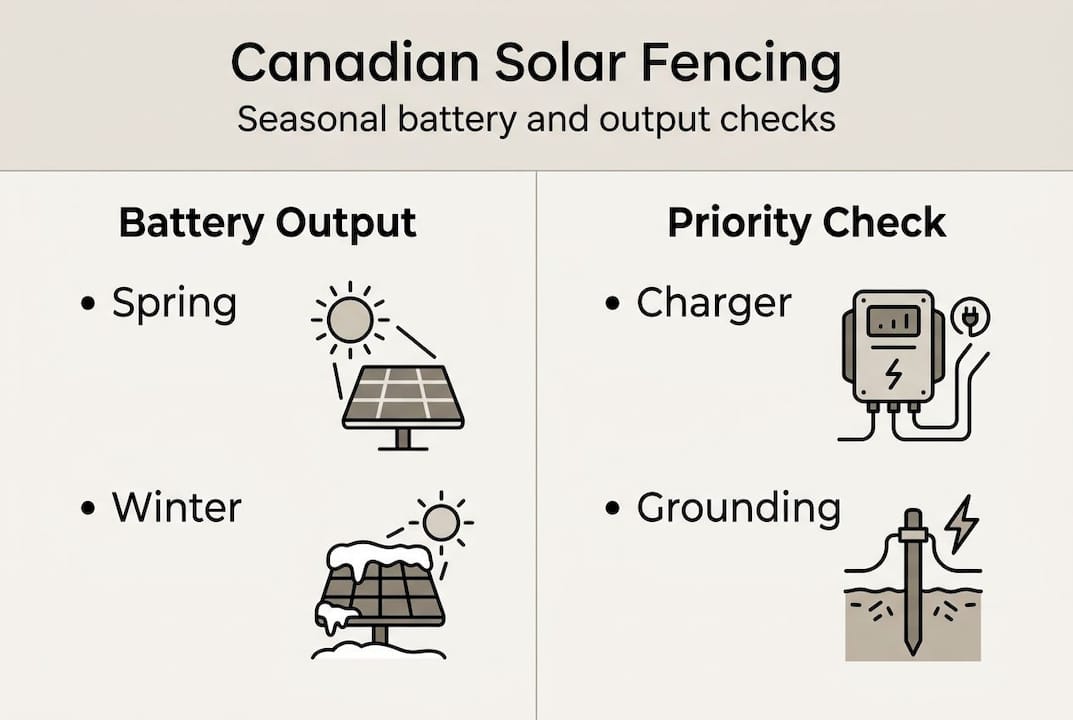
| Season | Typical solar output | Battery risk | Priority check |
|---|---|---|---|
| Spring | Moderate to high | Low | Wire and insulator inspection |
| Summer | Peak (8 to 12 mAh/hr) | Very low | Vegetation contact on fence line |
| Fall | Declining | Low to moderate | Battery charge level |
| Winter | Low (3.1 mAh/hr) | Moderate to high | Panel snow clearance, battery voltage |
The winter output data makes it clear that winter is the season to watch most closely. A battery that is not fully charged going into a multi-day cloudy stretch can leave your fence underpowered when you need it most.
For cattle-specific setup and troubleshooting, the electric fence for cattle guide covers voltage requirements by animal type and how to diagnose common performance drops. If you are running a Gallagher solar charger, the Gallagher S40 charger tips article walks through model-specific settings and battery management.
Always check your charger and battery warranty before the season starts. Most quality chargers carry a two to five year warranty, and knowing your coverage avoids unexpected replacement costs.
A fresh perspective: Beyond the hype, what really drives reliable solar fencing?
The fencing industry loves to talk about the latest technology. Virtual fencing, GPS collars, app-controlled energizers. These tools have genuine value. But in our experience working with Canadian farmers, the most common reason a solar fence underperforms has nothing to do with the charger model or the collar software. It is a grounding rod sitting in dry gravel, or a panel tilted flat and buried under February snow.
Expert analysis confirms that prioritizing low-impedance chargers and solid grounding matters more than chasing the newest tech. Virtual fencing with 99%+ efficacy sounds transformative, but the durability and cost realities mean it works best as a complement to a solid physical perimeter, not a replacement for it.
The farmers who get the most out of solar fencing are not the ones with the most expensive systems. They are the ones who spent time on grounding is key principles, planned their panel angles before winter, and check their battery voltage every few weeks. Fundamentals beat gadgets on most Canadian farms, most of the time.
How FenceFast can help you build smarter solar fences
Ready to put these principles into practice? FenceFast stocks a full range of solar fencing systems, chargers, batteries, and accessories built for Canadian conditions, with expert support to help you choose the right setup for your operation.

Whether you are setting up rotational grazing paddocks for cattle or protecting a market garden from wildlife, we have the components to get it done right. The electric fence accessory kit is a great starting point for smaller setups, and the netting for nuisance animals works well for poultry and perimeter protection. Browse our catalog or reach out to our team for personalized advice on sizing and installation.
Frequently asked questions
Do solar fences work in Canadian winters?
Yes, modern solar fences remain effective in cold conditions. Winter charging output is lower than summer, averaging around 3.1 mAh per hour versus 8 to 12 in peak months, but a properly sized battery system maintains reliable voltage through most winter periods.
Is virtual fencing a total replacement for traditional livestock fences?
No. Virtual fencing delivers over 99% containment in trials, but collar costs, subscription fees, and cellular coverage gaps make it impractical as a full perimeter substitute for most Canadian farms.
How can I make my solar fence more reliable?
Focus on grounding first, then charger quality, and keep panels free of snow and shade. These three factors account for the majority of solar fence performance issues on Canadian farms, as expert guidance confirms.
Do solar fences need cell service?
Basic solar electric fences need no cellular connection at all. Only GPS collar and virtual fencing systems require reliable cellular coverage, and northern climate trials note that service gaps are the primary limitation for those smart systems in remote areas.
Recommended
- Solar fencing: sustainable control for Canadian farms 2026 – FenceFast Ltd.
- Solar powered electric fence guide for Canadian farmers 2026 – FenceFast Ltd.
- Solar Panel Electric Fence Charger: Reliable Livestock Control – FenceFast Ltd.
- Solar fence energizer basics: secure livestock with reliable power – FenceFast Ltd.

