

TL;DR:
- Virtual fencing offers labor savings, better pasture control, and sustainability benefits for ranchers. Funding programs like OFCAF and BMP can cover up to 85% of project costs, with eligibility and deadlines varying by province. Successful applications require careful planning, compliance with specific criteria, and early submission.
Most Canadian ranchers assume virtual fencing is a premium technology reserved for large operations with deep pockets. That assumption is costing producers real money. Programs like OFCAF (Agricultural Climate Solutions: Farm Climate Action Fund) and provincial BMP (Beneficial Management Practices) grants can cover up to 85% of costs, but the rules, deadlines, and eligible expenses vary significantly by province. Understanding those differences before you apply is what separates funded projects from rejected ones. This guide breaks down everything you need to know about eligibility, program structure, application strategy, and real research findings so you can move forward with confidence.
Table of Contents
- Understanding virtual fencing and its benefits
- Overview of OFCAF and BMP virtual fencing funding by province
- Eligibility: What costs and projects qualify for funding?
- Navigating the application process: Practical tips and common pitfalls
- Weighing the impact: Tradeoffs, research findings, and producer experience
- Why smart funding strategy beats simply chasing grants
- Get expert guidance on virtual fencing solutions and funding
- Frequently asked questions
Key Takeaways
| Point | Details |
|---|---|
| Max funding varies by province | OFCAF and BMP grants can cover up to 85% of eligible expenses, but amounts and deadlines are specific to each region. |
| Eligible costs are specific | Funding covers GPS collars, base stations, setup, and planning for new projects, but rarely retrofits. |
| Smart applications win | Success requires early action, benchmarking project needs, and thorough supporting documents. |
| Tradeoffs exist | Virtual fencing offers labor and sustainability gains, but may have small productivity drawbacks. |
Understanding virtual fencing and its benefits
Virtual fencing replaces physical wire with GPS-enabled collars that use audio and mild electrical cues to guide cattle within digitally defined boundaries. There are no posts to pound, no wire to string, and no permanent infrastructure to maintain. The boundaries exist in software, and you update them from a smartphone or tablet. That flexibility is the core appeal.
For a virtual fencing explained overview, the technology works through a combination of GPS satellites, cellular connectivity, and solar-powered neckbands. Each collar tracks the animal’s position in real time. When an animal approaches a virtual boundary, it first hears an audio warning. If it continues, a brief electrical pulse follows. Cattle learn the system quickly, typically within three to five days.
The practical benefits for producers are significant:
- Labor savings: Moving cattle between paddocks no longer requires extra hands or hours of fence riding.
- Improved pasture control: Tighter rotational grazing cycles let pastures recover more fully before the next graze.
- Reduced overgrazing: Precise boundary control prevents cattle from hammering one area repeatedly.
- Sustainability credentials: Healthier pastures mean better soil structure, carbon retention, and biodiversity scores that funders care about.
- Adaptability: Boundaries shift with seasonal forage conditions without any physical re-fencing.
Research backs these claims. [Precise rotational grazing](https://www.ars.usda.gov/.../Raynor et al. 2025) enabled by virtual fencing reduces labor and overgrazing while improving soil health and biodiversity, according to Raynor et al. (2025). That science is exactly why government funders see virtual fencing as a high-value investment in sustainable agriculture.
“Virtual fencing allows producers to practice adaptive, multi-paddock grazing without the capital cost of permanent fence infrastructure, making it one of the most versatile tools available for range management today.”
If you’re curious how operations in your region have already put this to work, the experience of boosting grazing and cutting costs on BC ranches provides a grounded, real-world look at what to expect.
Overview of OFCAF and BMP virtual fencing funding by province
With the technology and its benefits clear, it’s time to explore how OFCAF and BMP funding actually works where you ranch. These programs don’t operate the same way in every province, and the differences matter a lot when you’re planning a project budget.
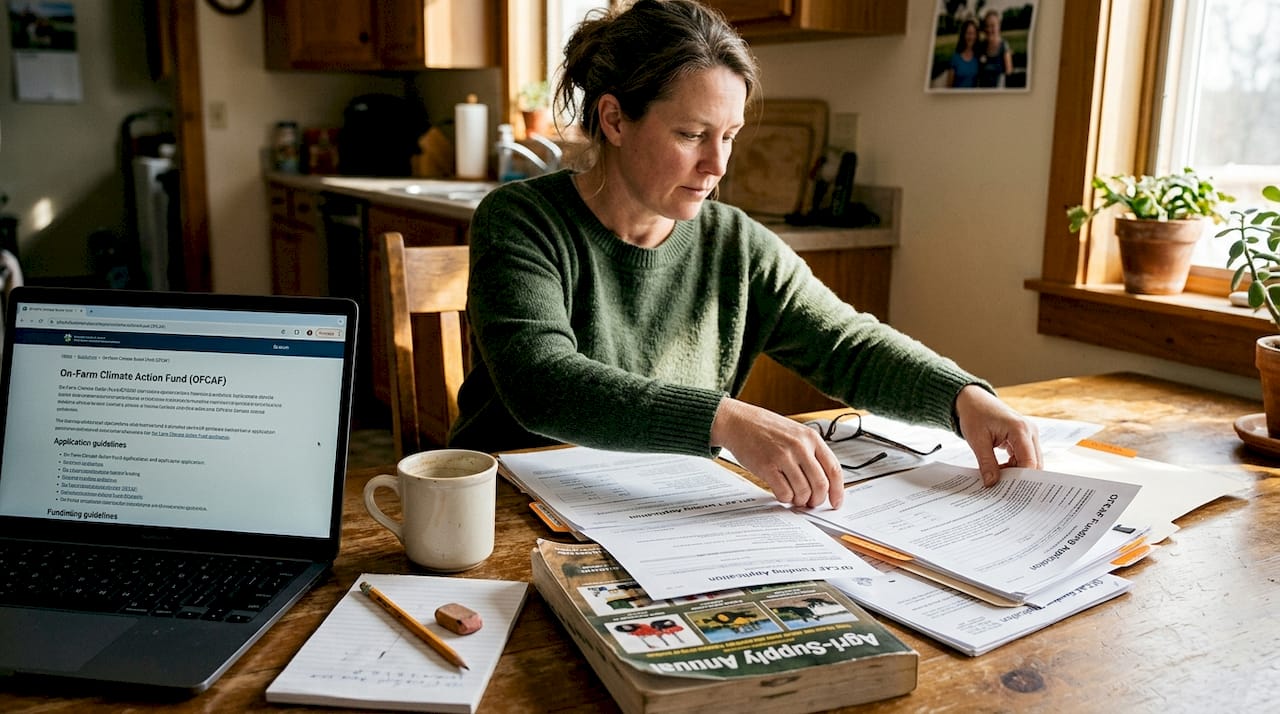
| Province | Program | Delivered by | Max funding | Cost-share | 2026 Deadline |
|---|---|---|---|---|---|
| Alberta | OFCAF | RDAR | $75,000/project | Up to 85% | April 10, 2026 |
| British Columbia | OFCAF + BMP stack | CFGA/BCFC + IAFBC | Varies | Up to 85% combined | Mar 15 + Mar 18 |
| Ontario | OFCAF | OSCIA | Varies | Program-dependent | Check OSCIA portal |
Here’s how each province breaks down:
- Alberta: RDAR delivers OFCAF with up to $75,000 per project and an 85% cost-share ratio. This is one of the most generous single-program structures in the country. Applications opened April 10, 2026.
- British Columbia: OFCAF covers up to 70% of eligible costs, and BMP up to 60% can be stacked on top, bringing combined coverage to as high as 85%. The two programs have separate deadlines: OFCAF closes March 15 and BMP closes March 18 in 2026. Missing one deadline means losing the stacking benefit.
- Ontario: OSCIA administers OFCAF, and virtual fencing qualifies as an eligible BMP under specific project templates. Ontario requires applicants to attend Knowledge Sharing Events (KSEs) before submitting, which adds a planning step many producers overlook.
Key insight: In BC especially, grant stacking is the smartest play. Applying to both OFCAF and BMP simultaneously for the same virtual fencing project, while keeping paperwork aligned across both programs, can dramatically reduce your out-of-pocket cost. Knowing the virtual fencing costs upfront helps you build a realistic project budget before applying.
Statistic: BC producers who successfully stack OFCAF and BMP can reduce their direct investment in virtual fencing to as little as 15 cents on the dollar.
Eligibility: What costs and projects qualify for funding?
Having seen the funding programs, it’s equally important to know which costs and activities actually qualify. Many ranchers make costly mistakes here by assuming everything in a virtual fencing setup is covered.
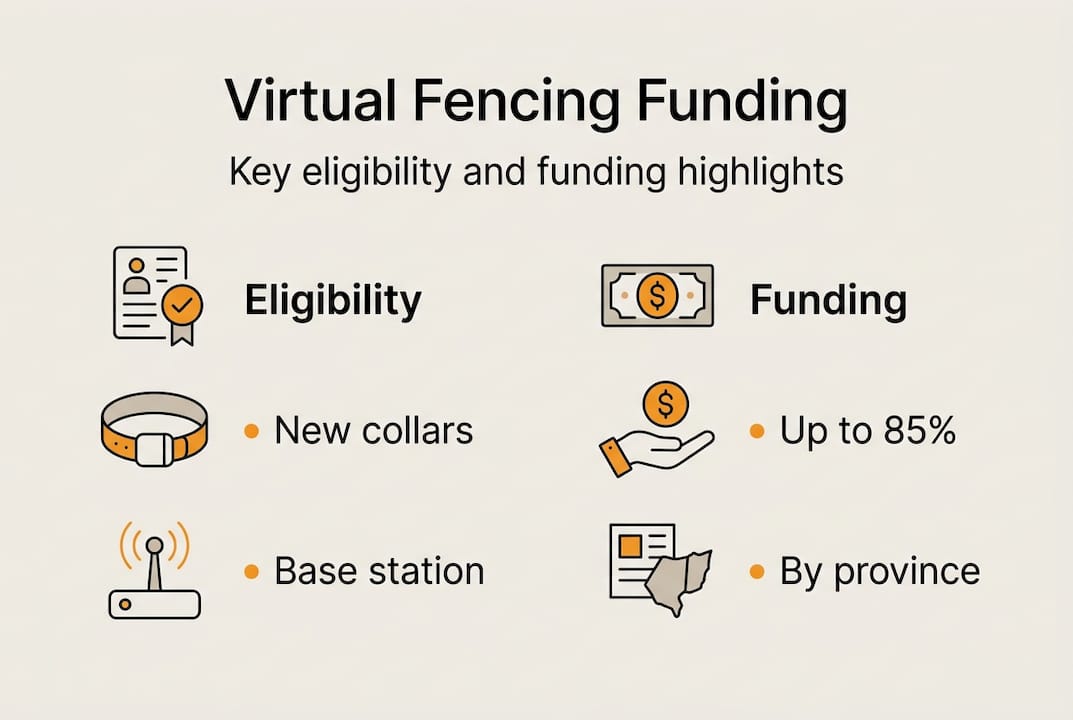
Eligible expenses generally include:
- GPS collars and neckbands (new units only)
- Base stations and receivers
- Shipping and handling for equipment
- Professional grazing plan development
- Agrologist or mentor support fees
- Aerial photography used for boundary planning
According to RDAR’s funding guidelines, eligible costs for virtual fencing projects cover GPS collars, base stations, shipping, and planning support, but the project must be new. Retrofitting old or existing equipment is not covered under these programs. If you have legacy technology that you’re trying to upgrade piece by piece, expect a harder application review.
| Expense type | Typically eligible | Notes |
|---|---|---|
| New GPS collars | Yes | Must be new units |
| Base stations | Yes | Included in most programs |
| Shipping/installation | Yes | Reasonable costs accepted |
| Retrofit of old gear | No | New projects only |
| Existing fencing removal | No | Not a funded activity |
| Ongoing subscription fees | No | Hardware only |
Strong applications share a few common traits. They include a detailed grazing plan validated by an accredited agrologist. They attach aerial photos showing current pasture conditions and proposed boundary zones. And they demonstrate that adequate cellular coverage exists in the project area.
Pro Tip: Before you write a single line of your application, contact your local cellular carrier and confirm that your pasture areas have consistent coverage. Rural dead zones can disqualify a project or create expensive workarounds. This is one of the most overlooked details in otherwise solid applications.
For producers wondering about system flexibility in areas with coverage gaps, portable systems for livestock can offer complementary solutions worth exploring.
Navigating the application process: Practical tips and common pitfalls
You know the eligible expenses. Here’s how to avoid the most common approval mistakes and boost your funding odds.
The application process differs by province, but a few universal principles apply:
- Apply early. Several provinces use first-come, first-served systems once applications open. Waiting until the deadline in a competitive round is risky.
- Attend required events. Ontario’s KSE requirement is non-negotiable. Show up, bring questions, and network with other producers who’ve been through the process.
- Align your paperwork across programs. If you’re stacking in BC, ensure your grazing plan, project scope, and budget descriptions match exactly between your OFCAF and BMP submissions. Discrepancies cause delays and rejections.
- Hire an agrologist early. A qualified grazing plan isn’t just a checkbox; it’s often what separates approved applications from declined ones.
- Verify cell coverage in writing. Some programs ask for documentation of cellular connectivity in the project area.
Applications can be merit-based or first-come, depending on the province, and stacking across programs like BC’s OFCAF and BMP is possible but requires precise coordination. Don’t underestimate the administrative side.
“The producers who get funded aren’t always the ones with the biggest operations. They’re the ones who submitted complete, well-documented applications on time.”
Pro Tip: Start a project folder the moment you decide to apply. Drop in your aerial photos, cell coverage screenshots, grazing plan drafts, and any correspondence with your regional deliverer. When deadline day arrives, you’ll be organized instead of scrambling.
If you’ve heard reasons to avoid virtual fencing and aren’t sure what to believe, reading through common virtual fencing myths can help you separate fact from friction. And if you’re thinking about how virtual fencing fits into a broader rotational grazing solutions strategy, there’s detailed guidance available on that too.
Weighing the impact: Tradeoffs, research findings, and producer experience
Finally, it’s important to weigh the real-world results and research so you can decide if virtual fencing funded by grants is the right call for your ranch.
Most producers who adopt virtual fencing report genuine wins:
- Less time spent moving cattle manually
- Better control over grazing distribution
- Faster pasture recovery between rotations
- Improved records of where cattle grazed and when
At the same time, the research picture is nuanced. Funders and producers report sustainability and labor wins, but Raynor et al. (2025) found that steers managed under virtual fencing gained roughly 10 kg less over a grazing season compared to conventionally fenced animals. Methane reduction results were inconsistent across study conditions.
“Virtual fencing is not a silver bullet for every operation. It performs best where flexibility, labor savings, and soil health goals align with the technology’s strengths.”
This doesn’t mean the technology isn’t worth pursuing. It means you should go in with clear expectations. If your primary goal is rapid weight gain for a feedlot program, talk to your agrologist about whether virtual fencing fits that model. If your goals center on maximizing pasture health, sustainability benchmarks, or reducing fencing labor across large, rugged terrain, the technology and the grant programs behind it make a compelling case.
Why smart funding strategy beats simply chasing grants
Here’s a perspective that doesn’t get said enough: chasing the biggest grant percentage isn’t always the smartest move. We’ve seen producers rush applications to hit high cost-share thresholds, only to find that their pastures lack reliable cell coverage, their herd composition doesn’t suit virtual fencing well, or their grazing goals don’t align with what the technology actually delivers.
The producers who get the most long-term value from OFCAF and BMP funding are the ones who start with honest operational questions. Does your terrain support consistent GPS signal? Is your herd calm enough to adapt quickly? Do your sustainability goals match the program’s intent?
Understanding the true costs of virtual fencing before you apply is more valuable than any funding percentage. A project that genuinely fits your operation and gets 70% covered will outperform a rushed 85% project that underdelivers in year two. Take the time. Do the planning. The grants will still be there.
Get expert guidance on virtual fencing solutions and funding
If you’re ready to explore your options or need help making sense of the forms, here’s where to get reliable support.
Navigating OFCAF and BMP applications while simultaneously choosing the right virtual fencing system is a lot to manage alone. At FenceFast, we’ve spent 26 years working alongside Canadian ranchers as an authorized Gallagher dealer, and we understand both the technology and the funding landscape.
We carry the full range of FenceFast virtual fencing solutions, including Gallagher eShepherd GPS neckbands, base stations, and app-based herd management tools. We also help producers identify which systems qualify for grant funding, so you’re not buying equipment that leaves you ineligible. Reach out before your application deadline to make sure you’re set up for success from day one.
Frequently asked questions
What expenses are eligible for virtual fencing funding under OFCAF and BMP in 2026?
Eligible expenses typically include GPS collars, base stations, shipping, grazing plans, and professional planning support for new projects. Retrofits and ongoing subscriptions are generally not covered.
How much grant coverage can a producer receive for virtual fencing?
Up to 85% coverage is possible, with Alberta offering this through RDAR’s OFCAF program and BC achieving it through OFCAF and BMP stacking. Your province and project details determine the final amount.
Are there restrictions on retrofits or existing fencing equipment?
Yes. Most programs fund new virtual fencing equipment only. Retrofitting old systems is not typically an eligible expense under OFCAF or BMP guidelines.
Does every province have the same deadlines and requirements for OFCAF or BMP funding?
No. Deadlines and requirements differ significantly. BC’s 2026 deadlines are March 15 for OFCAF and March 18 for BMP, while Alberta opened April 10 and Ontario timelines vary through the OSCIA portal.
What are the main drawbacks or tradeoffs of virtual fencing noted in research?
Research shows [strong containment rates](https://www.ars.usda.gov/.../Raynor et al. 2025) of 94 to 99%, but also roughly 10 kg less steer weight gain per season and no consistent reduction in methane emissions compared to traditional fencing.

