

Traditional fencing locks you into fixed boundaries that can’t adapt to your herd’s changing needs or seasonal pasture conditions. Portable fence systems flip that script entirely, offering flexible livestock containment that moves with your management strategy rather than against it. Whether you’re rotating cattle through fresh grazing areas or managing temporary paddocks, portable fencing delivers the mobility and control Canadian farmers need without the permanent infrastructure costs. This guide walks you through modern portable fence technologies, from solar-powered electric systems to GPS-enabled virtual fencing, showing you how to choose, install, and fund the right solution for your operation.
Table of Contents
- Understanding Portable Fence Systems And Their Benefits
- Innovations In Portable Fencing: Virtual Fencing And High-Tech Solutions
- Choosing And Setting Up Portable Fence Systems For Your Livestock
- Cost Considerations And Funding Options For Portable Fencing In Canada
- Explore FenceFast Solutions For Portable Fencing Needs
- Frequently Asked Questions
Key takeaways
| Point | Details |
|---|---|
| Flexible containment | Portable fence systems enable easy pasture rotation and temporary paddock creation without permanent infrastructure investment |
| Solar power advantage | Solar energizers power fences up to 60 km in remote areas, eliminating grid dependency for off-grid Canadian pastures |
| Virtual fencing breakthrough | GPS collar technology achieves over 99% containment rates while enabling remote paddock management without physical barriers |
| Selection factors | Choose systems based on fence length requirements, livestock species, terrain conditions, and available power sources |
| Financial support | Government programs cover up to 85% of solar-powered electric fencing costs, reducing adoption barriers for Canadian producers |
Understanding portable fence systems and their benefits
Portable fence systems are movable containment solutions designed to manage livestock across changing pasture conditions without permanent installation. These systems typically include lightweight posts, electrified wire or netting, and battery or solar-powered energizers that deliver controlled shocks to deter animals from crossing boundaries. Unlike fixed fencing that commits you to static grazing patterns, portable options let you shift paddock boundaries in hours rather than days.
The mobility advantage transforms pasture management entirely. You can implement intensive rotational grazing by moving cattle to fresh forage every few days, improving both animal nutrition and soil health through controlled grazing pressure. Temporary containment for breeding groups, sick animals, or seasonal pasture access becomes straightforward without building permanent infrastructure. This flexibility proves especially valuable in Canadian operations where snow cover, spring flooding, or summer drought creates shifting grazing windows throughout the year.
Solar-powered energizers extend portable fencing into truly remote territory. These units power up to 20-60 km of fence without grid connections, perfect for Crown land grazing leases or back pastures beyond electrical service. The solar panel charges an integrated battery that maintains fence voltage even during cloudy stretches, keeping your livestock contained regardless of weather conditions.
Cost savings add up quickly compared to conventional fencing. You avoid the material expense of thousands of fixed posts and multiple strands of high-tensile wire stretched across entire properties. Labor requirements drop dramatically since two people can install a portable electric fence section in under an hour versus days of post-pounding and wire-stretching for permanent installations. Maintenance becomes simpler too, with fewer components exposed to weather damage and easier access for repairs when issues arise.
Pro Tip: Match your energizer output to actual fence length plus 20% buffer capacity. A 40 km rated unit works perfectly for 30-35 km of actual fence, ensuring strong voltage even with vegetation contact or minor ground faults that reduce effectiveness.
Explore more about portable livestock fence solutions and portable electric fences livestock applications for different farm scenarios.
Innovations in portable fencing: virtual fencing and high-tech solutions
Virtual fencing eliminates physical barriers entirely by using GPS-enabled collars that train and contain livestock through audio cues and mild electric corrections. Each collar tracks the animal’s location continuously, issuing warning sounds when the animal approaches a virtual boundary line you’ve drawn on a smartphone app. If the animal continues forward, the collar delivers a brief correction pulse similar to traditional electric fence contact. Animals learn the boundary association within days, achieving reliable containment without posts, wire, or energizers.
The management benefits revolutionize daily operations. You can shift paddock boundaries from your truck or kitchen table by redrawing virtual fence lines in the app, eliminating the physical labor of moving posts and wire. Real-time GPS tracking shows exactly where each animal grazes throughout the day, helping you identify health issues, monitor breeding activity, or locate missing animals instantly. Labor savings compound over time since you’re not building, maintaining, or repairing physical infrastructure across vast grazing areas.
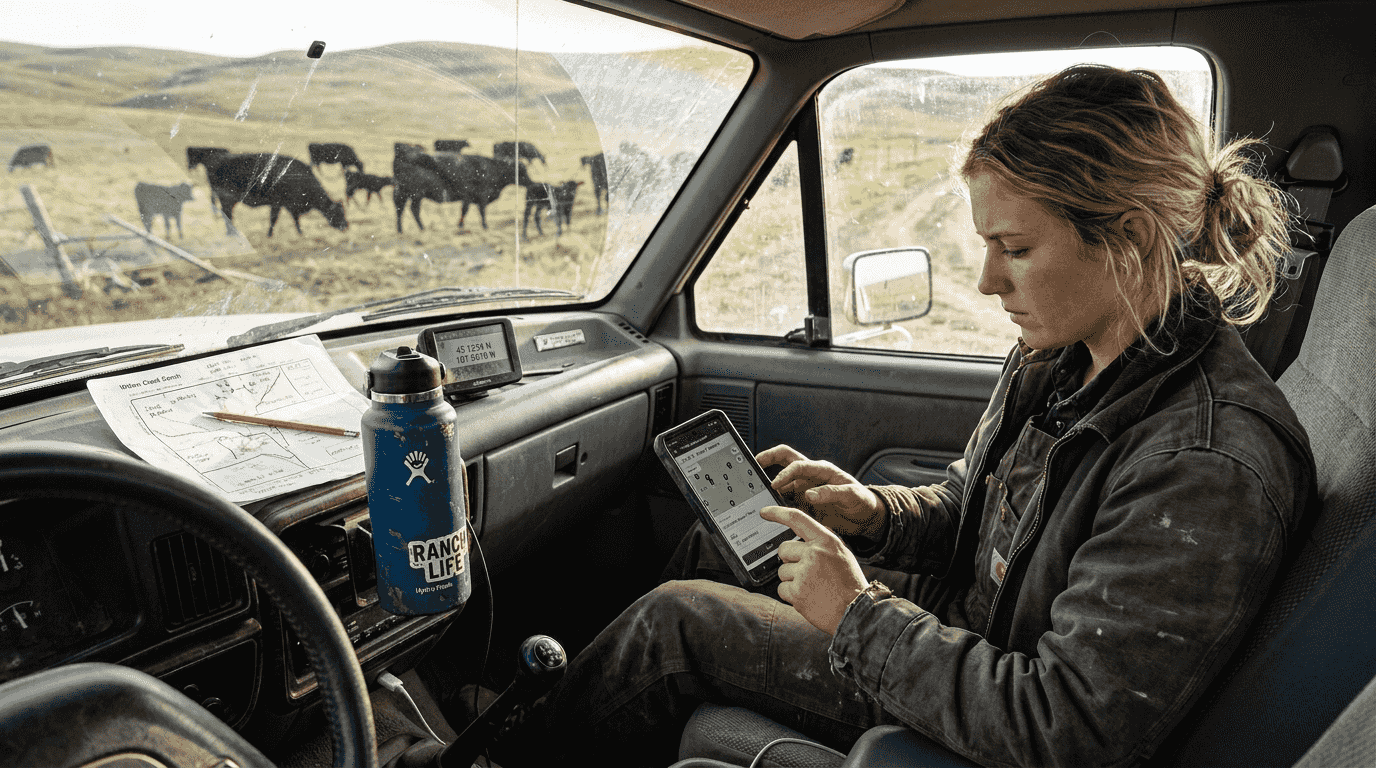
Research shows high-tech collars keep cattle from straying with remarkable success. Alberta trials with cow-calf pairs demonstrated over 99% containment effectiveness, proving virtual fencing works reliably even with protective mother cows and curious calves. The system maintained boundaries across varied terrain including wooded areas, creek crossings, and open grassland without physical reinforcement.
Virtual fencing shines in specific scenarios:
- Large-scale range operations where building physical fences proves impractical or impossible
- Rotational grazing systems requiring frequent paddock shifts across the growing season
- Environmentally sensitive areas where physical infrastructure disrupts wildlife corridors or natural landscapes
- Leased Crown land where permanent improvements aren’t permitted or economically justified
- Mixed terrain with steep slopes, dense brush, or water features that complicate traditional fence installation
Virtual fencing technology achieved containment success rates exceeding 99% in controlled Alberta research trials, demonstrating reliable livestock control without physical barriers across diverse Canadian grazing conditions.
Limitations exist compared to conventional portable fencing. Initial collar costs run higher than basic electric fence supplies, though the gap narrows when you factor in eliminated infrastructure expenses. GPS coverage requirements mean virtual fencing won’t work in deep valleys or heavily forested areas with poor satellite visibility. Battery life demands regular monitoring and recharging, adding a management task that physical fences don’t require. Some livestock species adapt faster than others, with cattle and sheep responding well while goats and pigs may need longer training periods.
Learn more about portable livestock fencing solutions and review our portable electric livestock fence guide for traditional alternatives.
Choosing and setting up portable fence systems for your livestock
Selecting the right portable fence system starts with honest assessment of your specific operation. Fence length requirements depend on pasture size and paddock configuration, with most cattle operations needing 1-3 km per paddock in rotational grazing systems. Livestock type matters significantly since cattle respect lower voltage than pigs or goats, which require stronger corrections to contain effectively. Terrain influences post spacing and wire height, with rough ground demanding closer post intervals to maintain proper wire tension. Power source availability determines whether you need solar, battery, or grid-powered energizers based on access to electricity in your grazing areas.
Follow these steps for effective portable fence installation:
- Walk the intended fence line and clear major vegetation that could short out electrified wires
- Mark corner and gate locations with temporary stakes to visualize the paddock layout
- Install corner posts first using step-in posts or lightweight fiberglass rods depending on soil conditions
- String the electrified wire or netting between corners, maintaining consistent height appropriate for your livestock
- Space intermediate posts every 3-5 meters to prevent sagging, adjusting based on terrain and wire tension
- Connect the energizer to the fence system and establish proper grounding with metal rods driven 1 meter into moist soil
- Test voltage at multiple points along the fence line using a fence tester to confirm adequate power delivery
- Train livestock to respect the fence by walking them along the boundary and allowing them to touch the wire under supervision
| Energizer Type | Power Source | Fence Capacity | Best For | Typical Cost | | — | — | | Battery | Replaceable battery | Up to 5 km | Small paddocks, short-term use | $80-150 | | Solar | Solar panel + battery | 20-60 km | Remote pastures, year-round grazing | $200-500 | | AC plug-in | Grid electricity | 40-100 km | Near buildings, permanent rotational systems | $150-400 | | Solar hybrid | Solar + AC backup | 30-80 km | Operations with partial grid access | $300-600 |
Maintenance requirements stay minimal with proper attention. Check fence voltage weekly using a digital tester to catch problems before livestock discover weak spots. Inspect wire connections and posts after storms or high winds that might knock sections down. Clear vegetation growth along the fence line monthly during growing season to prevent shorts that drain energizer power. Replace worn insulators or damaged wire sections immediately since even small breaks can compromise the entire fence’s effectiveness.
Common issues usually trace to simple causes. Low voltage typically results from poor grounding, vegetation contact, or undersized energizers for the fence length. Livestock escaping despite adequate voltage suggests they’ve learned the fence timing or found gaps in wire coverage. Energizer failure often connects to corroded battery terminals, depleted solar batteries during extended cloudy periods, or lightning damage to electronic components.
Pro Tip: Battery lasts approximately one week on cloudy days in solar-powered systems, so monitor charge levels during winter months when daylight hours drop and snow may cover panels. Position solar panels at 45-degree angles facing south to maximize winter sun exposure and keep panels clear of snow accumulation for consistent charging.
Find detailed guidance in our portable electric fence energizer selection guide, basic electric fence setup guide, and install electric fence livestock control instructions.
Cost considerations and funding options for portable fencing in Canada
Initial investment in portable fencing varies widely based on system sophistication and scale. Basic battery-powered setups for small paddocks start around $300-500 including energizer, wire, posts, and insulators for 1-2 km of fence. Mid-range solar systems covering 5-10 km of rotational grazing paddocks typically run $800-1,500 with quality components. Large-scale operations implementing virtual fencing face higher upfront costs of $150-200 per GPS collar, meaning a 100-head herd requires $15,000-20,000 in collar investment before considering base station and subscription fees.
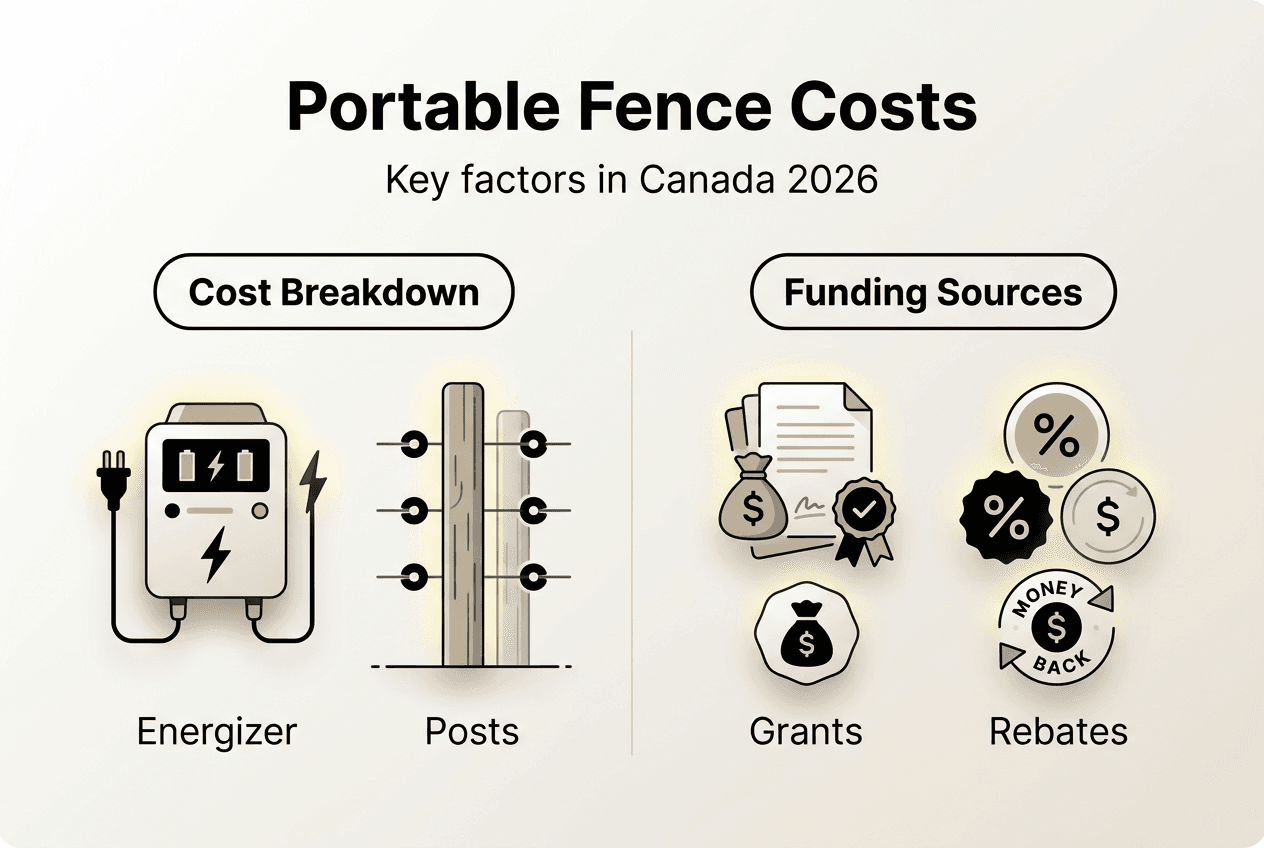
Hardware costs break down into distinct categories. Energizers represent the largest single expense at $150-500 depending on power output and solar capability. Posts and reels add $100-300 for enough materials to fence several paddocks. Wire or netting costs $50-150 per kilometer depending on conductor quality and strand count. Grounding supplies, insulators, gates, and testing equipment contribute another $100-200 to complete functional systems.
Installation labor stays manageable with portable systems compared to permanent fencing. Two people can install a complete portable paddock in 2-4 hours versus multiple days for conventional fence construction. This translates to $100-200 in labor costs if you’re hiring help, or simply an afternoon of your own time for DIY installation. The time savings multiply across rotational grazing seasons since moving portable fences takes 30-60 minutes versus hours of rebuilding permanent paddock divisions.
Maintenance expenses remain low throughout the system’s lifespan. Annual costs typically stay under $50-100 for replacement insulators, wire repairs, and battery replacements in non-solar units. Solar systems require minimal maintenance beyond occasional panel cleaning and battery replacement every 3-5 years at $50-100 per battery. Virtual fencing adds subscription fees of $5-15 per collar monthly for GPS service and software access, plus collar battery replacements every 2-3 years.
| System Type | Initial Cost | Annual Maintenance | Lifespan | Government Funding | Net 5-Year Cost |
|---|---|---|---|---|---|
| Basic battery fence (2 km) | $400 | $75 | 5-7 years | Not eligible | $775 |
| Solar electric fence (10 km) | $1,200 | $50 | 8-10 years | Up to 85% | $430 |
| Premium solar system (30 km) | $3,500 | $100 | 10-12 years | Up to 85% | $1,025 |
| Virtual fencing (50 head) | $8,500 | $3,600 | 5-8 years | Varies by program | $26,500 |
Government support dramatically improves portable fencing economics. Up to 85% funding covers solar-powered electric fencing systems through various federal and provincial agricultural programs. These rebates target environmental benefits like improved grazing management, reduced soil erosion, and enhanced wildlife habitat protection. Application processes vary by province but generally require project proposals demonstrating environmental outcomes alongside livestock management improvements.
Cost-saving strategies help stretch your fencing budget further:
- Start with one or two paddocks to test portable fencing before committing to whole-farm conversion
- Purchase quality energizers and reusable posts while accepting economy wire for initial trials
- Buy bulk wire and post packages when expanding systems to capture volume discounts
- Share equipment with neighbors for seasonal grazing needs rather than each buying complete systems
- Prioritize solar power in remote areas to avoid ongoing battery replacement costs
- Apply for government funding before purchasing to maximize rebate eligibility
- Consider leasing virtual fencing collars initially to evaluate effectiveness before buying
Explore portable fence farm solutions for more cost-effective implementation strategies.
Explore FenceFast solutions for portable fencing needs
FenceFast provides Canadian farmers with reliable portable fencing products designed specifically for agricultural livestock management. Our inventory includes solar-powered energizers, electric fence accessories, and specialized netting systems that perform consistently in Canadian weather conditions from coastal British Columbia to prairie Manitoba. Whether you’re managing cattle, sheep, goats, or mixed livestock operations, we stock the components you need to implement flexible grazing systems.

Our Patriot electric fence accessory kit delivers everything needed for basic portable paddock setup in one package. For larger containment areas or predator protection, the Patriot positive negative fence netting offers pre-assembled sections that install quickly without threading individual wire strands. Visit FenceFast to compare portable fencing options and find systems matched to your specific livestock management requirements.
Frequently asked questions
What are portable fence systems?
Portable fence systems are temporary, movable livestock containment solutions you can relocate across pastures without permanent installation. They typically use lightweight posts, electrified wire or netting, and battery or solar-powered energizers to create flexible paddock boundaries. These systems excel in rotational grazing operations where you need to shift cattle, sheep, or other livestock to fresh forage every few days without building fixed infrastructure.
How does solar power enhance portable fencing?
Solar power eliminates grid dependency by charging integrated batteries that maintain fence voltage in remote pastures beyond electrical service. Battery lasts approximately one week on cloudy days in quality solar energizers, ensuring continuous livestock containment even during extended overcast periods common in Canadian winters. The solar panels convert available sunlight into stored energy that powers the fence 24/7 without manual battery swapping or generator refueling.
What is virtual fencing and how effective is it?
Virtual fencing uses GPS-enabled collars that train livestock to respect invisible boundaries through audio warnings and mild electric corrections when animals approach designated limits. Research demonstrates over 99% containment success in Alberta trials with cow-calf pairs across varied terrain. You manage paddock boundaries remotely through smartphone apps, eliminating physical fence infrastructure while maintaining reliable livestock control.
Where can I find portable fencing accessories in Canada?
FenceFast offers comprehensive portable fencing supplies including the Patriot electric fence accessory kit for basic setups and Patriot positive negative fence netting for larger containment needs. We ship nationwide across Canada excluding PO boxes, delivering energizers, posts, wire, insulators, and testing equipment directly to your farm. Our product specialists provide guidance on system selection based on your specific livestock type, pasture size, and management goals.

