

Managing herds across sprawling Canadian countryside means adapting quickly to changing conditions and grazing needs. Portable electric fence systems offer a smart, flexible livestock control solution that can be swiftly moved and customized for cattle, horses, and other animals. These systems use visible synthetic cords with stainless steel wire and are powered by batteries, solar panels, or mains electricity, providing reliable containment wherever you need it. Find out how adaptable electric fencing can make animal management easier and safer on your rural property.
Table of Contents
- What Is A Portable Electric Fence System?
- Types And Power Sources Compared
- How Portable Fences Control Livestock
- Setup, Maintenance, And Compliance Rules
- Safety Risks And Frequent Mistakes
- Portable Fencing Vs. Permanent Alternatives
Key Takeaways
| Point | Details |
|---|---|
| Portable Electric Fences | Offer flexible solutions for livestock management, allowing farmers to quickly create and manage grazing boundaries. |
| Power Source Options | Include battery, solar, and mains electricity, each suited for different scenarios and environments. |
| Safety and Maintenance | Regular inspections and proper grounding are essential to prevent safety hazards and ensure optimal performance. |
| Comparison with Permanent Fencing | Portable fences provide lower initial costs and higher adaptability, while permanent fences offer durability and stability. |
What Is a Portable Electric Fence System?
A portable electric fence system is a flexible, temporary livestock management solution designed to provide safe and efficient animal control across various agricultural settings. These innovative fencing systems utilize a unique combination of lightweight materials and electrical technology to create movable boundary lines for livestock management.
Portable electric fences typically consist of several key components that work together to create an effective containment strategy:
- Electrical conductor: A synthetic cord or wire infused with conductive metal strands
- Energizer/charger: A power source that generates electrical pulses
- Grounding system: Metal rods that complete the electrical circuit
- Portable posts: Lightweight, easy-to-install supports for the fence
The core mechanism relies on delivering a short, intense electrical pulse along wire segments that deters animals from crossing boundaries. When an animal touches the wire, they complete an electrical circuit that delivers a sharp but safe shock, conditioning them to avoid the fence.

These systems are particularly valuable for Canadian farmers and ranchers who need adaptable livestock management solutions. Unlike traditional permanent fencing, portable electric fences can be quickly repositioned, allowing for dynamic grazing management, temporary pasture rotation, and rapid property boundary establishment.
Power sources for these systems vary, providing significant flexibility:
- Battery-powered units for remote locations
- Solar panel chargers for sustainable operation
- Mains electricity connections for stationary setups
Portable electric fences represent a modern, adaptable approach to livestock control that prioritizes both animal safety and farm efficiency.
Pro tip: When setting up a portable electric fence, always test the voltage and grounding to ensure consistent, safe performance across your livestock management area.
Types and Power Sources Compared
Portable electric fence systems offer Canadian farmers and ranchers multiple power configurations, each designed to meet specific agricultural needs and environmental conditions. Understanding the strengths and limitations of different power sources is crucial for selecting the most appropriate electric fencing solution.
The primary power sources for portable electric fences include:
- Battery-powered systems: Ideal for remote locations with limited electrical infrastructure
- Solar-powered units: Sustainable and low-maintenance options for outdoor settings
- Mains electricity connections: Consistent power for stationary or semi-permanent installations
Electric fence energizers operate by generating controlled electrical pulses across fence wires, with each power source offering unique advantages. Battery-powered units provide maximum portability, allowing farmers to quickly establish temporary grazing boundaries or create quick animal management zones.
Solar-powered electric fence chargers have gained significant popularity among Canadian agricultural producers. These systems leverage photovoltaic technology to generate consistent electrical current, making them particularly effective in rural settings with abundant sunlight. The key benefits include:
- Zero ongoing electricity costs
- Environmentally friendly operation
- Reliable performance in remote locations
- Minimal maintenance requirements
Mains electricity connections remain valuable for permanent or semi-permanent fence installations, providing uninterrupted power and consistent voltage levels. These systems are particularly suitable for established pastures, livestock paddocks, and areas with reliable electrical infrastructure.
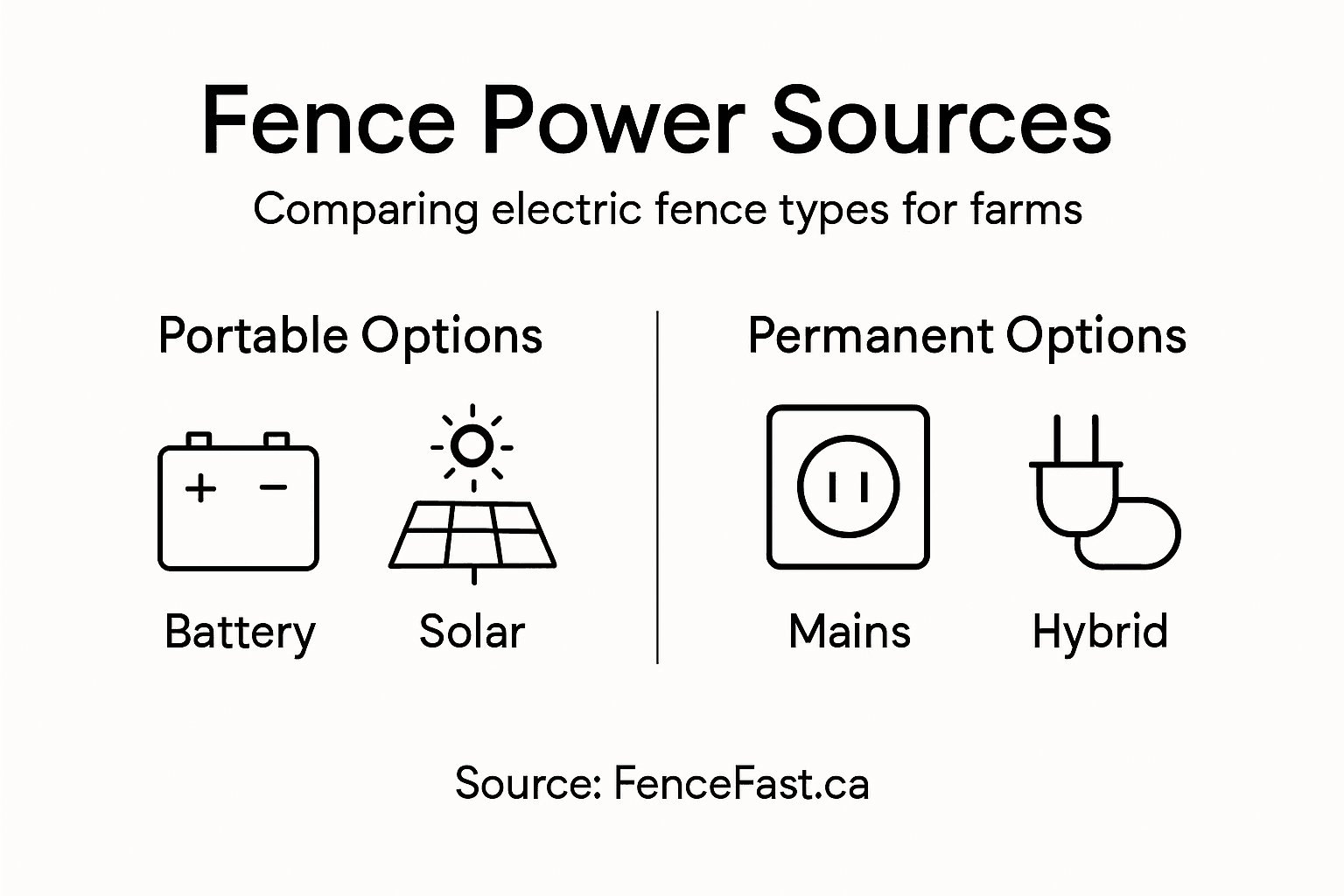
Here’s a concise overview of electric fence power sources and their suitability:
| Power Source | Ideal Use Case | Cost & Maintenance | Reliability |
|---|---|---|---|
| Battery-powered | Remote, temporary pastures | Moderate, frequent checks | Portable but may drain quickly |
| Solar-powered | Outdoor, off-grid locations | Low, minimal maintenance | Reliable with sunlight |
| Mains electricity | Stationary, permanent fences | Low, stable ongoing cost | Highly consistent |
Modern portable electric fence systems offer unprecedented flexibility, allowing farmers to adapt their livestock management strategies quickly and efficiently.
Pro tip: Consider your specific terrain, livestock type, and power availability when selecting an electric fence power source to ensure optimal performance and reliability.
How Portable Fences Control Livestock
Portable electric fences are sophisticated livestock management tools that create dynamic, flexible boundaries using electrical deterrence and behavioral conditioning. These systems leverage a precise combination of psychological and physical mechanisms to guide animal movement and containment without requiring permanent infrastructure.
The primary control mechanisms include:
- Electrical shock: A brief, uncomfortable pulse that discourages boundary crossing
- Psychological conditioning: Training animals to respect invisible limits
- Visual markers: Lightweight posts and visible wires that signal boundaries
- Consistent pulse patterns: Predictable electrical signals that animals learn to avoid
Virtual fencing technologies are revolutionizing how farmers manage livestock movement. Modern systems use GPS-enabled collars that provide audio warnings and mild electrical pulses when animals approach preset boundaries, creating an intelligent and adaptive containment strategy.
The electrical component works through a carefully calibrated shock system. When an animal contacts the wire, they receive a short, sharp pulse that is uncomfortable but not harmful. This creates a powerful learned response where livestock quickly associate the fence line with a negative sensation, effectively training them to avoid crossing boundaries.
Advanced portable electric fencing offers several strategic advantages for Canadian farmers:
- Rapid deployment in multiple pasture locations
- Minimal infrastructure investment
- Easy reconfiguration for rotational grazing
- Reduced physical labor for fence maintenance
Portable electric fences transform livestock management from a rigid, static approach to a dynamic, responsive system that adapts to changing agricultural needs.
Pro tip: Regularly inspect and test your portable electric fence’s voltage and grounding to maintain consistent animal control and prevent unexpected livestock movement.
Setup, Maintenance, and Compliance Rules
Portable electric fences require meticulous planning and implementation to ensure effective livestock management and regulatory compliance across Canadian agricultural settings. Successful deployment involves understanding complex technical requirements and local regulatory standards that govern electric fencing installations.
Key setup considerations include:
- Terrain assessment: Evaluating ground conditions and landscape features
- Power source selection: Matching energizer capabilities to fence length
- Voltage requirements: Ensuring consistent electrical output
- Livestock-specific design: Adapting fence height and configuration
Electric fencing installation demands precision in multiple technical domains. Farmers must carefully select energizers compatible with their specific livestock type, fence length, and environmental conditions to maintain optimal performance.
Proper grounding represents the most critical technical aspect of electric fence installation. Multiple ground rods are typically required to create an effective electrical circuit, with recommended spacing and depth varying based on soil conductivity and fence length. Professional installers suggest using three 6-foot grounding rods spaced at least 10 feet apart to ensure consistent electrical transmission.
Compliance and maintenance protocols demand regular system checks:
- Monthly voltage testing
- Vegetation management around fence lines
- Inspection of wire tension and connections
- Checking for potential electrical shorts
- Verifying energizer functionality
Effective portable electric fencing is not just about installation, but consistent maintenance and adherence to regulatory standards.
Pro tip: Invest in a reliable voltage tester and perform weekly checks to maintain your portable electric fence’s performance and prevent unexpected livestock escape scenarios.
Safety Risks and Frequent Mistakes
Portable electric fences involve critical safety considerations that Canadian livestock owners must carefully understand to prevent potential hazards for animals, wildlife, and human operators. Overlooking fundamental safety protocols can lead to unintended consequences and potential legal liabilities.
Common safety risks associated with electric fencing include:
- Electric shock: Potential injury from improper grounding
- Wildlife entanglement: Risks to non-target animal populations
- Structural failures: Compromised fence integrity
- Voltage inconsistencies: Unpredictable electrical performance
Electric fence safety risks demand comprehensive understanding and proactive management. Farmers must recognize that these systems are not simply installed and forgotten, but require ongoing monitoring and maintenance to ensure safe operation.
Wildlife interaction presents a significant concern for electric fence installations. Improperly designed fences can pose serious risks to small animals, particularly when wire heights are not carefully calculated. Research indicates that fence wires positioned less than 7 cm above ground significantly increase the potential for unintended wildlife mortality.
Frequent mistakes that compromise electric fence safety include:
- Inadequate grounding systems
- Using low-quality energizer units
- Failing to post appropriate warning signage
- Neglecting regular voltage and tension inspections
- Improper wire spacing and height configurations
Safety in electric fencing is not an afterthought, but a fundamental design requirement that protects both livestock and surrounding ecosystems.
Pro tip: Conduct quarterly comprehensive safety audits of your electric fence system, focusing on grounding effectiveness, voltage consistency, and potential wildlife interaction points.
Portable Fencing vs. Permanent Alternatives
Livestock management strategies in Canadian agriculture demand flexible solutions that balance cost-effectiveness, adaptability, and long-term infrastructure needs. Portable and permanent fencing represent two distinct approaches, each offering unique advantages for farmers seeking optimal livestock control.
Key differences between portable and permanent fencing include:
- Initial investment: Portable systems require lower upfront costs
- Flexibility: Portable fences allow rapid reconfiguration
- Durability: Permanent fences provide long-term boundary stability
- Maintenance requirements: Portable systems demand more frequent adjustments
Paddock design strategies reveal that combining both fencing approaches can maximize agricultural productivity. Farmers can leverage portable fencing’s adaptability while maintaining core permanent boundary infrastructure.
Portable fencing offers significant advantages for dynamic grazing management. These systems enable farmers to quickly subdivide pastures, implement rotational grazing techniques, and optimize land utilization without extensive permanent infrastructure investments. The ability to rapidly reconfigure livestock boundaries allows for more precise pasture management and improved forage utilization.
Comparative advantages of each fencing approach include:
This table highlights key differences between portable and permanent fencing for livestock management:
| Factor | Portable Fencing | Permanent Fencing |
|---|---|---|
| Installation | Quick and easy setup | Labor-intensive initial build |
| Adaptability | Reconfigures as needed | Fixed, little flexibility |
| Upfront Cost | Low to moderate | High investment required |
| Longevity | Suits short-term use | Designed for decades of use |
-
Permanent Fencing Benefits:
- Consistent long-term boundary definition
- Reduced annual installation labor
- Higher structural integrity
-
Portable Fencing Benefits:
- Lower initial capital requirements
- Enhanced grazing management flexibility
- Easy adaptation to changing agricultural needs
Successful livestock management requires understanding the strategic balance between portable and permanent fencing solutions.
Pro tip: Develop a hybrid fencing strategy that combines permanent perimeter boundaries with flexible internal portable fencing to maximize agricultural efficiency.
Take Control of Your Livestock with Portable Electric Fencing Solutions
Managing livestock with portable electric fences requires reliable, efficient equipment designed to adapt to your farm’s unique challenges. Whether you face frequent pasture rotations, need quick setup in remote locations, or want to maximize grazing management flexibility, having the right tools can transform your livestock control strategy. At FenceFast.ca, we understand these needs and offer a comprehensive range of electric fencing systems including energizers, solar panels, grounding equipment, and durable fencing components tailored for Canadian farmers and ranchers.

Explore our carefully selected products and expert guidance at FenceFast.ca to build a portable electric fence system that delivers consistent voltage, easy mobility, and safety compliance. Don’t wait until your livestock strays or your fencing fails. Visit us now to access trusted supplies, take advantage of design consulting, and get nationwide shipping directly supporting your flexible livestock management goals.
Frequently Asked Questions
What components make up a portable electric fence system?
A portable electric fence system typically consists of an electrical conductor, an energizer or charger, a grounding system, and portable posts. These components work together to create an effective containment strategy for livestock.
How do portable electric fences control livestock?
Portable electric fences control livestock by delivering a brief electrical shock when an animal touches the wire, thus discouraging them from crossing boundaries. They also utilize psychological conditioning, visual markers, and consistent pulse patterns to help manage animal movement.
What are the advantages of using solar-powered electric fence systems?
Solar-powered electric fence systems offer several advantages, including low maintenance, zero ongoing electricity costs, and reliable performance in remote locations with abundant sunlight, making them an environmentally friendly option.
How do I maintain my portable electric fence system?
To maintain your portable electric fence system, regularly test the voltage and grounding, manage vegetation around the fence line, inspect wire tension and connections, and ensure proper function of the energizer. Monthly system checks are recommended to prevent unexpected livestock escapes.

