

TL;DR:
- Rotational grazing improves land health and forage yields by allowing pastures to recover before re-grazing. Adaptive management based on plant growth, rather than a fixed schedule, is crucial in Canada’s variable climate. Innovations like multi-species grazing and portable fencing enhance productivity and pasture resilience, especially when supported by programs like OFCAF.
Continuous grazing has been the default for generations of Canadian farmers, but it quietly drains your pastures year after year while you assume things are holding steady. The truth is, innovative rotational grazing strategies are now backed by solid Canadian research, proven funding programs, and better fencing technology than ever before. Whether you’re running cow-calf pairs on the Prairies, managing mixed species in BC, or trying to stretch your season in Ontario, this guide walks you through the core techniques, seasonal adjustments, and practical steps to get real gains from your land.
Table of Contents
- How rotational grazing works and why it matters
- Key rotational grazing strategies for Canadian farms
- Innovations: Multi-species, portable fencing, and smart resource use
- Critical adjustments for tough seasons and maximizing gains
- Funding, fencing, and practical steps for your plan
- Rotational grazing success: What most guides overlook
- Ready to put rotational grazing to work?
- Frequently asked questions
Key Takeaways
| Point | Details |
|---|---|
| Adaptation is key | Flexible rotation timing and intensity improves results in variable Canadian climates. |
| Boost stocking rates | Portable fencing and rotational systems often increase carrying capacity by at least 10% in year one. |
| Leverage funding | OFCAF covers most fencing and water setup costs, easing the transition to advanced grazing. |
| Multi-species benefits | Integrated sheep, goats, and cattle help control parasites and graze land more uniformly. |
| Prioritize soil health | Practices like bale grazing and leaving adequate regrowth drive long-term productivity. |
How rotational grazing works and why it matters
At its core, rotational grazing means dividing your pasture into paddocks and moving livestock through them on a planned schedule so each area gets a full recovery period before animals return. Continuous grazing, by contrast, leaves livestock on the same land season after season, which selectively removes the most palatable plants, compacts soil, and eventually degrades the entire pasture stand. The difference in long-term land health is dramatic.
The main benefits of rotational grazing are well documented:
- Land recovery: Resting paddocks allows grasses to rebuild root reserves, which improves drought resilience and species diversity over time.
- Even livestock distribution: Animals graze more uniformly across paddocks instead of overusing areas near water or shade.
- Improved forage yield: Properly timed rest periods increase total dry matter production per acre compared to continuous systems.
- Soil structure: Reduced compaction and improved organic matter accumulation happens naturally when animals are moved regularly.
The challenge for Canadian farmers is that fixed rotation schedules often fail because our weather is wildly variable. A 30-day rest period that works beautifully in a wet June can severely overgraze a paddock in a dry August. That’s where rotational grazing basics and adaptive management come in. Adaptive Managed Intensive Grazing (MIG) responds to actual plant growth conditions rather than the calendar, and as research confirms, adaptive MIG is recommended over fixed schedules to avoid overgrazing during dry periods across BC and Prairie regions.
“The goal isn’t to follow a rigid schedule. It’s to read your pasture and move your animals at the right moment for the plant, not for your convenience.”
This mindset shift from calendar-based to plant-based decision-making is the single biggest improvement most Canadian ranchers can make right now, regardless of which specific strategy they adopt.
Key rotational grazing strategies for Canadian farms
There’s no single formula that fits every Canadian operation. The best approach depends on your forage species, climate zone, stocking density, and infrastructure. Here are the main strategies worth knowing.
Adaptive Managed Intensive Grazing (MIG) is the most flexible and widely recommended system for Canada. You monitor plant height and growth stage, then move animals when forage reaches the ideal grazing stage and before it gets grazed below the recovery threshold. It requires more management attention but delivers better results in variable weather years.
The prairie “sweet spot” approach focuses on grazing at the late vegetative stage, typically 15-20% reproductive, with about 20-40% forage removal, three-day graze periods in many prairie latitudes, and rest periods of 42-55 days adjusted for weather conditions. This method protects root carbohydrate reserves while still achieving meaningful forage utilization.
The “take half, leave half” rule is the simplest guide for any grazing system. You graze approximately 50% of the available forage and leave the rest as residual for regrowth. Research confirms that for ryegrass-based pastures, a post-graze residual of 1,500-1,700 kg DM/ha supports strong regrowth and avoids overgrazing stress.
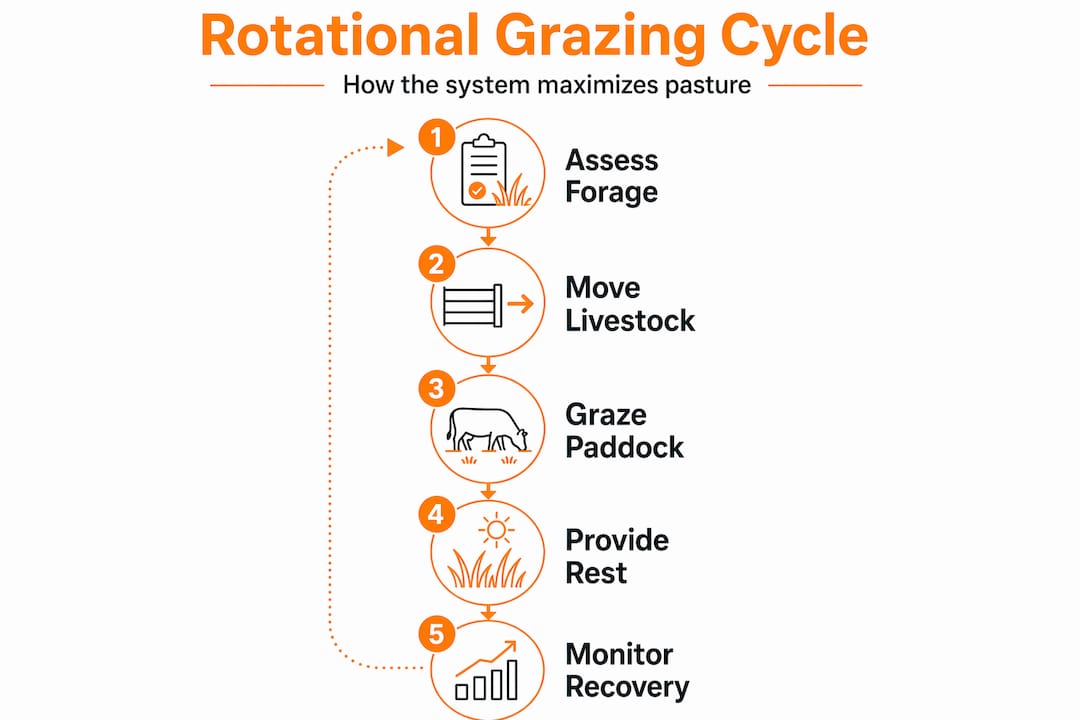
Here’s how these strategies compare at a glance:
| Strategy | Best for | Graze period | Rest period | Key parameter |
|---|---|---|---|---|
| Adaptive MIG | Variable prairie/BC climates | 1-5 days | 30-60 days (weather-adjusted) | Plant growth stage |
| Prairie sweet spot | Mixed grass prairies | 3 days | 42-55 days | 15-20% reproductive stage |
| Take half, leave half | All systems, beginner-friendly | Varies | Until recovery threshold | 50% forage removal |
To get your rotation working effectively, follow this implementation sequence:
- Map your total available pasture area and divide into a minimum of 4-6 paddocks (more paddocks give better flexibility).
- Establish your target move trigger based on plant height or growth stage for your main forage species.
- Set a realistic stocking density for each paddock based on current forage mass, not historical averages.
- Monitor paddocks weekly, adjusting rest periods based on observed regrowth, not the clock.
- Keep a simple grazing log noting entry date, exit date, forage height at entry and exit, and any weather anomalies.
- Review at the end of each season and adjust paddock numbers or rotation length for the following year.
Pro Tip: When a drought hits, extend your rest periods before you reduce grazing intensity. Giving overstressed plants more recovery time prevents long-term stand damage that takes years to reverse.
Check out rotational grazing solutions specifically designed for Canadian conditions to see how fencing layout choices connect directly with rotation effectiveness.
Innovations: Multi-species, portable fencing, and smart resource use
Once your core rotation schedule is running, layering in additional innovations can meaningfully boost both productivity and pasture health. Two of the most impactful additions for Canadian ranchers are multi-species grazing and strategic portable fencing deployment.
Multi-species grazing means running cattle alongside sheep, goats, or both in the same paddock or in sequence. Each species prefers different plant types and grazing heights. Cattle prefer tall, coarse grasses. Sheep target medium grasses and forbs. Goats browse shrubs and woody vegetation. Together, they create more uniform utilization across the entire paddock. Beyond forage use, multi-species grazing significantly enhances parasite control because gut parasites are generally host-specific. Larvae consumed by the wrong species don’t survive, breaking the parasite cycle that plagues single-species operations. A sheep-to-cow ratio of roughly 1:1 with daily moves is a practical starting framework for most Canadian farms.
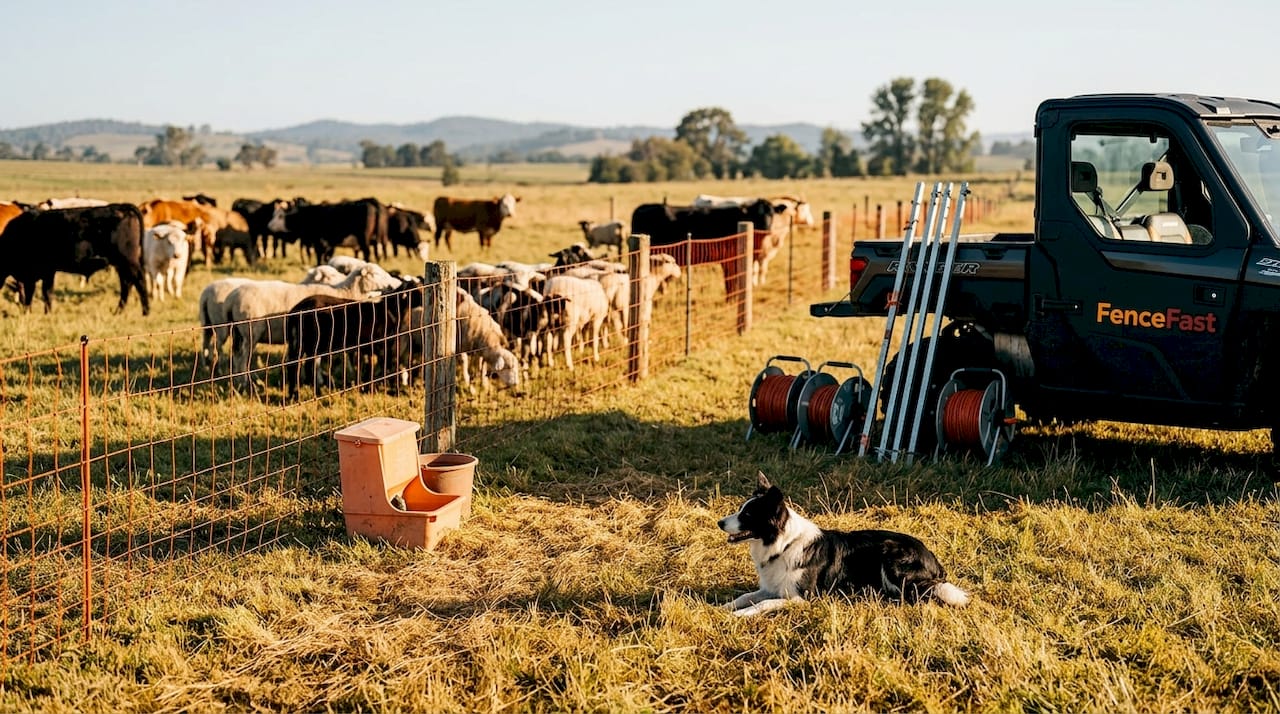
Portable fencing is the other game-changer. It lets you subdivide large permanent paddocks on the fly, tighten up grazing pressure in specific areas, and protect recovering sections without the capital cost of permanent infrastructure. The productivity gains are significant. Stocking rate improvements with rotational grazing and portable fencing range from 5-60%, with a typical first-year gain of around 10% for Canadian cow-calf operations, and higher gains on degraded pastures where there’s more room for recovery.
Here’s a realistic look at what those gains can mean in practice:
| Scenario | Before rotation | After 1 year (portable fencing) | After 3 years |
|---|---|---|---|
| Average productive pasture | Baseline stocking | +10% stocking rate | +20-30% stocking rate |
| Degraded/overgrazed pasture | Baseline stocking | +15-25% stocking rate | +40-60% stocking rate |
| OFCAF-funded infrastructure | Full capital cost | 70-85% cost offset | Full payback accelerated |
Key advantages of portable fencing worth highlighting:
- Speed of deployment: Modern step-in posts and reeled poly wire can subdivide a paddock in under 30 minutes.
- Flexibility: You can adjust paddock size based on herd size or forage availability without permanent commitment.
- Cost efficiency: Significantly lower upfront cost than permanent fencing, especially when testing new rotation layouts.
- Pairing with water systems: Temporary water lines connected to portable troughs keep animals distributed and eliminate the grazing shadow around permanent water points.
Explore the full range of portable fencing advantages for Canadian farms, and consider moveable fence ideas if you’re working with smaller land parcels or irregular pasture shapes.
Pro Tip: Rotate your bale grazing sites each winter rather than feeding from the same spots. The concentrated organic matter, nutrients, and soil disturbance from bale grazing can build significant soil organic matter over several years, reducing your need for purchased fertilizer and improving water retention across the whole paddock.
Critical adjustments for tough seasons and maximizing gains
The best rotational grazing plan in the world will struggle if you don’t adjust for the realities of Canadian weather. Year-to-year variability demands a flexible mindset and specific tactics for drought years, wet springs, and recovering pastures.
Here are the most important seasonal adjustments:
- Drought conditions: Extend rest periods significantly and shorten actual graze time per paddock. Stressed plants need more recovery time, and removing too much leaf area in dry conditions can kill root systems entirely.
- Wet springs: Speed up your rotation. Faster paddock moves prevent poaching (soil compaction from hooves in saturated conditions) and allow plants to get ahead of livestock demand when growth is rapid.
- First-year implementation on continuously grazed land: Go slow. Pastures that have been continuously grazed for years have depleted root reserves and weak stand composition. Intensive rotations in year one can stress these pastures further rather than helping them recover. Use conservative stocking in early years and increase gradually as stands improve.
- Late-season grazing: Allow higher residual height in the last grazing of the season so perennial grasses can build root carbohydrate reserves before dormancy. This pays dividends in spring green-up the following year.
- Heavily used sacrifice areas: Identify one or two areas near water or handling facilities as designated sacrifice zones and manage them separately from your rotation. This protects your productive paddocks from compaction around high-traffic points.
Review your portable fence systems options to ensure you have the flexibility to make these seasonal adjustments without being locked into a rigid infrastructure layout.
Pro Tip: Track forage height and soil health metrics, not just grazing days. A paddock that looks recovered by the calendar might still have shallow root depth or low organic matter. Simple tools like a grazing stick and occasional soil probes give you far better data than dates alone.
Funding, fencing, and practical steps for your plan
Here’s the part that makes rotational grazing systems genuinely accessible for most Canadian operations right now. The On-Farm Climate Action Fund (OFCAF) covers 70-85% of eligible fencing and water system costs, which is a transformational level of support for infrastructure that would otherwise be a major capital barrier. That means a paddock subdivision project that costs $20,000 in materials could end up costing you $3,000 to $6,000 out of pocket.
Funding highlight: OFCAF covers 70-85% of rotational grazing fencing and water infrastructure costs for eligible Canadian farmers.
Follow these practical steps to build and execute your rotational grazing plan:
- Assess your baseline: Walk every pasture and record current forage species, density, soil compaction, and drainage patterns.
- Sketch your paddock layout: Use aerial imagery or a simple sketch to plan paddock divisions, water access points, and lane systems.
- Calculate your stocking rate: Use current forage mass estimates to set conservative initial stocking densities for each paddock.
- Apply for OFCAF funding: Contact your provincial program delivery organization before purchasing materials. Funding applications must typically be approved before you start spending.
- Choose your fencing approach: Decide which sections benefit from permanent fencing and where portable systems give you more flexibility and lower cost.
- Install water infrastructure: Gravity-fed or solar-powered watering systems in each paddock eliminate the need for animals to travel back to centralized water, improving distribution dramatically.
- Start your rotation conservatively: Begin with more paddocks and fewer animals per paddock than you think you need. It’s much easier to intensify once pastures are responding than to recover from early overgrazing.
- Monitor and record: Keep a simple grazing log every time you move animals. After one full season, you’ll have data to make smarter decisions the following year.
Explore the full portable fencing guide for detailed product comparisons and layout recommendations suited to Canadian operations of every size.
Rotational grazing success: What most guides overlook
After years of working with Canadian ranchers across every major agricultural region, one thing becomes clear: the guides that hand you a formula and send you home are the ones that set farmers up to fail. Real success with rotational grazing comes from a willingness to read your land daily, not weekly.
The biggest trap is trusting the math too completely. Yes, the formulas for graze days, rest periods, and forage removal rates are valuable starting points. But a producer who watches their paddocks every morning and moves animals when the plants tell them to will consistently outperform one who follows a rigid schedule to the letter. It sounds old-fashioned, but “farming with your eyes” is still the most reliable monitoring tool available.
The other underestimated factor is soil organic matter. Most grazing guides talk about forage yield and stocking rates, but each 1% increase in soil organic matter adds approximately 0.17 inches per foot of additional water-holding capacity in your soil profile. That translates directly to drought resilience. Bale grazing rotations, compost applications, and longer rest periods that allow root mass to build are the practices that compound over decades. They don’t show up dramatically in year one, but by year five or six, the difference in your pastures is undeniable.
Many producers also underestimate the value of virtual fencing insights for monitoring and managing livestock location within rotational systems. Technology like GPS-enabled collars can show you exactly where your animals are spending time, which reveals pressure points and recovery bottlenecks your eyes might miss on a busy week.
The farms that win at rotational grazing long-term are not the ones with the most sophisticated systems. They’re the ones that stay curious, adjust without ego, and treat every season as new data rather than confirmation of what they already know.
Ready to put rotational grazing to work?
If you’re ready to build out your system or sharpen what’s already running, specialized Canadian fencing and livestock management solutions are available to support every stage of your plan.
FenceFast carries everything from portable poly wire systems and step-in posts to permanent electric fencing infrastructure, solar-powered energizers, and Gallagher eShepherd virtual fencing technology designed specifically for rotational grazing operations. Whether you need to subdivide a paddock this week or build out a full multi-paddock system with funding support, the team can help you navigate product choices, OFCAF funding eligibility, and installation planning. Learn more about rotational systems and get guidance tailored to your operation’s specific goals, land type, and budget.
Frequently asked questions
What is the best rotational grazing strategy for drought-prone areas in Canada?
Adaptive managed intensive grazing (MIG) with extended rest periods and shortened graze days is recommended, since adaptive MIG outperforms fixed schedules during dry periods across BC and Prairie regions by responding to actual plant conditions rather than the calendar.
How much can I increase my stocking rate by switching to rotational grazing?
Stocking rates can improve by 5-60%, with typical first-year gains around 10% for Canadian cow-calf operations using portable fencing, and potentially much higher on degraded pastures with more recovery potential.
Can I get funding for fencing and water systems for rotational grazing?
Yes. The On-Farm Climate Action Fund (OFCAF) covers 70-85% of eligible fencing and water infrastructure costs, making rotational system setup affordable for most Canadian farming operations.
What is the “take half, leave half” rule in grazing?
It means you graze roughly 50% of available forage and leave the rest as residual so plants can recover. For ryegrass-based pastures, leaving 1,500-1,700 kg DM/ha post-graze is the practical target to support strong regrowth.
How does multi-species grazing help my pastures?
Running cattle, sheep, and goats together promotes uniform grazing and parasite control because each species targets different plant types and host-specific parasites don’t survive when consumed by the wrong animal.

