

TL;DR:
- Solar-powered fencing is reliable and cost-effective, especially suited for remote farms.
- Proper sizing, grounding, and maintenance are key to system effectiveness in Canadian conditions.
- Despite higher upfront costs, solar fencing offers significant long-term savings and off-grid flexibility.
Many Canadian farmers assume solar-powered fencing is expensive, complicated, or unreliable in cold weather. The reality is almost the opposite. These systems are engineered specifically for remote, off-grid conditions, and a well-sized setup can pay for itself in as little as two years. Whether you’re managing cattle across a back quarter or rotating sheep through pastures without power access, solar-powered electric fences convert sunlight into DC electricity stored in deep-cycle batteries, giving you consistent, effective animal control without a hydro bill. This guide breaks down how the technology works, what components you actually need, and how to avoid the mistakes that trip up even experienced operators.
Table of Contents
- How solar powered fences work
- Key components and choosing the right system
- Installation, maintenance, and troubleshooting
- Cost, ROI, and comparing solar to traditional and virtual fencing
- What most Canadian farmers miss about solar fencing
- Ready to upgrade your farm with solar fencing?
- Frequently asked questions
Key Takeaways
| Point | Details |
|---|---|
| Simple design, real savings | Solar-powered fences deliver quick ROI and reliable livestock control for Canadian farms. |
| Sizing and maintenance matter | Most failures result from undersized panels or poor grounding, not from technology flaws. |
| Outperforms alternatives | Compared to grid and virtual options, solar fences offer lower long-term costs and off-grid flexibility. |
| Winter reliability needs extra planning | Canadian farms should oversize systems by 20–30% for reliable performance during dark winter months. |
How solar powered fences work
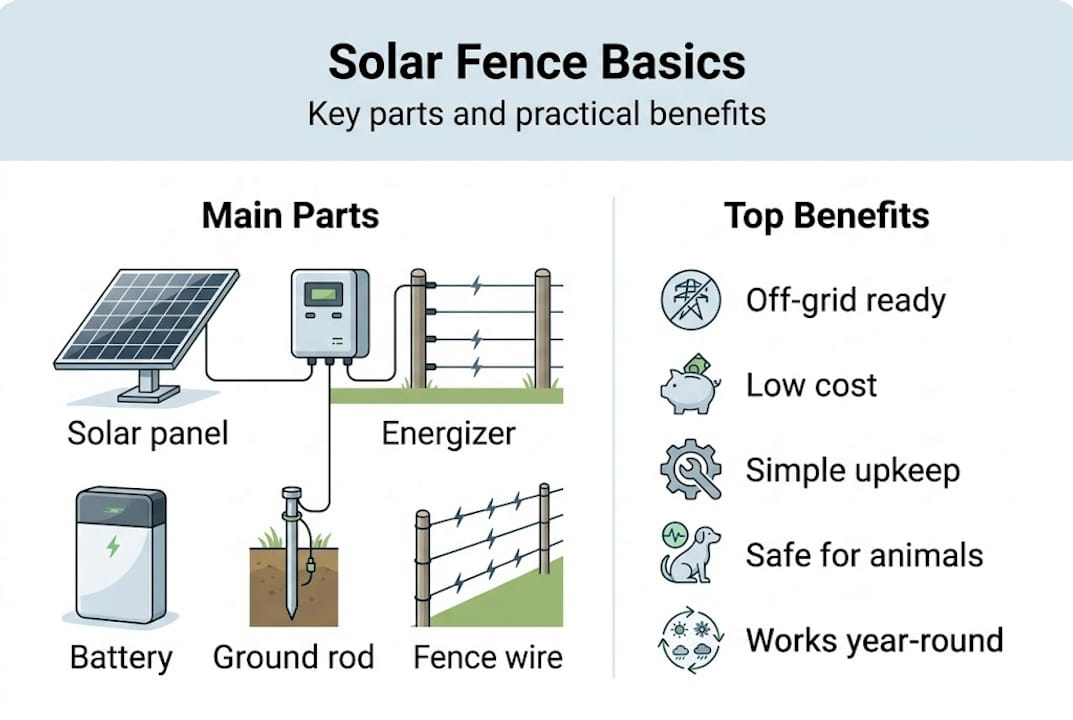
Understanding the energy flow is the fastest way to stop being intimidated by solar fencing. The system has five core parts, and each one has a clear job.
Solar-powered electric fences use photovoltaic panels to convert sunlight into DC electricity, which is stored in deep-cycle batteries via charge controllers, then converted by the energizer into high-voltage pulses delivered through fence wires. When an animal touches the wire and the ground simultaneously, it completes the circuit and receives a short, sharp pulse. That pulse is what changes behavior. It’s not the voltage that matters most, it’s the consistency.
Core components at a glance:
- Solar panel: Captures sunlight and generates DC power (typically 10 to 40 watts)
- Charge controller: Regulates power flow to prevent battery overcharge or deep discharge
- Deep-cycle battery: Stores energy for nighttime and overcast days
- Low-impedance energizer: Converts stored battery power into high-voltage, low-current pulses
- Ground rods: Complete the electrical circuit through the soil
- Fence wire: Delivers the pulse to the animal
The pulse itself runs between 5,000 and 10,000 volts, but the current is extremely low, measured in milliamps. That combination is what makes it safe for animals and people while still being effective. Think of it like a static shock that’s impossible to ignore.
| Component | Typical spec | Function |
|---|---|---|
| Solar panel | 10 to 40W | Generates DC power from sunlight |
| Deep-cycle battery | 7 to 100Ah | Stores energy for nights and cloudy days |
| Charge controller | 5 to 20A | Prevents overcharge and discharge |
| Energizer | 0.5 to 10 joules | Produces high-voltage pulses |
| Ground rods | 3 to 6 feet steel | Completes the circuit through soil |
For Canadian operations, battery backup is not optional. Cloudy stretches of 5 to 10 days are common in many provinces, especially in fall and early spring. A properly sized battery bank keeps your fence live even when the sun doesn’t show up for work.
Pro Tip: Mount your panel on an adjustable bracket so you can change the tilt angle seasonally. In January, a steeper angle captures more of the low winter sun and keeps your battery topped up.
Key components and choosing the right system
Now that the process makes sense, it’s time to look at the pieces that make up a reliable solar fence. Choosing the wrong size is the single most common and most expensive mistake farmers make.
Key components include a solar panel ranging from 10 to 40 watts or more, a deep-cycle battery with a 3 to 5 year lifespan and 7 to 21 days of autonomy, a charge controller, a low-impedance energizer, and properly driven ground rods. For Canadian winters, you need to oversize your panel and battery capacity by 20 to 30 percent above what the summer math suggests. This is not padding, it’s engineering reality.
Here’s how to match your system to your operation:
- Cattle on large parcels: Use a 30 to 40W panel with a high-joule energizer (2 joules or more). Cattle are tough to deter, so voltage must stay above 4,000V consistently.
- Sheep and goats: Require more fence lines and tighter wire spacing. A 20W panel with a mid-range energizer usually covers up to 5km of fence.
- Wildlife control (deer, bear): Needs a reliable, high-voltage pulse. A 20 to 30W panel with a 1 to 2 joule energizer handles most perimeter situations.
- Rotational grazing setups: Portable, lightweight systems with 10 to 20W panels work well for temporary paddocks.
| Livestock type | Panel size | Energizer output | Fence length |
|---|---|---|---|
| Cattle | 30 to 40W | 2 to 5 joules | Up to 10km |
| Sheep or goats | 20W | 1 to 2 joules | Up to 5km |
| Wildlife control | 20 to 30W | 1 to 2 joules | Up to 8km |
| Poultry or pigs | 10 to 15W | 0.5 to 1 joule | Up to 2km |
For charger setup details specific to your operation, it helps to calculate your total fence kilometers first, then work backward to energizer joule output, battery size, and panel wattage. Battery life averages 3 to 5 years with proper maintenance, and quality batteries provide up to 21 days of autonomy without solar input. That’s a significant buffer for Canadian winters.
For farmers focused on land stewardship, sustainable fencing practices also align well with solar systems since they eliminate diesel generator use and reduce your carbon footprint without sacrificing performance.
Installation, maintenance, and troubleshooting
With your chosen components in hand, let’s set up your fence and keep it running strong year-round. Installation is straightforward when you follow the right sequence.
Step-by-step installation:
- Choose a south-facing location for your panel with no shading from trees or structures
- Mount the panel at a 45-degree angle to maximize year-round solar capture
- Drive ground rods at least 3 feet deep, spacing them 10 feet apart for a minimum of 3 rods
- Connect the charge controller between the panel and battery, then connect the energizer
- Run fence wire at the correct height for your livestock species
- Test soil resistance (target below 500 ohms) and fence voltage (minimum 4,000V for livestock)
The Canadian installation guide recommends testing your grounding resistance before you ever run a pulse. Poor grounding is invisible until your animals start walking through the fence.
“Installation requires a south-facing panel at 45 degrees, clear vegetation, proper grounding with resistance below 500 ohms, and tested fence voltage of 4,000 to 6,000V minimum for livestock. Maintenance means cleaning panels, checking connections, testing voltage every six months, and replacing the battery every 3 to 5 years.” Solar-powered electric fence guide for Canadian farmers 2026
Routine maintenance checklist:
- Clean panel surface monthly, especially after dusty summers or icy winters
- Check all wire connections and insulators every spring and fall
- Test fence voltage with a digital voltmeter every six months
- Trim vegetation under and around fence wires regularly
- Inspect battery terminals for corrosion and clean as needed
Poor grounding and vegetation contact cause roughly 30 percent of all solar fence failures, and both are completely preventable. Lightning diverters are also worth installing in storm-prone regions to protect your energizer. For additional electric fence safety tips covering signage, wire height, and regulatory requirements, make sure you review provincial guidelines before commissioning your system.
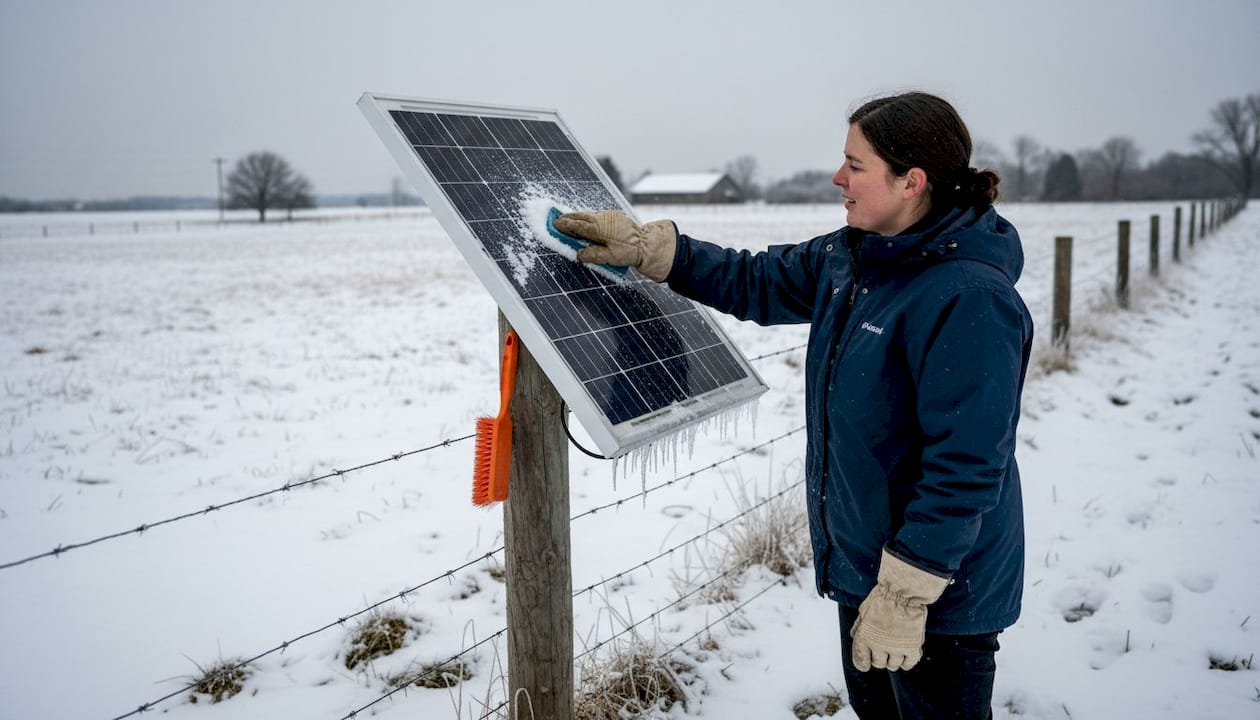
Pro Tip: In winter, check your panel for snow accumulation after every major storm. Even a thin layer of snow can cut output by 50 percent or more.
Cost, ROI, and comparing solar to traditional and virtual fencing
With your fence set up, it’s important to understand the real cost, payback, and how these systems stack up to other options. The numbers are more favorable than most people expect.
A complete solar fence system for a Canadian farm typically runs between $800 and $2,500 depending on panel size, energizer output, and battery capacity. Gallagher models, for example, power 1 to 10km of fence and retail between $200 and $600 for the energizer unit alone. Total system ROI averages 2 to 3 years through energy savings, with long-term savings of up to 70 percent compared to grid-powered systems.
| Fencing type | Upfront cost | Operating cost | Off-grid capable | Reliability |
|---|---|---|---|---|
| Solar electric | $800 to $2,500 | Very low | Yes | High |
| Grid-powered electric | $400 to $1,200 | Moderate (hydro) | No | High |
| Virtual fencing | $3,000 to $6,000+ | High (per animal) | Yes | Moderate |
Solar versus traditional fencing comes down to this: higher upfront cost, but dramatically lower operating costs and complete off-grid flexibility. Grid-powered systems are cheaper to buy but require trenching, wiring, and ongoing hydro costs. Virtual fencing uses GPS collars to manage livestock movement without physical barriers, which sounds appealing but carries a higher per-head cost and depends on technology that can fail in remote areas.
Where solar fencing wins outright:
- Remote pastures with no grid access
- Rotational grazing systems that move frequently
- Operations looking to reduce energy costs over a 5 to 10 year horizon
- Farms pursuing sustainability certifications or government incentive programs
For a full solar fencing cost breakdown and to explore solar livestock fencing solutions matched to your operation size, it pays to do the math before you buy.
What most Canadian farmers miss about solar fencing
Here’s what most farmers and suppliers won’t tell you about real-world solar fencing. The technology itself almost never fails. What fails is the implementation.
After seeing hundreds of setups across Canadian farms, the two problems that show up again and again are undersized systems and poor grounding. These are not beginner mistakes. Experienced operators make them too, especially when they’re scaling up from a small test paddock to a full perimeter fence. A system that worked fine on 2km suddenly struggles on 8km, and the voltage drops below the threshold that actually deters cattle.
Voltage above 4kV is essential, and poor grounding is the most common reason systems fall short of that number. In dry summer soil or frozen winter ground, resistance climbs and your fence loses punch. Three ground rods are the minimum. Five or six is better for large systems or dry regions.
Winter is where undersized systems get exposed. A panel sized for July output will struggle in December, and if your battery runs flat, you have zero fence. Oversizing by 20 to 30 percent is not excessive, it’s the margin that keeps your livestock contained when it matters most.
The complete solar fence guide covers these scenarios in detail, but the practical lesson is simple: buy bigger than you think you need, check your voltage monthly, and invest in quality ground rods. Cutting corners on grounding is the most expensive short-term saving you can make.
Ready to upgrade your farm with solar fencing?
If you’re ready to make the switch or simply want more support, here’s where to start. At FenceFast, we stock a full range of solar fence components built for Canadian conditions, from panels and energizers to ground rods and accessories.
Whether you’re putting up a new perimeter or upgrading an existing system, our team can help you size your setup correctly the first time. Browse our electric fence accessory kits for everything you need in one package, or explore our animal netting solutions for poultry and rotational grazing. We ship nationwide across Canada, and our product specialists are available to help you find the right system for your operation, your livestock, and your budget.
Frequently asked questions
How long do solar powered fences work during cloudy Canadian winters?
Properly sized systems with quality batteries provide 7 to 21 days of backup in low sunlight, with panel sizing 20 to 30 percent above summer averages needed for reliable winter operation.
Does a solar electric fence shock hurt animals or people?
The energizer produces high-voltage, low-amperage pulses every 1 to 3 seconds, which are unpleasant enough to change behavior but not strong enough to cause injury to animals or people.
What are the biggest causes of failure in solar electric fences?
Poor grounding and vegetation contact cause roughly 30 percent of all failures, resulting in low voltage that fails to deter animals effectively.
How does the cost of solar fencing compare with traditional electric or virtual fencing?
Solar systems cost more upfront but deliver up to 70% energy savings over grid-powered alternatives, reaching payback in 2 to 3 years, while virtual fencing carries a significantly higher per-animal cost.
Recommended
- Solar fencing: sustainable control for Canadian farms 2026 – FenceFast Ltd.
- Solar fencing for Canadian farmers: livestock management – FenceFast Ltd.
- Solar fence energizer basics: secure livestock with reliable power – FenceFast Ltd.
- Solar Fencing System Price: Smart Savings for Farms – FenceFast Ltd.

