

Picking the wrong fencing connector is one of those mistakes you only make once. A failed joint during calving season or a loose panel on a rotational grazing paddock can mean hours of chasing livestock and repairing damage. The right connector keeps your fence tight, your animals in, and your repair time short. This guide walks you through every major connector type used on Canadian farms, what to look for before you buy, and how to match the right hardware to your specific operation.
Table of Contents
- What to look for in a fencing connector
- Panel clamps
- Temporary fence top connectors and security clamps
- Insulator connectors for electric fencing
- Other common fencing connectors
- Comparison of fencing connector types
- Choosing the right fencing connector for your farm
- Get quality fencing connectors and expert advice
- Frequently asked questions
Key Takeaways
| Point | Details |
|---|---|
| Connector type matters | Selecting the right connector ensures reliable, long-lasting fencing for your livestock. |
| Temporary vs. permanent needs | Clamp and security connectors are best for portability, while panel and insulator options suit durable, fixed installations. |
| Choose for terrain and weather | Adapt to uneven ground and harsh climates with specialized connectors like panel clamps and galvanized hardware. |
| Insulators on electric fences | Always use insulator connectors on electric fencing to enhance safety and performance. |
What to look for in a fencing connector
Before you order a box of connectors, it pays to think through a few key criteria. Not every connector works in every situation, and buying the wrong type wastes money and labor.
Here are the main factors to evaluate:
- Strength and load rating: Cattle push hard. Horses push harder. Make sure the connector is rated for the pressure your animals can apply.
- Weather resistance: Canadian winters are brutal. Look for galvanized or powder-coated finishes that resist rust and freeze-thaw cycles.
- Post compatibility: Some connectors are designed for wood posts only. Others work with steel T-posts or round steel. Know your post type before buying.
- Temporary vs. permanent use: Connectors for rotational grazing need to come off and go back on quickly. Permanent installations need maximum holding strength.
- Ease of installation: A connector that requires specialized tools slows down every repair and setup job on the farm.
- Cost vs. longevity: Cheap connectors fail faster. High-tensile setups last 20 to 40 years with proper bracing, and quality connectors are a big part of that lifespan.
If you are still deciding on your overall fence design, reviewing the types of livestock fencing available will help you narrow down which connectors you actually need. Farmers running multiple paddocks should also look at portable fence solutions before committing to a connector style.
Pro Tip: Buy a small quantity of any new connector type and test it on one section of fence before ordering in bulk. What works on flat ground may not perform the same on a hillside pasture.
With those criteria in mind, let’s look at the main connector types available.
Panel clamps
Panel clamps are one of the most versatile connectors on the market. They attach fence panels directly to posts, whether wood or steel, and hold them firmly in place without welding or permanent fastening.
What makes panel clamps stand out is their ability to handle uneven terrain. On flat land, almost any connector works. But on rolling pasture or rocky ground, panels shift and gaps open up. Panel clamps secure to wood or steel posts even when the ground beneath them is anything but level, keeping your fence line tight from post to post.
Key advantages of panel clamps:
- Adjustable positioning: You can slide the clamp up or down the post to match panel height.
- No welding required: Bolt-on installation means any farmhand can do it with basic tools.
- Reusable: When you reconfigure a pen or paddock, the clamps come off and go back on without damage.
- Compatible with multiple post types: Works on round steel, square steel, and wood posts.
Panel clamps are the connector of choice for permanent livestock pens that still need occasional reconfiguration. They give you the holding strength of a fixed installation with the flexibility of a removable system.
For more ideas on how to put panel clamps to work in different farm layouts, check out these fencing ideas for livestock that cover both permanent and semi-permanent setups.
Pro Tip: When installing panel clamps on steel T-posts, position the clamp just below the top knob of the post. This prevents the panel from riding up under pressure from livestock leaning against it.
Temporary fence top connectors and security clamps
For flexible livestock management, temporary connectors are a go-to option. Temporary fence top connectors and security clamps join panels and gates quickly for portable livestock enclosures, making them essential for rotational grazing, temporary weaning pens, and handling setups that change throughout the season.
These connectors are built for speed. You can assemble a full portable pen in a fraction of the time it takes to build a permanent structure. When the grazing rotation moves, the whole setup comes down and goes back up somewhere else.
Features that make these connectors practical on working farms:
- Zinc-galvanized finish: Resists rust through wet springs and harsh winters without special maintenance.
- Lightweight design: At around 1.8 lbs per connector, one person can carry and install them without help.
- Hardware included: Pegs and nuts come with the connector, so there is no scrambling for the right bolt size at the hardware store.
- Fast assembly and disassembly: No special tools needed. Most setups take minutes per panel.
These connectors work especially well for operations that practice intensive rotational grazing, where paddock boundaries shift every few days. If you want to build a full system around this approach, explore portable livestock fencing options and temporary fencing ideas for rural properties.
Stat to know: A connector weighing just 1.8 lbs with all hardware included means a single person can carry enough connectors for a full portable pen in one trip, cutting setup time significantly on large acreages.
Insulator connectors for electric fencing
Electric fencing requires specialized connectors, so let’s review the purpose of insulator connectors. These are not just accessories. They are critical components that determine whether your electric fence actually works.
An insulator connector keeps the electrified wire separated from the fence post. Without proper insulation, the electrical charge bleeds into the post and into the ground, reducing the shock delivered to livestock and shortening the effective range of your energizer. Over time, poor insulation also degrades the wire and the post.
Insulator connectors are available for every wire type used in modern electric fencing:
- Polywire and polytape: Snap-on insulators that clip directly to the post without tools.
- High-tensile smooth wire: Screw-mount or nail-on insulators that hold the wire at a fixed distance from the post.
- Braided wire systems: Offset insulators that keep the wire away from vegetation and wooden posts.
- Corner and end post insulators: Designed to handle the tension changes at corners without cracking or pulling loose.
For cattle operations specifically, electric fencing connectors compatible with high-tensile systems are the standard choice because they handle the wire tension and voltage requirements of a full perimeter fence. If you are setting up your first electric system, the electric fence setup guide covers insulator placement in detail.
Other common fencing connectors
Along with panel clamps and insulators, several other connectors play key roles on working farms. Each one solves a specific problem, and knowing when to use them saves time and money.
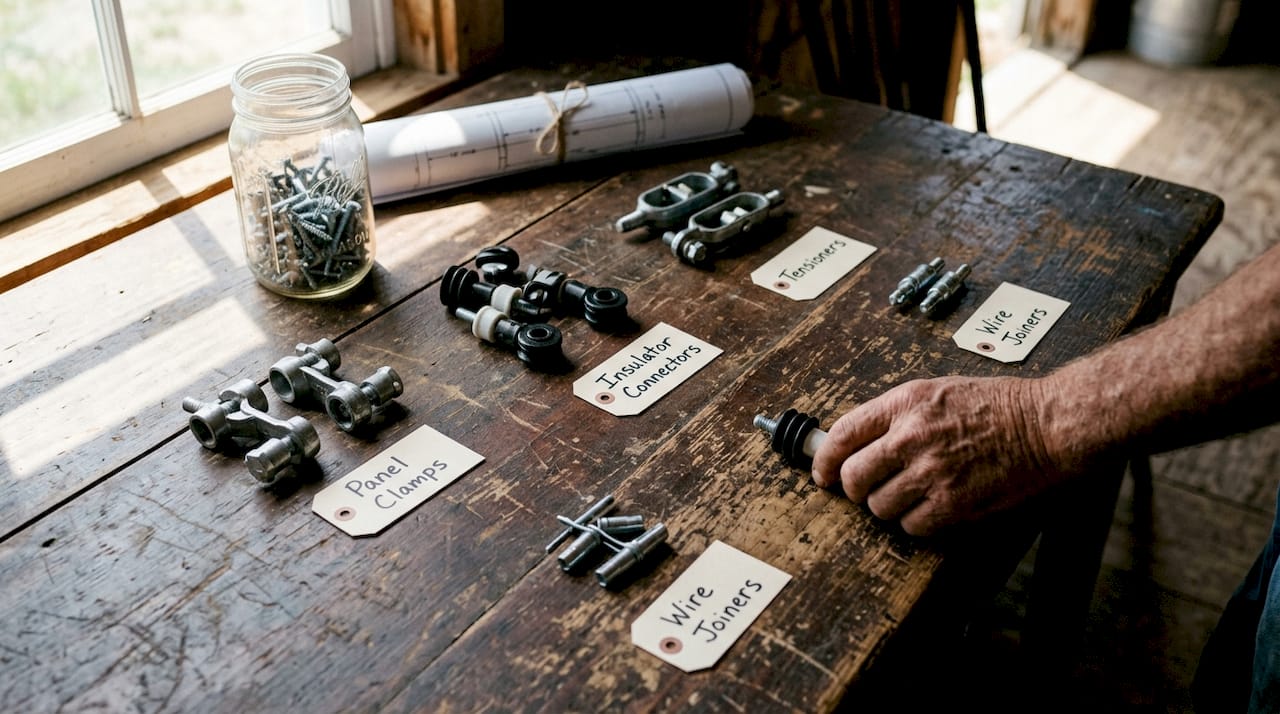
Tensioners keep wire taut over long fence runs. Wire naturally sags over time, especially after a hard winter. A tensioner lets you tighten the wire without cutting and re-splicing it. They are essential for any high-tensile or barbed wire fence longer than a few hundred feet.
Wire joiners and splice sleeves let you repair a broken wire or extend a fence run without losing tension. A splice sleeve crimps over both wire ends and holds them together as strongly as the original wire. These are fast, clean, and permanent.
Gate latches and hinges are connectors too, and they are often the weakest point in a fence line. A gate that swings poorly or latches loosely is an escape route waiting to happen. Heavy-duty hinges and positive-locking latches are worth the extra cost on any gate that livestock use regularly.
Brace wire connectors are used at corner and end posts to anchor the bracing wire that keeps your posts upright under tension. Without them, high-tensile fences pull corner posts inward over time.
For a full breakdown of how these connectors fit into a complete fence build, the field fence guide walks through each component in sequence.
Comparison of fencing connector types
With the main options explained, compare them side by side in the following table.
| Connector type | Material | Typical use | Pros | Cons |
|---|---|---|---|---|
| Panel clamp | Galvanized steel | Permanent and semi-permanent panels | Strong, reusable, works on uneven terrain | Slower to install than temporary options |
| Security clamp / top connector | Zinc-galvanized steel | Portable pens, rotational grazing | Fast setup, lightweight, hardware included | Not suited for permanent high-pressure applications |
| Insulator connector | Plastic / UV-stabilized polymer | Electric fence wire attachment | Prevents energy loss, easy to replace | Must match wire type exactly |
| Tensioner | Galvanized steel | High-tensile and barbed wire runs | Maintains wire tension over long distances | Requires correct installation to avoid over-tensioning |
| Wire joiner / splice sleeve | Galvanized steel | Wire repairs and extensions | Strong, permanent, clean repair | Requires crimping tool for best results |
For a broader look at how these options stack up across different farm types, the fencing solutions comparison covers permanent, semi-permanent, and portable systems in detail.
Choosing the right fencing connector for your farm
After seeing all the options, here is how to approach your decision. The right connector depends on your animals, your land, and how often your fence layout changes.
- Identify your livestock first. Cattle and horses require heavier-duty connectors with higher load ratings. Sheep and pigs can be managed with lighter systems. Poultry need insulator-based electric setups more than mechanical clamps.
- Assess your terrain. Flat, even ground gives you more connector options. Rolling or rocky terrain calls for panel clamps that adjust to grade changes without creating gaps.
- Decide how often you move fence. If your paddock layout changes seasonally or more often, invest in quality temporary connectors that hold up to repeated assembly and disassembly. If your fence is permanent, prioritize holding strength over speed.
- Factor in your climate exposure. All outdoor connectors should be galvanized or coated. In areas with heavy snowfall or freeze-thaw cycles, check that the connector material does not become brittle in cold temperatures.
- Set a realistic budget per linear foot. Quality connectors add a small cost per post but dramatically reduce repair and replacement costs over a 10 to 20 year fence lifespan. Calculate total cost of ownership, not just purchase price.
For farms with smaller acreages or operations that reconfigure paddocks frequently, moveable fence ideas for small Canadian farms offers practical layout strategies that pair well with temporary connector systems.
Get quality fencing connectors and expert advice
You now have a clear picture of which connectors work for which situations. The next step is sourcing quality hardware that will actually hold up through a Canadian season.

At FenceFast, we carry a full range of fencing connectors, from panel clamps and security clamps to insulator connectors and tensioners, all selected for Canadian farm conditions. Our team can help you match the right connector to your livestock, terrain, and project timeline. If you are building or upgrading an electric system, the Patriot electric fence accessory kit is a practical starting point that includes the connectors and accessories needed for a complete setup. Reach out for personalized guidance or browse our catalog to get your next project moving.
Frequently asked questions
Which connector type is best for temporary fencing?
Security clamps and top connectors are the best choice for temporary setups because they install and remove quickly without tools and are light enough for one person to handle.
How long do high-tensile fencing connectors last?
High-tensile setups last 20 to 40 years with proper bracing and maintenance, and quality connectors are a key part of reaching that lifespan.
Do I need special connectors for electric fences?
Yes. Insulator connectors are required to keep the electrified wire separated from the post. Without them, energy loss reduces fence effectiveness and can create safety hazards.
Are panel clamps suitable on uneven terrain?
Panel clamps secure to wood or steel posts on uneven ground, making them one of the few connector types that perform reliably on rolling or rocky pasture.
What features make a connector durable in Canadian climates?
Look for zinc-galvanized or powder-coated finishes, hardware that resists corrosion, and materials that stay flexible in cold temperatures. Connectors with included pegs and nuts that are galvanized throughout offer the best protection against freeze-thaw damage.

