

Many Canadian farmers assume solar fence energizers are a warm-weather luxury that fails the moment temperatures drop below freezing. That assumption costs real money in escaped livestock and damaged fences. The truth is that modern solar systems can handle brutal prairie winters, remote pastures without grid access, and everything in between. In this guide, you will learn exactly what a solar fence energizer is, how each component works, what specs matter for Canadian conditions, and how to keep your system running strong through every season.
Table of Contents
- What is a solar fence energizer?
- Key components you need to know
- How solar fence energizers work: The science in simple terms
- Installation and maintenance essentials for Canadian farms
- Troubleshooting common issues and optimizing performance
- Solar fence energizer solutions for Canadian ranchers
- Frequently asked questions
Key Takeaways
| Point | Details |
|---|---|
| Essential parts | Every solar fence energizer uses panels, batteries, a controller, energizer, and strong grounding. |
| Canadian winter tips | Oversize your panel and battery to ensure 7+ days of reliable fencing even in low sunlight. |
| Critical voltage range | Maintain 4,000 to 6,000 volts for effective and humane livestock control. |
| Routine maintenance | Keep panels clean and check grounding, especially after storms, for best performance. |
| Avoid common failures | Most fencing problems come from poor grounding or unchecked vegetation. |
What is a solar fence energizer?
A solar fence energizer is a self-contained power system that keeps your electric fence charged without any connection to the grid. That matters enormously on large Canadian operations where running power lines to remote pastures would cost thousands of dollars. Instead of a cord, you rely on sunlight.
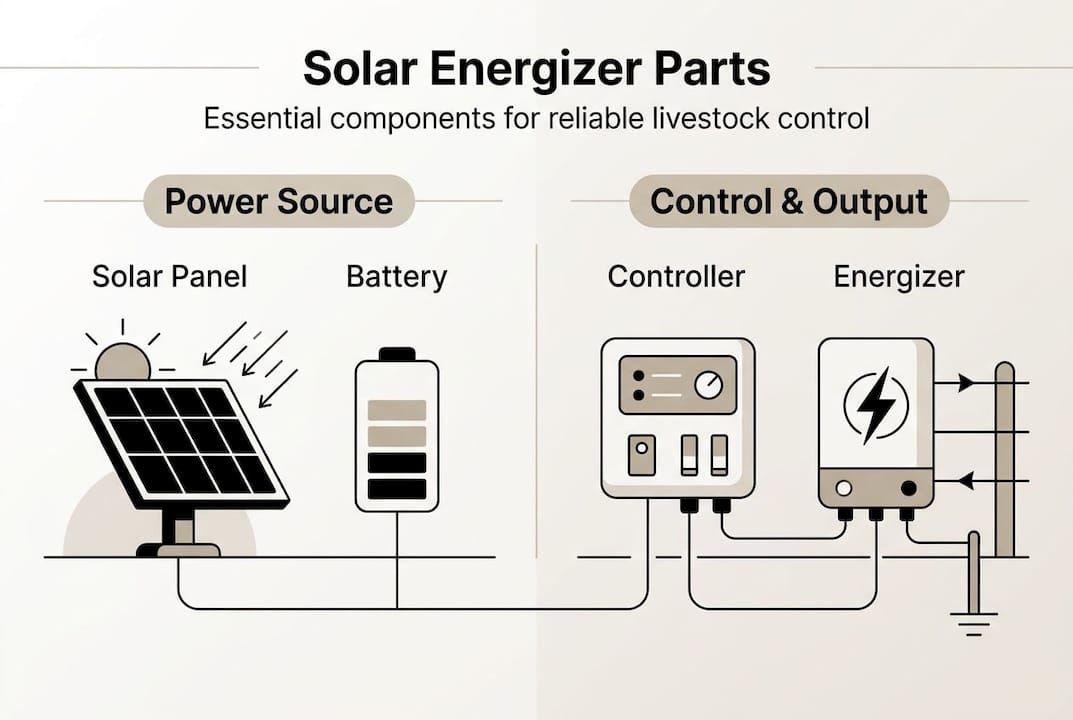
The system has five core parts working together: a solar panel, a deep-cycle battery, a charge controller, the energizer unit itself, and ground rods. Each one plays a specific role. The full solar fence overview explains the relationship between these parts in detail, but here is the short version.
Sunlight hits the panel and gets converted into DC electricity. That electricity flows through the charge controller, which protects the battery from overcharging, and gets stored in the deep-cycle battery. When the energizer needs power, it draws from that battery and converts the stored energy into rapid, high-voltage pulses that travel through the fence wire. As the photovoltaic conversion process shows, those pulses are high voltage but extremely low amperage, which means they startle livestock without causing injury.
Core components at a glance:
- Solar panel (captures and converts sunlight)
- Deep-cycle battery (stores energy for cloudy days and nights)
- Charge controller (regulates charging to protect battery life)
- Low-impedance energizer (converts stored power into fence pulses)
- Ground rods (complete the electrical circuit through the soil)
| Component | Basic function | Why it matters |
|---|---|---|
| Solar panel | Converts sunlight to DC power | Primary energy source |
| Deep-cycle battery | Stores power for dark periods | Keeps fence live overnight |
| Charge controller | Prevents overcharge/discharge | Extends battery lifespan |
| Energizer | Creates high-voltage pulses | Delivers the actual shock |
| Ground rods | Completes the circuit | Without this, nothing works |
Key components you need to know
Now that you know what a solar fence energizer does, let’s break down what’s inside and how each part matters for year-round Canadian reliability.
Panel wattage is where most farmers underestimate their needs. A 10 to 40 watt panel covers most small to mid-sized setups, but Canadian winters cut available sunlight dramatically. A panel that works fine in July may leave your battery half-charged by February. Choosing panel wattage correctly is one of the most important decisions you will make, and this panel sizing guide walks through the math for different fence lengths and climates.
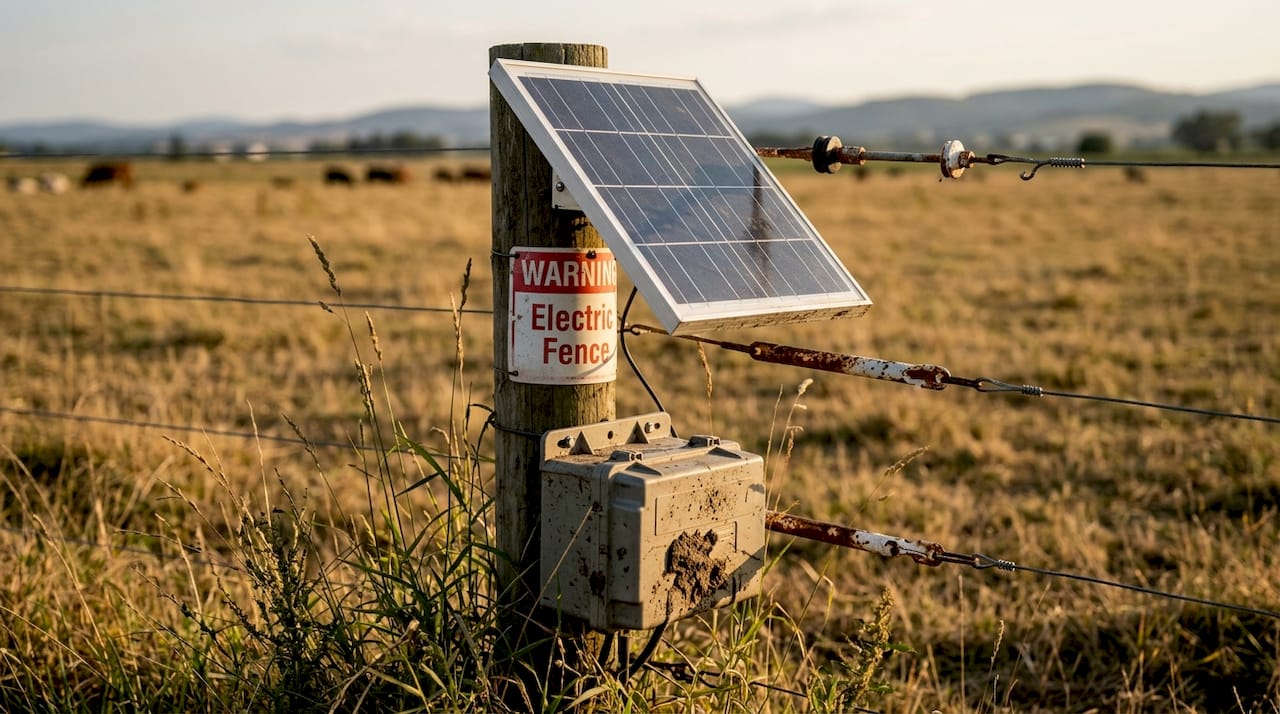
The battery needs to carry your system through at least 7 days without meaningful sun. That is not a conservative estimate for Canada. It is a realistic minimum. A battery sized for only 2 to 3 days of autonomy will leave your fence dead during a stretch of overcast winter weather.
For the energizer itself, always choose a low-impedance model. Low-impedance energizers push power through wet grass, weeds, and other vegetation that would kill a high-impedance unit. The best energizer options for Canadian farms are rated at roughly 0.5 joules per 2 miles of fence, with a working voltage of 4 to 6 kilovolts for effective livestock containment.
Pro Tip: Always oversize your panel and battery by at least 20 to 30 percent for Canadian winter conditions. The extra capacity costs less than one escaped animal.
What each component contributes to reliability:
- Larger panels keep batteries topped up during short winter days
- High-capacity batteries bridge multi-day cloudy periods
- Quality charge controllers prevent battery damage from temperature swings
- Low-impedance energizers maintain voltage even with vegetation contact
- Three or more ground rods in moist soil ensure a complete, strong circuit
| Component | Recommended spec for Canada | Consequence of undersizing |
|---|---|---|
| Solar panel | 20 to 40W minimum | Dead battery in winter |
| Battery | 7+ days autonomy | Fence failure during cloud cover |
| Energizer | Low-impedance, 0.5J per 2 miles | Weak pulse, animals push through |
| Ground rods | 3+ rods in moist soil | Incomplete circuit, no shock |
How solar fence energizers work: The science in simple terms
Understanding the parts is only half the story. Here is how all the components work together to keep your animals in and predators out.
The energy flow follows a clear sequence:
- The solar panel absorbs sunlight and produces DC electricity.
- The charge controller monitors battery voltage and regulates the incoming current.
- The deep-cycle battery stores that energy, ready for use day or night.
- The energizer draws from the battery and fires rapid pulses through the fence wire.
- An animal touches the wire, completes the circuit through the ground, and receives a brief shock.
- The animal learns to respect the fence and avoids it in the future.
Those pulses reach 5,000 to 10,000 volts but last only a few milliseconds and carry very low amperage. Voltage is what you feel. Amperage is what can cause serious harm. Because the amperage is so low, the shock is sharp and memorable but not dangerous to livestock or humans.
“A properly designed solar fence energizer delivers a pulse that an animal remembers without suffering. That memory is what makes the fence work long-term.”
The low-impedance design is critical here. Vegetation touching the wire bleeds off energy. A high-impedance energizer loses so much power to that vegetation that the pulse reaching the animal may be too weak to deter it. Low-impedance units push through that resistance and maintain effective voltage at the fence line. For a step-by-step walkthrough of setting up this system on your property, the solar fence setup steps guide covers everything from panel placement to first voltage test.
Installation and maintenance essentials for Canadian farms
After knowing how it works, it is time for practical advice. Here is how to get your system running reliably, even in the coldest prairie winter.
Step-by-step installation:
- Choose a site with unobstructed southern exposure for the panel.
- Mount the panel at a 45 to 60 degree angle facing south to maximize winter sun capture.
- Install ground rods in moist soil, spacing them at least 3 meters apart.
- Connect the charge controller between the panel and battery before connecting the energizer.
- Run fence wire and test voltage with a digital voltmeter before introducing livestock.
For the detailed installation guide, including wiring diagrams and grounding best practices, that resource covers every step in depth.
Maintenance is where most farmers fall short. A solar fence energizer is not a set-and-forget system. Monthly tasks keep it reliable:
- Wipe the solar panel surface clean of dust, snow, and bird droppings
- Check battery voltage and look for signs of sulfation (white crust on terminals)
- Inspect all wire connections for corrosion
- Trim vegetation along the fence line to prevent energy bleed
- Test fence voltage after any major storm or temperature swing
Pro Tip: Before the first hard frost, upsize your panels and batteries if your current setup was sized for summer. A system rated for 20W in July may need 30W to stay reliable in January. The maintenance benefits of a consistent routine far outweigh the time it takes.
Common mistakes to avoid:
- Mounting the panel flat instead of angled (loses up to 40% efficiency in winter)
- Using a starter battery instead of a deep-cycle battery
- Installing only one ground rod in dry or rocky soil
- Skipping monthly vegetation trimming along the fence line
- Ignoring battery voltage until the fence is already dead
Troubleshooting common issues and optimizing performance
Even with proper setup, issues can arise. Here is how to keep your fence system running smoothly when the unexpected strikes.
The most common symptom is dropped voltage at the fence line. Your energizer may be working fine, but the pulse is losing energy somewhere between the unit and the wire. Start by checking the obvious: is vegetation touching the wire? Is the battery fully charged? Are all connections tight and corrosion-free?
Grounding and vegetation cause roughly 30 percent of all animal escapes from electric fences. That is a staggering number, and almost all of those failures are preventable with basic routine checks. Test ground resistance with a fence tester. It should read below 500 ohms. Anything higher means your ground system is not completing the circuit effectively, and your animals are not getting a reliable shock.
Voltage at the fence line must stay above 4 to 5 kilovolts to deter most livestock. If you are reading below that, work through this checklist:
- Check battery charge level first
- Inspect the panel for shading, dirt, or damage
- Walk the fence line and look for vegetation contact points
- Test ground rod resistance
- Check all wire connections and insulators for damage
Pro Tip: Keep a digital voltage tester clipped to your fence kit at all times. A 30-second test after any storm tells you immediately whether your system is still performing. For a full breakdown of failure modes and fixes, the electric fence troubleshooting guide covers every scenario in detail.
After storms, temperature swings from freeze-thaw cycles can loosen ground rods and crack wire connections. Make a habit of doing a quick visual inspection and voltage test within 24 hours of any major weather event.
Solar fence energizer solutions for Canadian ranchers
You now have the knowledge to choose, install, maintain, and troubleshoot a solar fence energizer built for Canadian conditions. The next step is getting the right gear without the guesswork.

At FenceFast, we stock solar fence systems and accessories that are tested for Canadian climates, from the mild Pacific coast to the deep-freeze prairies. The Patriot fence accessory kit gives you a solid starting point with the essential components bundled together, while the Gallagher i-Series Fence Monitor lets you track fence voltage remotely so you know the moment something drops. Whether you are setting up a new pasture or upgrading an aging system, our team can help you match the right panel wattage, battery capacity, and energizer output to your specific operation. Browse our full selection and get your fence working for you year-round.
Frequently asked questions
How long will a solar fence energizer battery last in winter?
A properly sized deep-cycle battery provides 7 or more days of autonomy without sunlight when matched correctly to panel output. Undersized batteries will fail during extended overcast periods common in Canadian winters.
What voltage is effective for containing livestock?
A working voltage of 4,000 to 6,000 volts is the effective range for most livestock species. Dropping below 4,000 volts significantly reduces deterrence, especially for cattle and horses.
How should I angle my solar panel for best results?
Mount the panel facing south at 45 to 60 degrees to capture maximum sunlight during the low-angle winter sun. Adjusting the angle seasonally can improve output by 15 to 20 percent.
What are common reasons a solar fence fails?
Most failures trace back to poor grounding or vegetation contact with the wire, which bleeds off voltage before it reaches the animal. A low battery from undersized panels is the third most common cause.
Are solar fence energizers safe for humans and animals?
Yes. The high-voltage pulses last only milliseconds and carry very low amperage, which means the shock is sharp and startling but does not cause injury to livestock or people who accidentally contact the wire.

