

TL;DR:
- Forest conservation fencing uses wildlife-friendly barriers to protect ecosystems and reduce human-wildlife conflict. Proper design, maintenance, and community involvement are crucial for fencing success and ecosystem preservation. Combining physical barriers with social and technological solutions enhances long-term conservation outcomes.
Forest conservation fencing is the strategic use of wildlife-friendly barriers to protect forest ecosystems, reduce human-wildlife conflict, and preserve biodiversity across managed landscapes. Unlike standard agricultural fencing, these systems are designed with ecological permeability as a core requirement. Projects like Kenya’s Kaptagat forest initiative and Uganda’s Budongo restoration program prove that the right fencing approach can transform a degraded boundary into a functioning habitat edge. This guide covers the main fencing types, design standards, maintenance realities, and community factors that determine whether a conservation fence succeeds or fails.
What is forest conservation fencing and why does it matter?
Forest conservation fencing is a category of habitat preservation fencing built specifically to protect forest boundaries from encroachment, poaching, and browsing pressure while keeping wildlife movement intact. The term covers a wide range of systems, from solar-powered electric fences to living tree boundaries, each matched to a specific threat and landscape context.
The scale of need is significant. Kenya’s Forest Service launched the Kaptagat fencing project in may 2026, targeting 273 km of total fencing with a 50 km first phase focused on the highest-pressure zones. That scale reflects how serious encroachment has become across gazetted forests. A fence is not just a line on a map. It is an active management tool that defines where human activity ends and forest ecosystem recovery begins.
What separates conservation boundary fencing from a standard farm fence is intent and design. Every material choice, post spacing, and wire configuration either supports or undermines the wildlife living in and around the forest. Get the design wrong and you create a barrier that traps animals, disrupts migration, and ultimately harms the ecosystem you set out to protect.
What are the main types of conservation fencing?
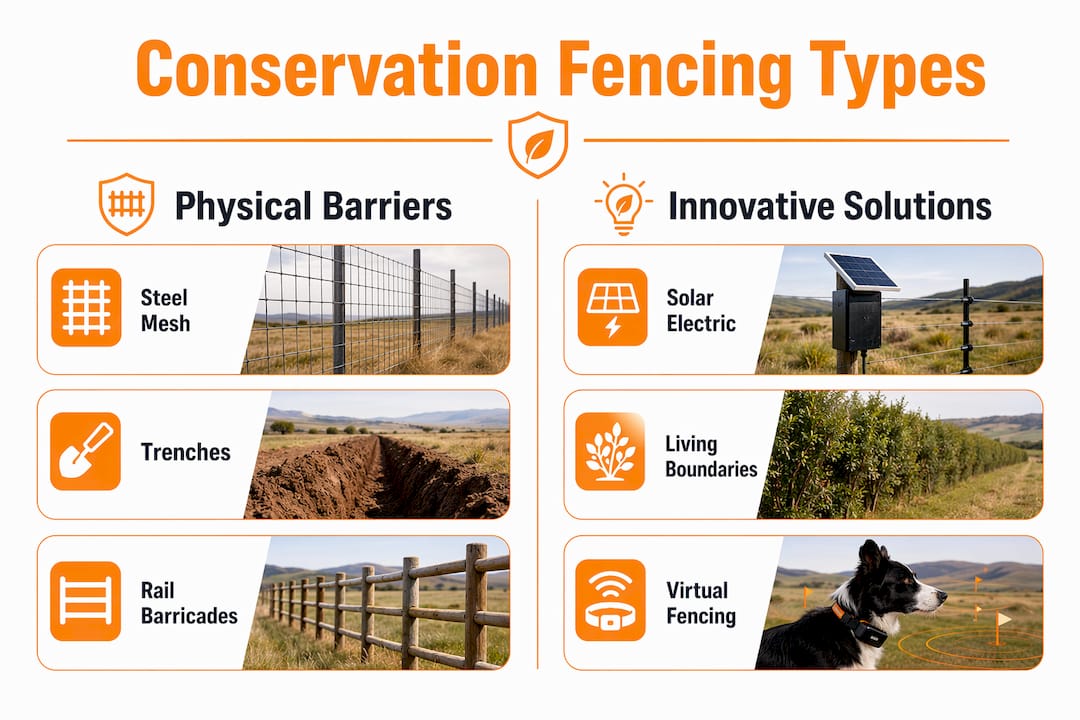
The four primary fencing types used in forest protection each address a different threat profile. Choosing the right one depends on the species present, the budget, and the expected lifespan of the installation.
Solar-powered electric fencing
Solar electric fencing is the most widely deployed solution for remote forest edges. It delivers a deterrent shock without physical entrapment, making it safer for wildlife than rigid barriers. In India’s Saragur taluk, a combination of solar fencing and trenches reduces poaching and human-wildlife conflict by over 80%. That result shows what a well-maintained electric system can achieve when paired with complementary physical barriers. Solar power makes these systems viable in areas with no grid access, and properly maintained units last decades.
Physical barriers: steel mesh, trenches, and rail barricades
Steel mesh fencing is the standard for permanent installations. Permanent steel mesh is recommended for projects with a lifespan exceeding 15 years, providing structural integrity without frequent replacement. Elephant exclusion zones in India’s Saragur region combine 59.2 km of trenches with 37.2 km of railway barricades, demonstrating that physical barriers work best as a layered system rather than a single solution.
Living boundaries
Living boundaries use indigenous tree lines as both physical and biological markers. Uganda’s Budongo-Masege restoration project spans 400 hectares with 96 km of indigenous tree lines, integrating planting with ecosystem restoration. These green boundaries earn more community respect than invisible fence lines. They also provide habitat value in their own right, functioning as wildlife corridors alongside their boundary role.
Temporary vs. permanent materials
| Fencing type | Best use case | Lifespan | Key limitation |
|---|---|---|---|
| Solar electric | Remote forest edges, large mammals | 10–25 years | Requires vegetation management |
| Steel mesh | Permanent exclusion zones | 15+ years | Higher upfront cost |
| Living tree lines | Community-managed boundaries | Decades | Slow establishment phase |
| Polythene/temporary | Short-term restoration plots | 1–3 years | UV degradation, not wildlife-safe long-term |
Matching materials to project duration reduces environmental impact and avoids the cost of early replacement. Temporary polythene suits short-term work, but any installation expected to last more than a few seasons needs UV-stabilized, frost-proof materials from the start.
How do you design fencing that protects forests without harming wildlife?
The core principle of ecological fencing methods is permeability. A fence that excludes people and large browsers while allowing smaller species to move freely is the goal. Achieving that balance requires specific design choices, not general good intentions.
The NSW Government’s wildlife-friendly fencing standards set a clear benchmark:
- Height: approximately 90 cm, tall enough to deter deer and large browsers without trapping jumping species
- Top strands: no barbed wire on the top two strands, which cause the most injury to animals attempting to cross
- Bottom wire: a 30 cm loose or raised bottom wire allows small mammals, reptiles, and ground-nesting birds to pass underneath
- Post spacing: 5 m between posts to reduce entanglement risk
- Panels: smooth, slippery recycled plastic panels support amphibian and small wildlife movement along fence lines
Legacy fencing creates barrier effects that disrupt migratory routes and fragment habitat. The fix is not always a full rebuild. Drop-down fence segments, one-way gates, and canopy crossings can retrofit existing fences to restore connectivity at a fraction of the cost of replacement.
Pro Tip: Assess wildlife movement patterns before you install anything. Knowing which species use a corridor lets you place wildlife-friendly modifications precisely where they are needed, rather than applying them uniformly across the entire fence line.
One underappreciated design element is the canopy crossing. In areas where arboreal species like squirrels or martens need to cross a fence line, a simple rope or wooden bridge above the fence height maintains connectivity without compromising the barrier below. These additions cost very little relative to the conservation value they deliver.
For land managers working near wetlands or riparian zones, check Fencefast’s wildlife-friendly fence design guide for Canadian-specific specifications on bottom wire clearance and post materials that work in freeze-thaw conditions.
What are the practical challenges of maintaining conservation fences?
A fence that works on installation day can fail within months without a maintenance plan. This is the most common mistake land managers make, and it is entirely preventable with upfront planning.
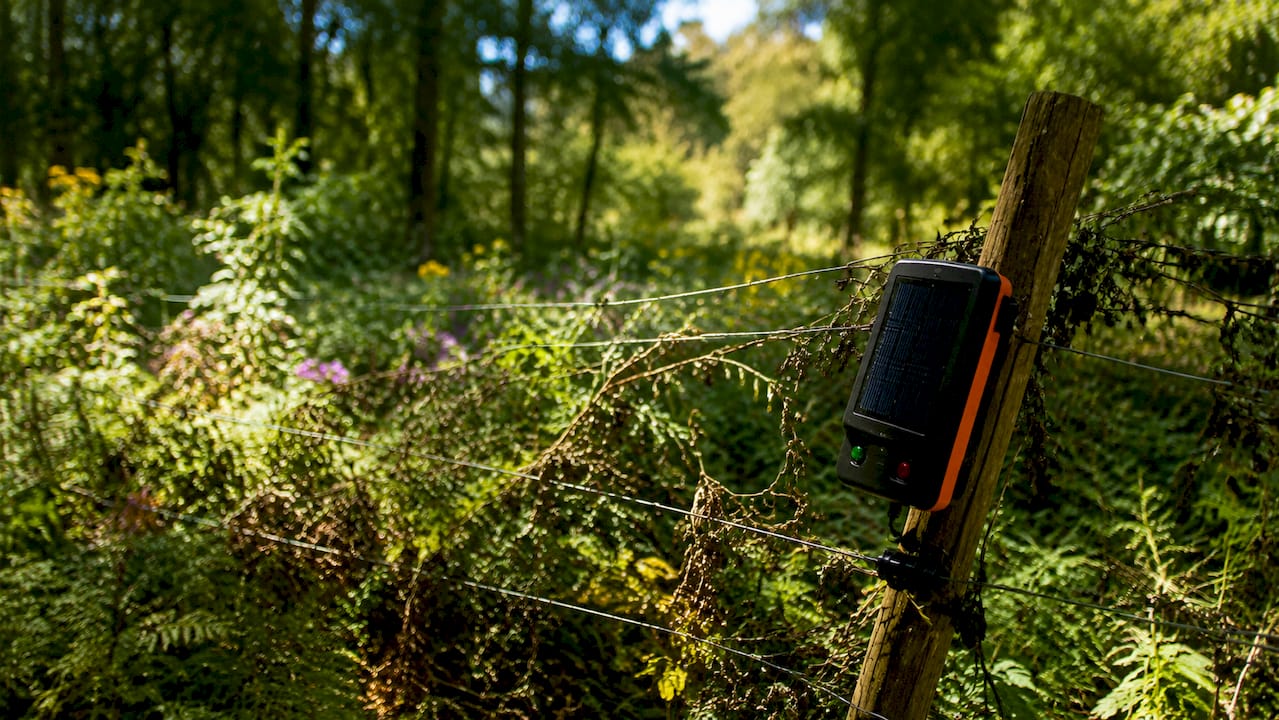
Electric fencing is the most maintenance-intensive option. Overgrown vegetation grounds electric fences, rendering them ineffective without any visible sign of failure. A fence that looks intact but carries no charge offers zero protection. Regular vegetation clearing along the fence line is not optional. It is the primary maintenance task for any electric system.
Pro Tip: Build vegetation management into your project budget before you finalize the fence design. A solar electric fence that costs less to install than steel mesh will cost more to maintain over five years if you underestimate the labor required for clearing.
Beyond electric systems, all conservation fences face these recurring challenges:
- Physical damage from falling trees, flooding, or large animals testing the barrier
- Vandalism in areas where local communities were not involved in the planning process
- Material fatigue in UV-exposed or frost-prone environments where lower-grade materials degrade faster than expected
- Wildlife entrapment when bottom wire gaps close due to soil movement or debris accumulation
Long-term maintenance planning consistently outperforms upfront cost-saving as a strategy for sustainable fencing. Spending less on materials and nothing on maintenance is the fastest path to a failed project. Budget for annual inspections, vegetation clearing, and a materials reserve for spot repairs from day one.
Community involvement also directly affects maintenance outcomes. Fences installed without local buy-in get cut, ignored, or stripped for materials. Fences that local communities helped plan and benefit from get reported when damaged and sometimes repaired before the land manager even knows there is a problem.
How do large-scale projects combine community and technology?
The most effective forest protection barriers in operation today combine physical fencing with social structures and emerging technology. Neither element works as well alone.
Kenya’s Kaptagat project illustrates the physical scale required for serious forest protection. The 273 km total fencing plan with a phased 50 km first phase targets the highest-pressure encroachment zones first. Phased implementation allows the project team to learn from early sections before committing to the full perimeter. That adaptive approach reduces costly design errors at scale.
Uganda’s Budongo-Masege project takes a different approach. Rather than relying on physical fencing alone, it uses Collaborative Forest Management groups to actively maintain living tree boundaries. These groups have a direct economic stake in the forest through eco-tourism and sustainable harvesting rights. That economic link is what makes the social fence work. Communities protect what they benefit from.
| Project | Location | Scale | Key innovation |
|---|---|---|---|
| Kaptagat Forest | Kenya | 273 km planned | Phased electric and physical barrier system |
| Budongo-Masege | Uganda | 400 ha, 96 km tree lines | Living boundaries with community forestry groups |
| Saragur Taluk | India | 122.7 km combined barriers | Solar electric, trenches, and rail barricades layered |
Virtual fencing and sensor-based monitoring are emerging as complements to physical systems. GPS-enabled collar technology, like Gallagher’s eShepherd system, can track animal movement near forest boundaries and alert managers to incursions in real time. These tools do not replace physical fencing in high-pressure zones, but they add a monitoring layer that improves response time and reduces the need for constant physical patrols.
Moving from invisible boundary lines to living, productive green boundaries improves community respect and long-term conservation success. A tree line that provides shade, fruit, or timber has inherent value to the people living beside it. That value is the most durable form of fence protection available.
Key takeaways
Forest conservation fencing succeeds when physical barriers, wildlife-safe design, and community engagement work together as a single system rather than independent components.
| Point | Details |
|---|---|
| Match materials to project lifespan | Use permanent steel mesh for 15+ year installations; temporary polythene only for short-term plots. |
| Design for permeability | A 30 cm bottom gap, no top-strand barbed wire, and 5 m post spacing protect wildlife movement. |
| Maintain electric fences actively | Vegetation grounding is the leading cause of electric fence failure; budget for regular clearing. |
| Integrate community from the start | Social fencing through shared economic benefits reduces vandalism and improves long-term boundary integrity. |
| Assess wildlife movement before installing | Pre-installation surveys allow targeted modifications that prevent costly barrier effects on migratory species. |
The uncomfortable truth about conservation fences
I have seen well-funded fencing projects fail within two years, and I have seen low-budget community-managed tree lines hold a forest boundary for a decade. The difference is almost never the fence itself.
The field defaults to physical solutions because they are measurable and fundable. You can photograph a fence line. You can report kilometers installed. What you cannot easily report is whether the local community understands why the fence is there, or whether the wildlife assessment was done before the posts went in. Those invisible factors determine whether the fence is still working in year five.
The design standards from the NSW Government and the Working Lands for Wildlife program are clear and well-tested. The barrier effect problem is understood. The vegetation management requirement for electric fencing is not a surprise. What keeps projects from applying this knowledge is the pressure to install fast and report progress. Adaptive management, which means slowing down to assess, adjust, and engage, gets cut when budgets tighten.
My honest recommendation: spend at least 20% of your project budget on pre-installation wildlife movement assessment and community engagement before a single post goes in. That investment will save you from retrofitting a fence that fragments the habitat you set out to protect. The Budongo-Masege model works because the community is the fence. The physical tree line just marks where the commitment lives.
— Juiced
How Fencefast supports your conservation fencing project
If you are planning a forest protection or habitat preservation project in Canada, Fencefast carries the materials and expertise to help you get it right from the start.

Fencefast stocks solar-powered electric fencing systems, permanent steel mesh components, and wildlife-safe accessories suited to forest edge and conservation boundary applications. The team offers design consultation to match materials to your project’s lifespan and wildlife management goals. Whether you need a phased electric system for a remote forest boundary or durable mesh for a long-term exclusion zone, Fencefast’s full product range covers both standard and custom configurations. Explore the catalog and request a quote to get your conservation fencing project moving with the right materials from day one.
FAQ
What is the recommended height for wildlife-friendly conservation fencing?
The standard height for conservation boundary fencing is approximately 90 cm. This height deters large browsers while reducing the risk of injury to jumping or climbing species.
How does solar-powered electric fencing help with forest protection?
Solar electric systems reduce human-wildlife conflict by over 80% in documented projects and operate without grid access, making them practical for remote forest boundaries. They require regular vegetation clearing to stay effective.
What is the biggest maintenance risk for electric conservation fences?
Vegetation grounding is the primary failure mode. Overgrown grass and shrubs contact the wire, drain the charge, and leave the fence inactive without any visible sign of failure.
How do living boundaries differ from physical fencing?
Living boundaries use indigenous tree lines as biological and physical forest markers, as demonstrated in Uganda’s Budongo-Masege project with 96 km of tree lines across 400 hectares. They provide habitat value and earn stronger community respect than wire fences alone.
Why does community involvement affect fencing success?
Physical fences without social engagement are vulnerable to vandalism and neglect. Communities with economic stakes in the forest, through eco-tourism or sustainable harvesting, actively protect boundaries and report damage before it becomes a critical failure.

