

TL;DR:
- Effective conservation fencing prioritizes permeability to support wildlife movement and reduce mortality. Proper design, placement, and adaptive management are essential for balancing ecological needs with livestock control. Virtual fencing and community-based approaches offer promising solutions for maintaining connectivity in shared landscapes.
Most conservationists know fences keep livestock in. Far fewer think carefully about what they keep out. Portable fencing for conservation is not simply a temporary barrier you move between paddocks. It’s a tool with real ecological consequences, and how you design, position, and deploy it determines whether your project supports wildlife or fragments it. This guide cuts through the assumptions and gives you the science, design principles, and technology options you need to use portable fencing in ways that actually serve your conservation goals.
Table of Contents
- Key takeaways
- Portable fencing for conservation: why connectivity comes first
- Wildlife-friendly design principles that actually work
- Technology that changes what’s possible
- Installing and managing portable fencing in the field
- Balancing agriculture and wildlife in shared landscapes
- What I’ve learned about getting portable fencing right
- How Fencefast can support your conservation work
- FAQ
Key takeaways
| Point | Details |
|---|---|
| Permeability is non-negotiable | Fence design that blocks wildlife movement can raise mortality rates in migratory species. |
| Wire geometry saves lives | Bottom wire at 16–18 inches and top wire at 40–42 inches dramatically reduces entanglement for most ungulates. |
| Virtual fencing removes the physical barrier entirely | GPS-enabled collar systems can replace physical fences and restore landscape connectivity across large rangelands. |
| Escape mechanisms belong in every plan | Liberty gates and ramped jump-outs prevent animals from becoming trapped against fence lines. |
| Community context determines success | Electric fencing combined with early warning systems outperforms standalone physical barriers in human-wildlife conflict zones. |
Portable fencing for conservation: why connectivity comes first
The fence ecology framework, developed and promoted through IUCN and conservation corridor research, rests on four steps: understand the context, avoid unnecessary fencing, minimize impacts where fencing is unavoidable, and mitigate what remains. That sequence matters because it puts connectivity ahead of convenience.
Habitat connectivity is not an abstract principle. Migratory ungulates rely on seasonal corridors that can span hundreds of miles. When a fence cuts across that corridor, even partially, the consequences show up in survival data. Semi-permeable fences alter migration timing and cause deaths as animals attempt crossings they cannot safely complete. The research is unambiguous: small differences in fence permeability produce significant differences in survival rates.
Why does this matter for portable fencing specifically? Because the temporary nature of mobile fencing solutions creates a false sense of security. Conservationists sometimes assume that because a fence can be removed, its ecological impact is reversible. It often is not. Animals that avoid a corridor during a critical migration window may not return, even after the fence comes down.
“The goal is not to build a fence that animals cannot cross. The goal is to build a fence that the right animals cannot cross, while the wrong animals can.”
The practical takeaway here is that your first design question should not be “How do I hold this fence in place?” It should be “Which species need to pass through, and how do I make that possible?”
Best practices that come directly from fence ecology field research include:
- Mapping existing wildlife corridors with GPS tracking data before selecting fence routes
- Identifying which species are most at risk from barrier effects along your proposed fence line
- Timing fence installation to avoid peak migration periods whenever operationally possible
- Building in designated crossing points from the start rather than retrofitting them later
- Scheduling regular inspections to detect entanglement events and modify the design accordingly
Wildlife-friendly design principles that actually work
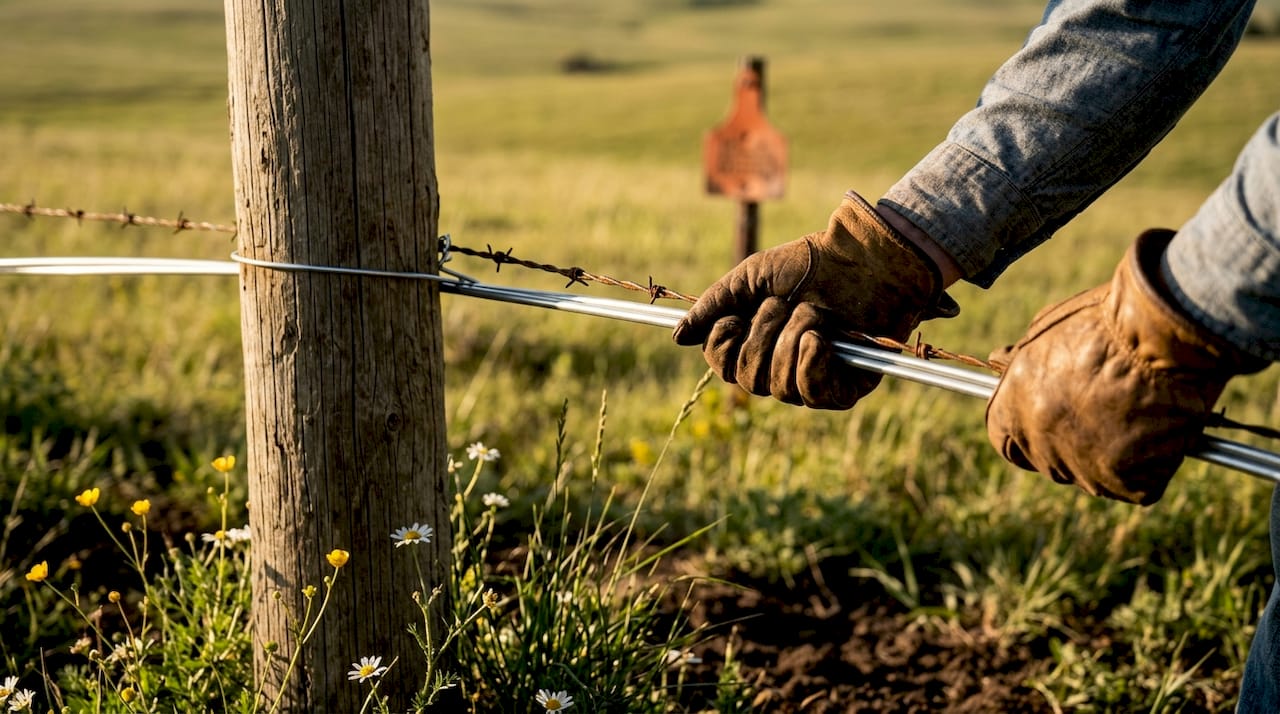
Once you accept that permeability is the core design goal, the specific geometry of your fence becomes critical. Pepperwood Preserve’s wildlife fencing guidelines recommend a bottom wire height of 16 to 18 inches above ground and a top wire no higher than 40 to 42 inches. That combination allows deer and pronghorn to pass underneath or jump cleanly over without snagging.
Smooth wire outperforms barbed wire for permeability. Barbed wire snags legs and necks during crossing attempts and can cause fatal injuries to fawns and juvenile animals. If your conservation grazing system requires wire fencing, smooth wire is the standard to build toward.
| Fence type | Wildlife permeability | Entanglement risk | Best use case |
|---|---|---|---|
| Smooth wire (4 strand) | High | Low | Conservation grazing, mixed-use habitat |
| Barbed wire | Low | High | Not recommended near wildlife corridors |
| Woven wire / mesh | Very low | High | Poultry or small predator exclusion only |
| Portable electric tape | Moderate | Very low | Temporary wildlife barriers, rotational grazing |
| Virtual fence (GPS collar) | Full | None | Large-scale connectivity restoration |
Netted and woven wire mesh panels, the kind widely used for livestock security, function as near-impermeable barriers for most medium and large wildlife. Avoid them along any fence line that intersects with known movement routes. If you are using temporary wildlife barriers for predator exclusion around a nesting site, mesh is appropriate. Deployed across a migration corridor, it becomes a death trap.
Pro Tip: If you must use mesh panels in conservation areas, install them only on interior sections of your enclosure and leave the perimeter fence as smooth wire with adequate bottom clearance. This way you get containment without blocking the movement of non-target species.
Escape mechanisms deserve more attention than they usually receive. One-way gates and “liberty gates” allow animals that enter a fenced zone to exit without assistance. Ramped jump-outs designed for highway fencing in Idaho use a sloped ramp that allows deer to step up and over a fence that they cannot jump from the opposite direction. The same principle applies to conservation enclosures where deer, elk, or other species might enter but be unable to find an exit.
Technology that changes what’s possible
Physical fencing, even well-designed portable fencing, still imposes some barrier effect. Two technological approaches are changing how conservationists think about this constraint.
Virtual fencing uses GPS-enabled collars to deliver audio and mild electric cues that train cattle to stay within app-defined boundaries. PERC’s 2026 analysis of virtual fencing for conservation identifies four core conservation functions: replacing physical fences to restore connectivity, enabling precision exclusion of livestock from riparian areas or sensitive habitat, supporting conservation easement compliance, and allowing rapid boundary changes in response to ecological monitoring.
The connectivity benefit alone is substantial. Removing physical fence lines from rangelands can restore movement corridors for elk, deer, pronghorn, and predators that have been fragmented for decades. Virtual fencing reduces physical barriers and gives land managers the flexibility to respond to drought, wildfire, and seasonal habitat shifts without installing or removing miles of wire.
For conservationists working with Gallagher eShepherd technology through suppliers like Fencefast, the practical workflow looks like this:
- Define your conservation zone boundaries in the app, pulling livestock away from riparian buffers or revegetating areas.
- Adjust boundaries seasonally to track forage conditions and allow recovery periods.
- Monitor GPS movement data to confirm both livestock containment and wildlife corridor integrity.
- Use compliance reporting to satisfy conservation easement requirements with documented precision.
Portable electric fencing complements virtual fencing for situations where collared livestock are not the only concern. In Zambia’s borderlands, electric polywire fencing around cluster farms reduced elephant crop raids while maintaining movement corridors between protected areas. The key design feature was clustering multiple farms inside a shared electric perimeter rather than fencing each field individually. Fewer fence lines meant more open landscape for elephants to move through.
Pro Tip: When exploring virtual fencing for rangelands, check whether your province or territory offers adoption grants through programs like OFCAF or BMP. The upfront collar cost is the main barrier, and government funding can shift the economics significantly.
Installing and managing portable fencing in the field
Knowing how to install portable fencing for a conservation project differs from standard agricultural deployment in a few important ways. The logistics of mobile fencing solutions favor stackable panels and quick-connect couplers for transport. The ecological requirements, however, demand that you add features those panels do not come with by default.
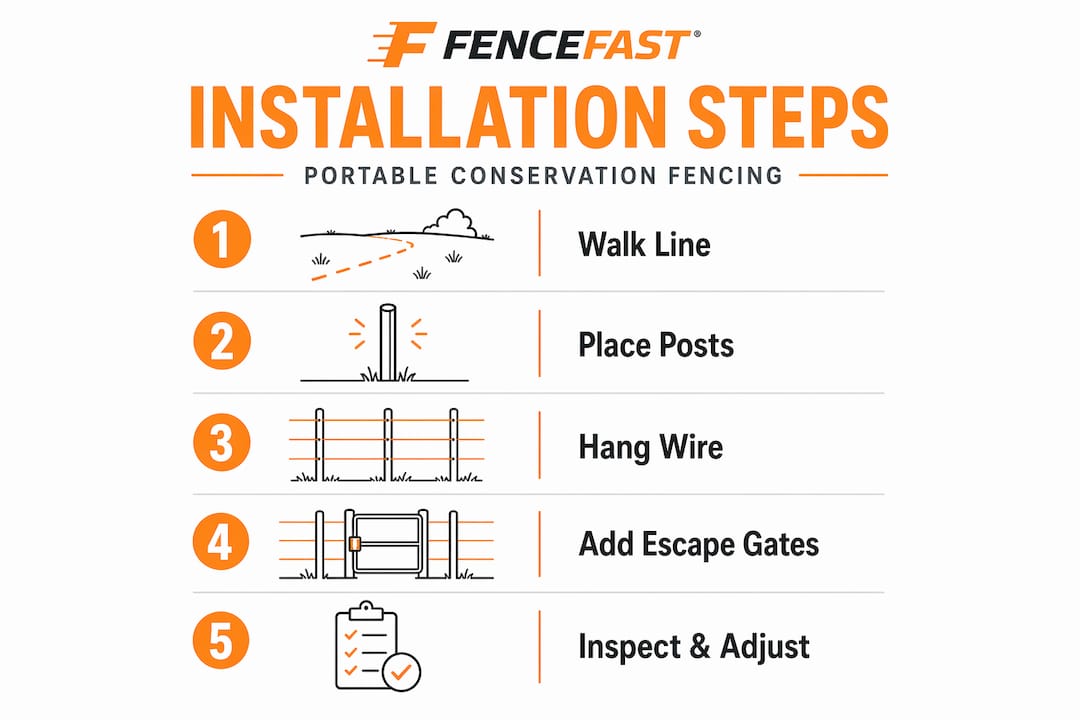
Before installation, walk your fence line and note every point where a known trail, drainage, or open slope crosses your proposed route. Each one of those points is a candidate for a designated wildlife crossing, a section of fence held higher off the ground, or an escape gate.
During installation:
- Keep bottom wire height consistent using a measuring tool, not just by eye
- Mark any temporary sections with high-visibility flagging or smooth plastic covers on barbed wire
- Record your fence line with GPS so you can cross-reference it with wildlife monitoring data later
- Avoid installing across drainage channels where animals predictably funnel during movement
After installation, adaptive management is what separates successful projects from well-intentioned failures. Check fence lines after weather events. Review any wildlife camera data or GPS tracking that overlaps with your fence corridor. If you see consistent avoidance of a section, that section likely needs modification rather than acceptance.
Portable fence systems for livestock control in Canada face additional seasonal considerations. Frozen ground makes driven posts difficult and changes animal movement patterns significantly. Plan for spring repositioning as part of your original project timeline rather than treating it as an unexpected task.
Balancing agriculture and wildlife in shared landscapes
Conservation fencing rarely operates in a purely ecological context. Most of the landscapes where it matters most are working lands, ranches, farms, and borderlands where human livelihoods depend on the same ground that wildlife depends on.
The cluster fencing model from Zambia offers a replicable framework for multi-stakeholder projects:
- Map all agricultural plots and identify shared perimeter options that would reduce total fence length.
- Engage landowners early to explain the trade-off between individual plot fencing and shared perimeter protection.
- Design the shared electric perimeter with community input on gate placement and maintenance responsibilities.
- Pair the fencing with complementary measures such as satellite tracking, early warning systems, and community ranger programs.
- Establish a shared maintenance protocol so no single landowner carries the full cost of upkeep.
The Zambia project demonstrates that electric fencing combined with community programs is more effective than either tool used alone. Fencing without community buy-in gets vandalized or poorly maintained. Community programs without physical deterrents lack the stopping power needed during crop-raiding pressure peaks.
Economic considerations shape adoption in Canada too. Ranchers who implement conservation grazing systems often face pressure to fence riparian areas to comply with water quality regulations. Portable fencing advantages for Canadian farms include the ability to exclude cattle from sensitive areas during growing season and rotate them back in as part of a managed grazing plan. That flexibility supports both ecological recovery and agricultural productivity when designed correctly.
What I’ve learned about getting portable fencing right
After working through enough conservation fencing projects, I’ve come to one firm conclusion: the projects that fail almost always fail because someone prioritized barrier strength over permeability. They built a fence that did exactly what a fence is supposed to do, and it damaged the ecosystem they were trying to protect.
The instinct to build a strong, impermeable barrier is deeply human. It feels like certainty. The problem is that fence impermeability raises ungulate mortality, and the damage accumulates quietly over migration seasons before anyone connects the fence to the population decline.
What actually works is designing for permeability first and containment second. That means accepting some trade-offs. Your livestock may occasionally push through a section of portable electric tape that a solid panel would have held. Your temporary barrier may need more maintenance than a permanent one. Those are real costs, and they are worth paying.
Virtual fencing is the most genuinely exciting development I’ve seen in this space. It resolves the tension between containment and connectivity in a way that no physical fence can. The collar technology is not perfect, and the learning curve for cattle acclimatization is real. But the ability to remove physical wire from a landscape while maintaining livestock control is a genuine shift in what conservation land management can accomplish.
The conservationists I’ve seen succeed treat fencing as one component of a monitored, adaptive system. Not a one-time installation. Not a problem solved. A tool that requires the same ongoing attention as any other part of habitat management.
— Juiced
How Fencefast can support your conservation work
Fencefast carries the full range of tools that make wildlife-friendly portable fencing possible in Canadian conditions, from portable electric fence energizers and polywire to Gallagher eShepherd virtual fencing systems. Whether you’re managing a conservation grazing rotation, protecting a riparian buffer, or looking for flexible portable livestock fence options that minimize wildlife disruption, Fencefast has the products and expertise to match your project’s specific requirements. As an authorized Gallagher dealer with over 26 years of experience, Fencefast also helps clients access government funding through OFCAF and BMP programs that can offset virtual fencing adoption costs. Visit Fencefast to explore the full product catalog or connect with their team for project-specific guidance.
FAQ
What wire heights work best for wildlife-friendly portable fencing?
Bottom wire should sit 16 to 18 inches above ground and top wire no higher than 40 to 42 inches, which allows most ungulates to pass safely without entanglement.
Can virtual fencing fully replace portable fencing for conservation?
Virtual fencing can eliminate physical barriers across large rangelands for collared livestock, but physical portable fencing is still needed for predator exclusion and areas where collar-based management is not practical.
How does fence permeability affect wildlife survival?
Research published in Scientific Reports in 2025 shows that even semi-permeable fences delay migration and increase mortality in ungulate populations, making permeability a critical design factor.
What are the key steps for how to install portable fencing in conservation areas?
Walk the fence line first to identify wildlife crossing points, maintain consistent bottom wire height, install escape gates at regular intervals, and document the fence route with GPS for ongoing monitoring.
How does cluster fencing support coexistence between farmers and wildlife?
Cluster fencing groups multiple farm plots inside a shared electric perimeter, which reduces total fence length across a landscape and preserves open movement corridors for wildlife between protected areas.
Recommended
- Wildlife friendly fence design guide for Canadian farmers – FenceFast Ltd.
- Animal fencing basics: Essential solutions for Canadian farms – FenceFast Ltd.
- Portable outdoor fencing guide for Canadian farmers 2026 – FenceFast Ltd.
- Animal species fencing requirements: The Canadian farmer’s guide – FenceFast Ltd.

