

TL;DR:
- High tensile wire, costing $75 to $120 per 100 feet, lasts 20 to 50 years and requires minimal upkeep, making it a cost-effective, durable choice for farm fencing. Proper installation, including below-frost-line posts and correct tensioning, is essential to ensure long-term performance and safety for livestock. It is suitable for large livestock and predator deterrence but not ideal for goats or sheep without supplementary systems.
Wood fencing costs between $450 and $600 per 100 feet, while high tensile wire runs $75 to $120 for the same span. That gap surprises a lot of farmers who assume that the cheapest wire is low-quality wire. The reality is the opposite. High tensile wire lasts 20 to 50 years with minimal upkeep, making it one of the strongest long-term investments you can make for your operation. If you’ve been putting off fencing decisions because the options feel overwhelming or the costs feel punishing, this guide cuts through the noise and gives you the numbers and the practical knowledge to make a confident choice.
Table of Contents
- What is high tensile wire?
- Durability and cost: Numbers that matter
- Livestock safety, security, and farm application
- Installation essentials and common pitfalls
- A fresh perspective: What most guides don’t tell you about high tensile wire
- Find the right tools and solutions for your fencing project
- Frequently asked questions
Key Takeaways
| Point | Details |
|---|---|
| Lasts decades | High tensile wire fences offer 20-50 years of durability with minimal maintenance. |
| Lower long-term cost | Despite higher upfront costs than barbed wire, high tensile wire is much more economical over time than wood or woven fencing. |
| Effective for multiple species | Ideal for cattle, bison, horses, and hogs, with optional electrification for extra security. |
| Requires correct installation | Proper tensioning and bracing are critical to avoid safety risks and maximize fence life. |
| Not for every animal | Sheep, goats, or horses with poor visibility may require alternative or modified fence setups. |
What is high tensile wire?
High tensile wire is a steel fencing wire manufactured to a much higher tensile strength than standard wire, typically rated at 170,000 to 200,000 pounds per square inch (PSI). Standard or low-tensile wire runs closer to 60,000 to 80,000 PSI. That difference in strength matters enormously on working farms where cattle push against fences, temperatures swing hard through Canadian winters, and the ground shifts with every freeze-thaw cycle.
The wire is made from high-carbon steel and is typically galvanized, meaning it’s coated in zinc to resist rust and corrosion. You’ll often see it available in Class 1, Class 3, or heavily galvanized grades. Class 3 galvanization is the most common choice for Canadian farms because the thicker zinc coating better handles the moisture, ice, and seasonal temperature extremes that wear out cheaper wire in just a few years.
What sets high tensile wire apart from barbed or standard woven wire isn’t just the raw strength. It’s the combination of strength and elasticity. The wire can flex and spring back under pressure rather than bending permanently out of shape. This matters a lot in freeze-thaw conditions because the ground heaves in winter, and posts shift slightly. Regular wire sags and stays sagged. High tensile wire resists sagging and stretching and snaps back to its original shape after the thaw.
Key physical properties to understand before buying:
- Tensile strength: 170,000 to 200,000 PSI, much higher than standard wire
- Wire gauge: Typically 12.5 gauge, which is thicker and stronger than common 14-gauge options
- Galvanization class: Class 3 offers the longest rust protection, especially important in humid or coastal regions
- Spring-back behavior: Designed to flex under load without permanent deformation
- Strand count: Single-strand design is common, requiring more strands per fence height but providing superior strength per strand
When you’re choosing durable fencing for a large pasture or property boundary, these properties translate directly into fewer repair calls and lower cost over time.
Durability and cost: Numbers that matter
Now that you know what high tensile wire is, let’s see how it holds up when compared to other fencing materials for actual costs and durability.
Here’s a direct comparison across the fencing types most Canadian farmers consider:
| Fencing type | Cost per 100 ft | Avg. lifespan | Maintenance level | Best use |
|---|---|---|---|---|
| High tensile wire | $75 to $120 | 20 to 50 years | Low | Cattle, bison, large perimeters |
| Barbed wire | $40 to $70 | 10 to 20 years | Medium | Cattle, rough terrain |
| Woven wire | $120 to $200 | 15 to 25 years | Medium to high | Mixed livestock, smaller animals |
| Wood board fence | $450 to $600 | 10 to 20 years | High | Horses, premium enclosures |
The cost story isn’t just about the purchase price. It’s about what you spend over a 20 to 30 year period. A wood fence that costs $500 per 100 feet and needs full replacement every 15 years, plus annual staining, painting, or board replacement, could easily cost you three or four times the initial price over a 30-year window. High tensile wire, purchased once at $100 per 100 feet and maintained with minimal effort, gives you a completely different total cost picture.
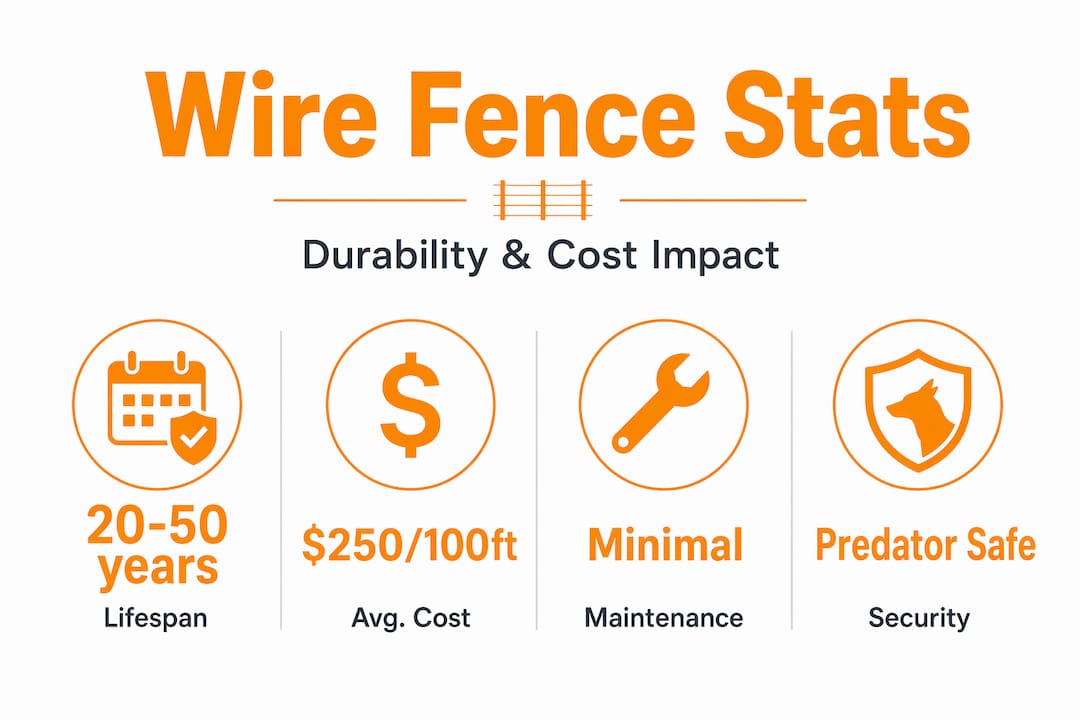
According to fencing material comparisons, barbed wire is cheaper upfront but brings higher costs in terms of animal injury risk, more frequent maintenance, and shorter replacement cycles. It also carries real liability if livestock or wildlife gets tangled and injured. High tensile wire is safer than barbed because there are no barbs to cut skin, and it’s superior to woven wire for large cattle perimeters because of lower material cost per foot.
The freeze-thaw cycle is one of the hidden killers of farm fencing in Canada. Temperatures that swing from minus 30 to plus 20 degrees Celsius through a single winter season put enormous stress on wire, posts, and connections. Standard wire snaps or sags. High tensile wire is engineered specifically to handle this kind of thermal expansion and contraction without losing its holding tension.
Here’s a simple breakdown of what proper ownership looks like over 20 years:
- Initial installation: Set posts and wire once, correctly, with proper bracing
- Year 1 to 3: Check tension after the first two or three freeze-thaw seasons and adjust if needed
- Year 4 to 10: Walk the fence line annually, check post integrity, re-staple any loose points
- Year 10 to 20: Minimal intervention needed if installation was done right; replace any damaged posts
Pro Tip: Never skip the initial tension check after the first full winter. Posts settle in frozen ground, and the wire may lose a few pounds of tension during that first season. A quick adjustment in spring locks in the tension and sets you up for decades of low-maintenance performance.
Livestock safety, security, and farm application
Durability and cost aren’t everything. Let’s see how high tensile wire actually performs day-to-day for the animals you manage.
High tensile wire is well-suited for a wide range of livestock, but the configuration matters. For cattle, the standard recommendation is a 5-strand fence at 54 inches in height. This height and strand count creates enough of a physical barrier to contain even determined animals without requiring the visual deterrent that a board fence provides.
A 5-strand high tensile wire fence at 54 inches is the proven baseline for beef cattle in Canada. This configuration provides adequate physical barrier strength, reduces material cost per unit length compared to woven wire, and allows electrification of one or more strands for added predator deterrence. With proper bracing, a well-built 5-strand system can handle the pressure of even a 1,500-pound bull.
Here’s how animal fencing basics apply across common Canadian farm animals:
| Animal | Strand count | Min. height | Electrify? | Notes |
|---|---|---|---|---|
| Beef cattle | 5 strands | 54 inches | Optional | Standard high tensile setup |
| Bison | 6 to 8 strands | 60 to 72 inches | Recommended | Bison need higher, heavier containment |
| Horses | 4 to 5 strands | 54 to 60 inches | Optional | Visibility aids needed; see note below |
| Hogs | 4 to 5 strands | 36 to 48 inches | Recommended | Low strands close to ground essential |
Electrification is one of the most practical upgrades you can make to a high tensile system. Running one or two strands through a fence energizer adds a psychological deterrent for livestock and a real physical deterrent for predators like coyotes, wolves, and even bears in some regions. The wire’s high tensile properties actually make it a better conductor pathway for electric current than soft wire because it maintains consistent contact with insulators under tension.
For wildlife exclusion, the same fence that keeps cattle in also keeps many predators out. Coyotes and dogs typically respect a taught, electrified 5-strand fence. Bears require additional configuration, usually a dedicated electric offset strand at the base, but high tensile wire forms a solid foundation for that system.
One important note on horses: they rely on vision to sense boundaries. Unlike cattle, horses don’t test fences with their bodies the same way. A wire that’s hard to see can lead to collision injuries. Adding a visible tape or ribbon woven through the top strand significantly reduces this risk.
Installation essentials and common pitfalls
You’ve seen the strengths. Now, here’s what you need to know before you build, so you don’t make costly mistakes.
High tensile wire installation is not complicated, but it is unforgiving if you cut corners on the fundamentals. Here are the core steps in order:
- Plan your layout and mark corner and end post locations before purchasing materials
- Set braced corner and end posts at 24 to 36 inches deep, which is below the frost line in most Canadian regions, using solid 6 to 8 inch diameter posts with proper H-brace or diagonal brace assemblies
- Space line posts 8 to 12 feet apart for standard cattle applications; wider spacing increases the spring effect but reduces rigidity in heavy snow areas
- Run the wire from the bottom strand up, anchoring at one end, unrolling across the full span, and working up through each strand
- Tension each strand to 200 to 250 pounds using specialized tensioning tools; this is not optional and cannot be done by hand alone
- Fasten wire to line posts using staples or clips, allowing slight movement so the wire can flex without breaking
- Test your tension with a wire tension meter and adjust before calling the job complete
According to fence installation steps, setting posts below the frost line at 24 to 36 inches and tensioning to 200 to 250 lbs per strand are the two most critical factors in a durable installation. Skip either one and you’re setting yourself up for a fence that fails within 5 years instead of lasting 50.
The specialized tools part deserves extra attention. High tensile wire requires a proper wire strainer or come-along tensioner to reach target tension. Standard wire stretching bars used for barbed wire will not generate enough force and can damage the wire’s temper if used incorrectly. A quality Hayes fencing tool built for high tensile applications is a non-negotiable part of any serious installation kit.
High tensile wire is not ideal for every application. For fencing for goats, the wire is often a poor choice because goats are expert climbers and squeezers who exploit the gaps between individual strands. Sheep have similar tendencies. These animals need woven wire or electric offset systems to be properly contained. Trying to use high tensile wire alone for goats and sheep typically results in repeated escapes and constant frustration.
Pro Tip: For horse paddocks, add a highly visible ribbon, tape, or electric polytape on the top strand. Horses that can’t see the wire clearly are prone to running through it at speed, which causes serious injury and can result in full fence replacement.
Common pitfalls that cost farmers real money:
- Under-tensioning the wire so it sags within the first winter season
- Skipping corner bracing or using undersized brace assemblies that fail under lateral load
- Stapling too tightly so the wire can’t flex, which causes breaks at the staple point in cold weather
- Not checking tension in spring after the first freeze-thaw cycle
Wire snap-back is a serious safety hazard. A strand under 200 pounds of tension that breaks or pops a staple will recoil with enough force to cause injury. Always stand to the side when tensioning and wear eye protection.
A fresh perspective: What most guides don’t tell you about high tensile wire
Here’s the unfiltered take that doesn’t always make it into the standard product descriptions.
The overwhelming majority of high tensile wire failures we hear about trace back to installation problems, not material defects. Farmers who install the fence correctly with braced corners, proper tension, and the right post depth almost never have problems. The wire does exactly what it’s designed to do for decades. The farmers who struggle are usually the ones who tried to shortcut the corner bracing, tensioned by feel instead of by meter, or set line posts at whatever depth the rocky ground would allow.
High tensile wire is also not the magic universal solution some suppliers present it as. The guidance on high tensile wire for goats is clear: it’s the wrong tool for goats and sheep without modifications. Using it anyway because it’s what you have on hand or what’s cheaper per roll will cost you more in escapes, chasing animals, and re-fencing than simply buying the right product from the start.
The real skill in fencing isn’t knowing that high tensile wire is strong. It’s knowing when to use it and when to reach for a different solution. A large cattle operation with 5 miles of perimeter fencing? High tensile wire is almost certainly your best option. A small mixed-species hobby farm with goats, sheep, and a couple of horses? You’ll likely need a combination of systems, and trying to force one wire type onto every situation will make your life harder. Match the tool to the job, not to the trend.
Find the right tools and solutions for your fencing project
When you’re ready to take the next step, specialized tools and systems make the difference between theory and real-world success on your farm.

At FenceFast, we supply everything Canadian farmers and ranchers need to install high tensile wire correctly the first time. Our Hayes fencing tools are purpose-built for high tensile wire, giving you the tension control and crimping precision that hand tools simply can’t deliver. If you’re looking to add electric security to your perimeter, the Gallagher Smart Fence is a portable, modular electric system that integrates with high tensile setups for immediate predator deterrence. As a one-stop source for professional fencing solutions, we stock the wire, connectors, post drivers, and energizers to complete your project with confidence. Talk to our team about the right configuration for your operation and your livestock.
Frequently asked questions
How long does high tensile wire last compared to barbed or wood fences?
High tensile wire lasts 20 to 50 years with minimal maintenance, far outlasting barbed wire at 10 to 20 years and wood fencing at 10 to 20 years, both of which require much more ongoing repair.
Is high tensile wire safe for all types of livestock?
High tensile wire works well for cattle, bison, horses with added visibility aids, and hogs, but goats and sheep need alternatives like woven or electric fencing because they squeeze through or climb over strand-based systems.
What is the recommended tension for installing high tensile wire?
Each strand should be tensioned to 200 to 250 lbs per strand using a dedicated tensioning tool, never by hand, to achieve the strength and spring-back performance the wire is designed to deliver.
Can high tensile wire fencing be electrified for extra security?
Yes, high tensile wire is fully compatible with electric energizers and can be electrified for predator deterrence and improved livestock containment by running energized strands through standard insulators on your existing posts.
What’s the biggest installation mistake to avoid with high tensile wire?
Inadequate corner bracing combined with improper tensioning is the most common cause of early fence failure, and poor installation risks wire snap-back injuries to you and your crew during setup or after a post failure.

