

TL;DR:
- Selecting weather-resistant connectors matched to wire gauge and climate is essential for farm fence reliability.
- Insulated crimp sleeves and split bolts offer high strength and corrosion resistance for electric and high-tensile fences.
- Using affordable connectors repeatedly can lead to costly repairs, escapes, and livestock safety risks.
Choosing the wrong wire connector is one of the most common and costly mistakes on Canadian farms. A weak join in an electric fence line can mean the difference between a secure paddock and a 2 a.m. call about cattle on the highway. Extreme temperature swings, persistent moisture, UV exposure, and constant animal pressure put every connection point through serious stress. This guide breaks down the main connector types available, compares them on the criteria that matter most to producers, and gives you a clear framework for matching the right connector to your specific fencing system and livestock.
Table of Contents
- Key selection criteria for agricultural wire connectors
- Common types of wire connectors used in Canadian agriculture
- Comparison table: Strength, cost, and best-use scenarios
- Connector selection by fencing type and livestock
- Why the cheapest wire connector can cost you more
- Get expert advice and top wire connectors at FenceFast
- Frequently asked questions
Key Takeaways
| Point | Details |
|---|---|
| Choose by need | Match connector type to your wire material, fencing system, and livestock for best results. |
| Don’t skimp on quality | High-grade connectors save time, reduce repairs, and enhance animal safety. |
| Weather matters | Select corrosion-resistant and insulated connectors for harsh Canadian climates. |
| Regular checks | Inspect connectors annually to prevent costly fence failures and livestock escapes. |
Key selection criteria for agricultural wire connectors
With the stakes established, it is worth looking at what actually separates a good connector from one that will fail you mid-winter. Not every connector is built for agricultural conditions, and the wrong choice can compromise an entire fence system even if every other component is top quality.
Several factors directly shape how a connector performs in a farm environment:
- Wire gauge compatibility. A connector sized for 12.5-gauge high-tensile wire will not grip 9-gauge galvanized wire reliably. Always match the connector specification to the wire diameter in your fence.
- Corrosion resistance. Canada’s freeze-thaw cycles, road salt drift, and coastal humidity all accelerate oxidation. Look for galvanized, stainless, or polymer-coated connectors where long service life matters.
- Insulation quality. For electric fences, the insulation around a connector determines whether voltage reaches the fence wire or bleeds away into a post or the ground. Poor insulation is the number one cause of ghost faults in electric fence systems.
- Ease of installation. A connector that requires specialized tooling may slow down large projects or field repairs. Crimp sleeves need a proper crimping tool, but twist-on connectors can go in by hand. Know what tools you will have on site.
- Clamping force and pull-out strength. Under animal pressure, a loose connector can slip, creating both a gap in containment and an intermittent electrical fault.
Understanding your fencing connector options before purchasing saves time and money. Canadian winters add a layer of complexity that producers in milder climates do not face. Metal contracts in extreme cold, which can loosen connections that seemed snug in September. Wet spring conditions accelerate galvanic corrosion when dissimilar metals are in contact. These are not theoretical concerns. They show up as fence faults and escape events every season across the Prairies, the Maritimes, and BC’s wet interior.
Reviewing guidance on choosing fencing wire alongside connector selection is a smart habit because the wire material and the connector material need to be compatible, both mechanically and electrochemically.
Pro Tip: Always match your connector type to both the wire material and your local weather conditions. A galvanized crimp sleeve on aluminum wire will corrode far faster than on galvanized steel wire. Match metals wherever possible to avoid accelerated wear.
Common types of wire connectors used in Canadian agriculture
Now that you know what to look for, here are the specific connector types you will encounter across Canadian farms and ranches, along with honest assessments of where each one shines and where it falls short.
Common fencing connectors vary more than most producers realize. According to FenceFast’s resource library, common types of connectors used to join fence wires in farms include crimp sleeves, split bolts, wire joiners, twist-on connectors, and insulated connectors.
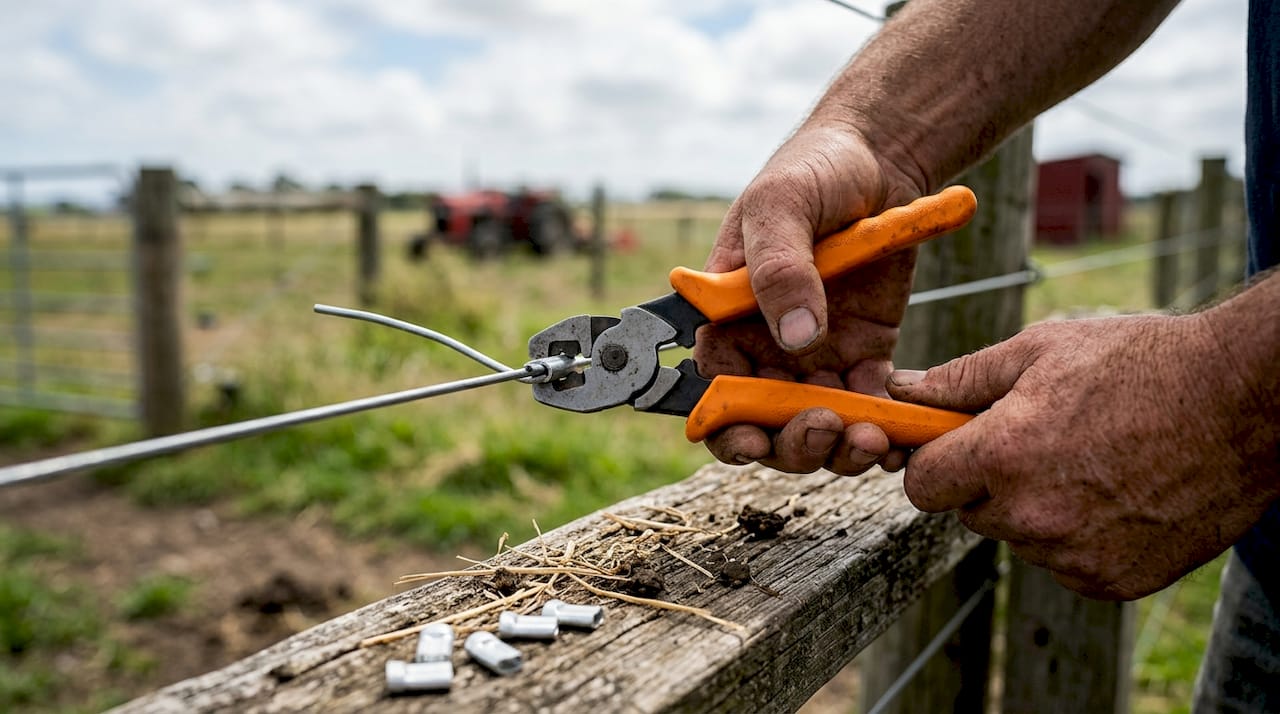
Crimp sleeves are small cylindrical metal tubes that slide over two wire ends and are compressed with a crimping tool. They create a clean, permanent join with excellent pull-out strength and good conductivity. The downside is that they require a crimping tool and are not easily undone if you need to adjust a repair later. They work particularly well on high-tensile and electric fence wire where a low-profile, mechanically strong connection is needed.
Split bolts use a threaded bolt and clamp plate to grip two wire ends together. They are common for larger wire gauges and underground connections, and they can be loosened and retightened without specialized tools. Corrosion can be an issue if they are not rated for outdoor use. Always look for silicon bronze or galvanized split bolts on exposed agricultural applications.
Wire joiners (sometimes called wire grips or barrel connectors) are specifically designed for field repairs on barbed and high-tensile wire. They grip the wire mechanically through a cam or wedge action and require no tools to install. They are fast, which makes them popular for emergency repairs on remote fence lines, but they can introduce a small resistance point in electric fence applications.
Twist-on connectors work similarly to household wire nuts but are sized for agricultural wire gauges. They are easy to apply in the field without tools and provide adequate performance for temporary or low-voltage connections. They are generally not the best long-term solution for permanent electric fences in wet climates.
Insulated connectors are designed specifically for electric fence systems. They house the metal connection point inside a UV-stable polymer shell that prevents voltage loss to the surrounding environment. For any energized fence line, insulated connectors are the standard you should be working toward.
Using weather-resistant connectors can extend fence life by years. In Canadian conditions, that means choosing connectors rated for both UV exposure and freeze-thaw cycling, not just basic outdoor use.
If you are dealing with broken strands, guidance on fixing wire on farms covers the field repair process step by step, including which connector types work best under time pressure.
Pro Tip: Keep a small repair kit in your vehicle or ATV pack that includes at least two crimp sleeves, a pair of wire joiners, and a fold-up crimping tool. Field repairs go faster when you do not have to drive back to the shop.
Comparison table: Strength, cost, and best-use scenarios
With the basics of each connector in mind, here is a direct comparison across the criteria that matter most on a working farm. This table is built to help you make a fast decision when you are planning a new fence installation or restocking your repair kit.
| Connector type | Pull-out strength | Corrosion resistance | Ease of install | Electric fence compatible | Relative cost |
|---|---|---|---|---|---|
| Crimp sleeve | Very high | High (galvanized) | Moderate (tool needed) | Yes | Low |
| Split bolt | High | Medium to high | Easy | With insulation tape | Low |
| Wire joiner | Medium | Medium | Very easy (no tools) | Limited | Very low |
| Twist-on | Low to medium | Low | Very easy | Not recommended | Very low |
| Insulated connector | High | Very high | Easy to moderate | Yes (designed for it) | Medium |
The numbers behind these choices matter. Insulated connectors are often preferred for electric fences due to better conductivity and corrosion protection, and insulated connectors can reduce power loss by up to 30% compared to basic wire twists. Over a long fence run, that kind of power loss translates directly into insufficient voltage reaching distant fence strands, which is exactly when animals test the wire and find it wanting.
When deciding between strength and cost, the rule is straightforward. Use the best connector you can justify for permanent installations because the labor cost of going back to fix a failed joint is always higher than the price difference between a basic connector and a quality one. Save the economical wire joiners for temporary setups and emergency repairs where speed matters more than longevity.
For electric fence wire selection to pair with the right connectors, the breakdown of wire selection for electric fencing covers conductor options including aluminum, galvanized steel, and stainless steel, each of which interacts differently with connector materials. For general cattle fencing strategy, cattle fencing tips provide a broader view of how connectors fit into a complete system design.
Connector selection by fencing type and livestock
Knowing how connectors stack up is useful, but the real-world question is always: what do I use for my operation? Here is a practical guide organized by fence type and animal species.
Step-by-step: Choosing connectors by fence type
- Electric fence (permanent). Select insulated crimp sleeves or purpose-built insulated connectors for all joins in the energized wire. Ground wire connections need solid contact, so use non-insulated crimps or split bolts at ground stakes. Review ground wire basics to ensure your grounding system is not undermining your connector performance.
- Electric fence (temporary or rotational). Wire joiners and insulated twist-on connectors are acceptable here because temporary fences are regularly dismantled and rebuilt. Speed of installation outweighs long-term durability.
- Barbed wire fence. Wire joiners and split bolts are the standard choice for field repairs. For new construction, crimped joints at strainer posts provide cleaner, stronger terminations.
- Woven wire (field fence or sheep netting). Crimp sleeves work well for inline joins on the horizontal strands. At corners and braces, split bolts or mechanical wire grips provide the clamping force needed for high-tension woven systems.
By livestock type:
- Cattle. Prioritize high pull-out strength. Cattle lean into fences, and a connector that slips under load creates an immediate escape risk. Insulated crimp sleeves on electric, split bolts or crimps on barbed and high-tensile.
- Sheep and goats. These animals probe fence lines aggressively at ground level. Ensure connectors near the base strands are tight and corrosion-free. Woven wire joins should use crimps rated for the wire gauge.
- Pigs. Pigs root under and push through at mid-height. Electric systems are common for pig containment, so insulated connectors throughout the energized circuit are essential.
Electric fences require connectors with strong conductivity and secure insulation to safely manage livestock, and cutting corners here introduces both escape risk and animal welfare concerns if an improperly insulated connector delivers a shock through an unexpected path.
Poor connector choice in wet regions, specifically using non-insulated connectors in soggy conditions, can cause current to bleed into the ground along fence posts, robbing the fence of effective voltage and potentially creating a hazard at the post itself. For a full walkthrough of proper electric fence setup, fence wire installation tips provide guidance that covers connectors within the broader installation sequence.
Pro Tip: In wet or cold regions, use insulated connectors for every join in an electric fence, not just the obvious ones. Even a single uninsulated join in a soggy area can drain enough voltage to make the entire fence ineffective.
Why the cheapest wire connector can cost you more
After understanding how to choose and apply the right connector, there is a common pitfall producers should be wary of: defaulting to the cheapest option in the bin because “a connector is just a connector.”
We have seen it repeatedly. A producer builds a solid fence with quality wire, quality posts, and a reliable energizer, then saves a few dollars using bargain bin twist-on connectors throughout the system. By the second winter, corrosion is compromising three or four connection points. By the third year, there are intermittent faults that take hours to trace. All that labor time tracing faults and making repairs adds up to far more than the cost difference between a quality connector and the cheap alternative.
There is also the livestock escape equation. When a connector fails under animal pressure, the cost is never just a replacement connector. It is the time spent gathering animals, the risk of road accidents, potential veterinary bills, and in some cases neighbor relations that take a season to repair. As we like to say: replacing a $3 connector is better than chasing $2,000 worth of cattle.
The smarter approach is to categorize your connections. On permanent, critical fence lines, especially those containing high-value breeding stock or bordering public roads, use the best-rated connector for the application. On interior temporary dividers used for rotational grazing, economical wire joiners are perfectly appropriate. That way you are not spending top-dollar on every join in a 200-acre paddock, but you are not gambling on a boundary fence that separates your herd from the highway either.
Understanding how your connector choice integrates with the full energized system is also important. Reviewing guidance on safe electric fence connections gives you a complete picture of how every component, including connectors, contributes to either a reliable or a fault-prone system.
Get expert advice and top wire connectors at FenceFast
For farmers eager to upgrade their fence reliability, the right partner can make the process much easier.
At FenceFast, we have spent over 26 years working with Canadian producers on fencing challenges from the Prairies to the Maritimes. We know what holds up through a Saskatchewan winter and what fails by March.

Whether you need to stock a repair kit, plan a full fence installation, or figure out which connector to use on a specialized high-tensile system, our team can point you in the right direction. You can shop wire connectors directly through our online catalog or dig into our detailed fencing connector tips resource to match products to your specific application. We ship across Canada and are always available to help you get the right solution the first time.
Frequently asked questions
What is the best connector for electric fencing in cold Canadian climates?
Insulated crimp sleeves and high-quality wire joiners offer reliable performance and protect against corrosion in cold conditions, since crimp sleeves and insulated connectors are specifically preferred for electric fences due to better conductivity and corrosion protection.
Can you mix different types of wire connectors on one fence line?
Mixing connectors is possible but should be done with caution to avoid corrosion and ensure consistent conductivity, because weather-resistant connectors maintain fence life while mixed metals or mismatched designs can create weak points.
How often should connectors on agricultural fences be checked or replaced?
Inspect connectors annually and replace any showing signs of rust, looseness, or reduced performance, since regular maintenance and timely replacement prevent costly fence failures before they become escape events.
Are there connectors specifically for high-tensile wire systems?
Yes, split bolts and specialized crimps are designed to safely join high-tensile wires, since different connector types suit specific wire strengths and the mechanical demands of high-tension livestock fencing systems.

