

For most livestock operations, a hot-dip galvanized woven wire or fixed-knot high-tensile fence delivers the best mix of durability and cost. Match the fence to the animal and the ground before you order anything.
- Cattle: Fixed-knot or heavy woven wire handles pressure and rubbing without sagging.
- Horses: Smooth high-tensile wire or welded rail alternatives avoid injury risk from barbs or loose knots.
- Sheep and goats: Woven mesh with closer pullout spacing near the bottom stops them from squeezing through.
- Deer exclusion: Taller mesh (7 to 8 feet) or a double-fence setup discourages jumping.
Coating matters as much as wire style. Coastal or humid sites need a heavier zinc-aluminum or hot-dip galvanized coating; drier inland farms can often get by with a standard class. Before calling a supplier, walk the fence line, note elevation changes, count how many gates you need, and decide between wood or steel posts. Those four data points determine almost everything else in your order.
Key Takeaways
Fixed-knot and high-tensile metal fencing, matched to the right coating class and correctly tensioned, gives farms the most durable and cost-effective containment over the long run.
| Point | Details |
|---|---|
| Match wire type to livestock | Fixed-knot for cattle, smooth high-tensile for horses, tight-spaced woven for sheep and goats. |
| Coating matches environment | Coastal and humid sites need heavier zinc-aluminum or galvanized coatings than dry inland farms. |
| Spacing drives material cost | Line posts every 10 to 20 feet, braced posts every 150 to 1,000 feet based on terrain. |
| Tension makes or breaks containment | Under-tensioned wire sags and lets stock through, regardless of wire quality. |
| Fencefast supplies the full order | Wire, posts, tools, and design consulting are available through Fencefast’s product collections. |
Table of Contents
- Metal Agricultural Fencing Types And When To Use Each
- How Do Steel Type And Coating Affect Fence Life?
- How Far Apart Should Fence Posts Be Spaced?
- Why Does Tensioning Matter So Much In Installation?
- What Should You Ask Suppliers Before Ordering?
- Fencefast Product Range And Installation Support
- Do You Need A Permit For Agricultural Fencing?
- Metal Fencing Versus Wood, Vinyl, And Electric-Only Options
- How Well Does Metal Fencing Actually Contain Livestock?
- Balancing Upfront Cost, Durability, And Maintenance
- Ready To Order? Here’s Where To Start
- Sources
Metal Agricultural Fencing Types And When To Use Each
Not all metal agricultural fencing does the same job, and picking the wrong type is the most common (and expensive) mistake new buyers make. Here’s how the four main styles break down.
Woven wire uses horizontal and vertical strands twisted together, forming a grid. It’s flexible, forgiving on rolling terrain, and good at stopping small animals from squeezing through. Fixed-knot fencing locks each intersection with a rigid knot rather than a twist, giving it far more resistance to animal pressure. It’s the standard choice for cattle and bison operations that need a fence to survive real shoving. High-tensile wire is smooth, high-strength steel strung under heavy tension. It flexes rather than breaks under impact and permits wider post spacing, which cuts material costs on long boundary runs. Welded mesh panels offer rigid, uniform openings, useful where visibility and a finished look matter, such as horse paddocks or property perimeters near roads.
- Choose fixed-knot for cattle, bison, or any large-stock operation with heavy contact pressure.
- Choose high-tensile for long, straight boundary runs where post count needs to stay low.
- Choose woven wire with tight bottom spacing for sheep, goats, or mixed small livestock.
- Choose welded mesh for horse enclosures or visible property lines where appearance counts.
Pro Tip: Don’t default to the cheapest wire style just because it’s cheapest per roll. A fixed-knot fence often needs fewer posts over the same run, which can make it the lower total-cost option once labor and post materials are counted.
How Do Steel Type And Coating Affect Fence Life?
Steel quality and coating class determine whether your fence lasts a decade or three. Mild steel wire is cheaper but more prone to uneven stretching. Fences built from tightly controlled alloy steel show more uniform tensile behavior and resist sagging better than wire made from inconsistent, low-grade stock. That consistency matters most on long runs, where one weak section can throw off tension across hundreds of feet.
Coating is the other half of the longevity equation. Two main options exist:
- Hot-dip galvanized: A thick zinc coating applied by dipping, offering strong general-purpose corrosion resistance.
- Zinc-aluminum coatings: Often outperform standard galvanizing in aggressive environments.
The right choice depends on where you farm. Coastal and high-humidity sites need a heavier coating class to avoid premature rust, while dry inland regions can often run a standard galvanized product for decades without issue. Heavier gauge wire paired with the right coating class is what separates a fence that needs re-tensioning every few years from one that quietly does its job for 20 years or more.
How Far Apart Should Fence Posts Be Spaced?
Getting spacing right the first time saves you from a fence that sags, leans, or blows out under stock pressure. The numbers below are your starting point for any bid or material order.
Line posts generally go every 10 to 20 feet, with braced or corner posts spaced every 150 to 1,000 feet depending on terrain, wire type, and how much tension the run carries. Steeper or rockier ground usually pushes you toward the tighter end of both ranges.
- Flat, stable ground: line posts near 20 feet apart, braced posts near the 300 to 500 foot mark.
- Hilly or uneven terrain: tighten line post spacing to 10 to 12 feet for better ground contact.
- High-tensile runs: posts can often be spaced wider since the wire itself carries more load without deforming.
- Heavy livestock pressure zones (feed lines, gates): add intermediate posts regardless of the general spacing rule.
Roll length also drives your material count. Fixed-knot rolls commonly run 8 feet by 330 feet, a standard size for large commercial fields that reduces the number of splices needed.
Why Does Tensioning Matter So Much In Installation?
Wire fences depend almost entirely on tension to hold their shape. Wire fences are supported mainly by tension and need to be stretched to the material’s safe limit during construction, using a stretcher, come-along winch, or tractor-mounted puller. Skip this step, or half-do it, and you get sag, entanglement risk, and a fence that livestock eventually learn to push through.
Fastening method matters just as much as the stretch itself:
- On wooden posts, staples should be fitted loosely so the wire can move slightly as temperatures shift.
- On T-posts, wrap clips hook the wire on both sides, keeping alignment while allowing controlled movement.
- Over-driving a staple flat kills the wire’s ability to expand and contract, which is a leading cause of snapped wire in cold climates.
Walk your fence line at least twice a year. The two repairs you’ll run into most often: re-tensioning wire that’s stretched loose over a season, and replacing a rotted wood post that’s let a whole section lean. Corrosion at ground level on lower-quality steel posts is the other common culprit worth checking.
Pro Tip: Keep a spare tensioning tool and a handful of extra clips or staples on the tractor during calving or lambing season. A five-minute fix before the animals find the weak spot beats an hours-long chase after they don’t.
What Should You Ask Suppliers Before Ordering?
A short conversation with your supplier before you order can save weeks of delay and a return shipment you didn’t budget for. Confirm these specs and questions up front:
- Material and gauge: wire diameter, knot style (fixed-knot vs. woven), and coating class.
- Coverage math: roll length, mesh spacing, and how many rolls your total run requires.
- Post recommendation: wood, steel T-post, or a mix, matched to your terrain.
- Steel source and warranty: ask directly about alloy consistency and any coating warranty period.
- Lead time and shipping: especially for large-acreage orders where freight matters as much as price.
Don’t forget the accessories: strain insulators or strainers, brace hardware, gate frames, and enough staples or clips to finish the whole run, not just the visible fence line.
Fencefast Product Range And Installation Support
Fencefast has worked as an authorized Gallagher dealer for 26 years, supplying fencing components, electric fencing systems, and virtual fencing technology to farms and ranches. That range covers the practical side of what this guide has walked through:
- Wire, connectors, staplers, and staples for traditional metal fence builds.
- Electric fencing systems, including power supplies, solar panels, and gate hardware.
- Design consulting for buyers planning long runs or complex terrain.
- Nationwide shipping for both fencing supplies and virtual fencing hardware.
Fencefast’s post spacing guide breaks the numbers above down further for readers planning a specific run. The metal post guide helps with the wood-versus-steel post decision.
Do You Need A Permit For Agricultural Fencing?
Fencing rules vary widely by jurisdiction, so what applies to a neighboring county or province may not apply to you. Most agricultural regions regulate three things: setback distance from property lines and roads, maximum fence height (particularly near residential zones), and boundary fence cost-sharing between adjacent landowners.
Livestock containment laws add another layer. Many jurisdictions hold the animal owner legally responsible for escapes onto public roads or neighboring property, which makes fence quality a liability question as much as a farming one. Some areas also require a minimum fence height or barrier type specifically for high-risk livestock like bulls or breeding stock.
Before ordering material, check with your county extension office or local agricultural authority on three points: whether a building or fencing permit applies to structures over a certain height, whether there’s a required setback from the road allowance, and whether boundary fences shared with a neighbor carry specific construction standards under local fencing law. These rules differ enough between states, provinces, and counties that no single number applies everywhere. A phone call before you dig your first post hole is cheaper than a fence you have to move later.
Metal Fencing Versus Wood, Vinyl, And Electric-Only Options
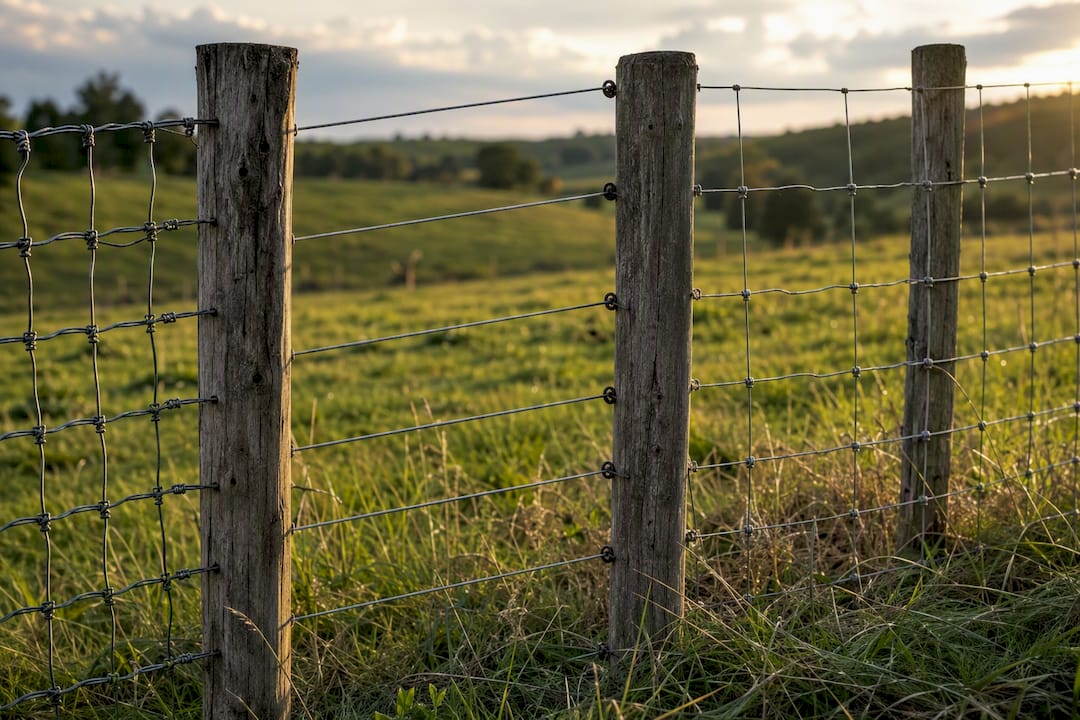
Wood fencing has a traditional look and can work for small paddocks, but it rots, warps, and needs far more frequent replacement than steel, especially at ground contact points. Vinyl fencing resists rot entirely but lacks the tensile strength to hold back a determined bull or a herd pressing against a fence line during a storm. It’s a good fit for décor-focused perimeters, a poor fit for real containment.
Electric-only fencing, including modern virtual fencing systems, offers flexibility and lower material cost, but it depends on a working power source and animal training. It works best as a complement to metal fencing rather than a full replacement on a working farm’s outer perimeter. A GPS-based virtual fence, for instance, gives you rotational grazing flexibility inside a property, while a physical metal boundary fence still handles the hard job of keeping stock off the road and out of the neighbor’s hay field.
Metal agricultural fencing, particularly fixed-knot and high-tensile wire, sits in the middle: higher upfront cost than wood in some cases, but dramatically lower lifetime cost once you account for replacement cycles. It handles direct animal pressure that vinyl can’t, and it doesn’t depend on electricity or battery charge the way an electric-only system does. For perimeter and containment fencing where failure means loose cattle on a highway, metal remains the standard most ranchers default to, with electric and virtual systems layered in for interior pasture management.
How Well Does Metal Fencing Actually Contain Livestock?
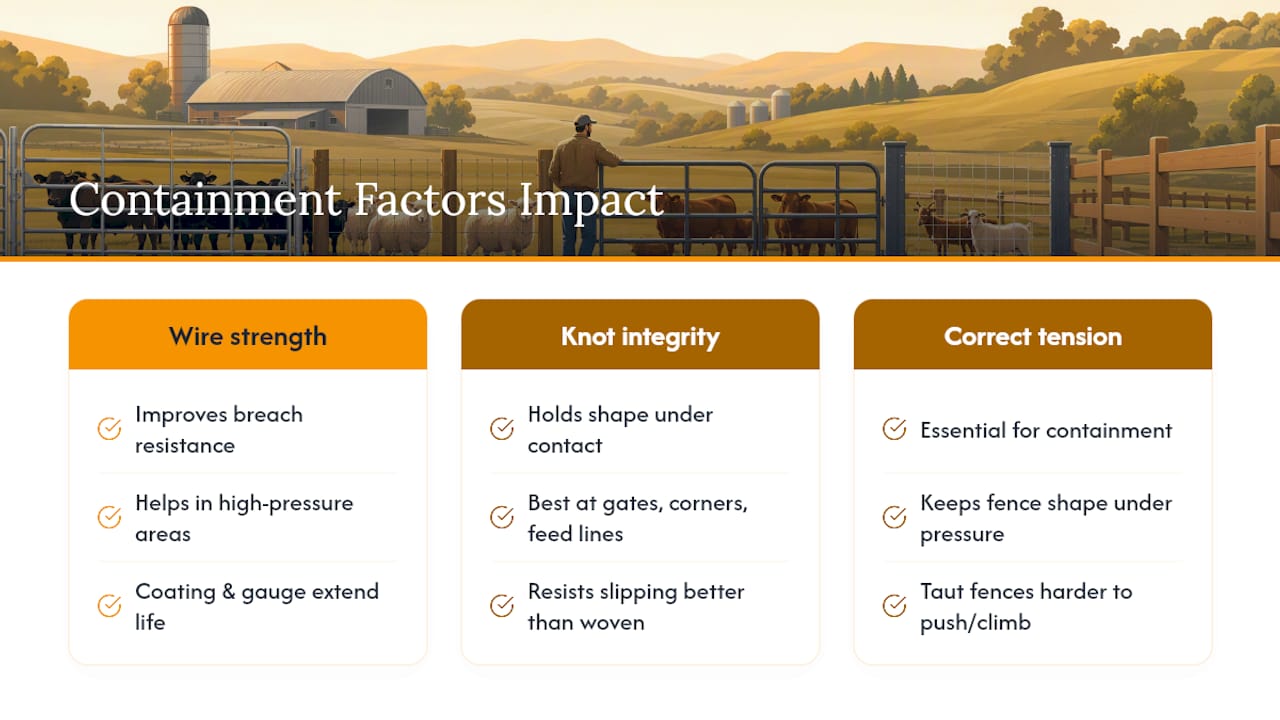
Containment effectiveness comes down to three things: wire strength, knot or joint integrity, and correct tension. Fixed-knot fencing holds its shape under repeated animal contact better than woven or barbed styles because the knot itself resists slipping, which matters most in high-pressure areas like feed lines, gates, and corners where cattle bunch up.
Height and mesh spacing determine what you’re actually keeping in or out. A cattle fence built to standard height with wide mesh does nothing to stop a determined goat or a curious calf from ducking underneath. Sheep and goat operations need mesh spacing tight enough near the ground that animals can’t wedge a head through and get stuck, a common cause of injury on farms running the wrong wire style for their stock.
Security against predators or trespassers is a secondary but real benefit of a well-built metal fence. A taut, properly braced fixed-knot or high-tensile fence is far harder to push through or climb than sagging woven wire, and it holds that resistance for years longer when the coating and gauge are matched to your site conditions. The single biggest containment failure isn’t the wire choice, though. It’s a fence that was never tensioned correctly in the first place.
Balancing Upfront Cost, Durability, And Maintenance
Spend more on gauge and coating when a fence guards a road boundary, a bull pen, or any stretch you can’t easily re-fence later. Cheaper wire makes sense for interior cross-fencing you might reconfigure anyway. Long runs and rough terrain are where professional design help pays for itself, since a spacing mistake compounds over hundreds of feet. Whatever you install, walk it twice a year. No coating outlasts neglect.
— Juiced
Ready To Order? Here’s Where To Start
Once you know your wire style, coating class, and post spacing, the ordering part is straightforward. Fencefast’s fence equipment collection carries the woven wire, fixed-knot, and high-tensile rolls covered in this guide, sized for everything from a small paddock to a full-section boundary run.
For the fastening side, tensioning tools, staples, clips, and strainers are stocked in the fence tools and fasteners collection, so you’re not placing a second order halfway through the job. If your run crosses rough terrain or you’re not sure how many braced posts a stretch actually needs, Fencefast’s design consulting service reviews your layout before material ships, catching spacing mistakes on paper instead of in the field. Measure your run, count your gates, and place your order through the fence equipment collection or request a quote through Fencefast’s site to get shipping timelines specific to your location.
Sources
Technical spacing and tensioning details draw from the Agricultural fencing overview on Wikipedia and Nucor’s agriculture coating guidance. For hands-on planning, see Fencefast’s field fence build guide and livestock containment methods guide.

