

TL;DR:
- Bale grazing significantly reduces winter feeding costs and improves soil health.
- Combining bale grazing with virtual fencing enhances efficiency, saving labor and minimizing physical fencing.
- Canadian producers report reliable winter performance and notable savings using these integrated systems.
Most Canadian ranchers assume winter feeding is just expensive, labor-heavy, and unavoidable. But bale grazing saves $0.65+ per cow per day compared to drylot feeding, and pairing it with virtual fencing technology pushes those savings even further. This guide walks you through how bale grazing works, what virtual fencing adds to the equation, and what Canadian producers are actually experiencing on the ground. If you’ve been told this is too complicated or too expensive to try, the data tells a different story.
Table of Contents
- How bale grazing transforms winter feed costs
- Introducing virtual fencing: Changing the winter game
- Real-world results: Evidence from Canadian ranches
- Essential steps and tips for confident adoption
- Why most producers underestimate the power of combining bale grazing and virtual fencing
- Ready to cut your winter feeding costs?
- Frequently asked questions
Key Takeaways
| Point | Details |
|---|---|
| Cost-effective winter feed | Bale grazing can cut winter feed bills by $0.65 or more per cow per day for Canadian ranchers. |
| Virtual fencing efficiency | App-managed virtual fencing can save 4-5 labor hours per day and enable flexible rotations even in harsh weather. |
| Evidence-based results | Real-world trials across Canada show reliable winter performance, improved pasture health, and reduced workload. |
| Smooth adoption | Training young herds and scaling up gradually help maximize the benefits of new grazing and fencing systems. |
How bale grazing transforms winter feed costs
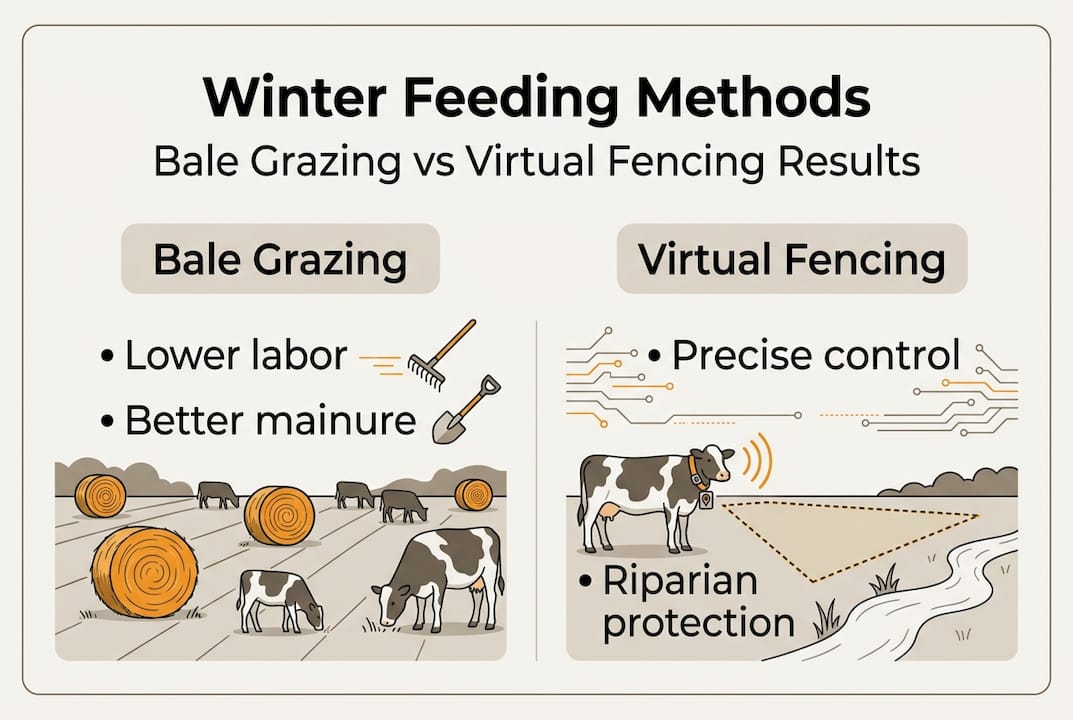
Bale grazing is straightforward in concept. You place round bales across a pasture or cropland in a grid pattern before the ground freezes, then allow cattle to graze them one section at a time throughout winter. Instead of hauling feed daily to a drylot, the cattle come to the feed. Manure gets distributed across the field naturally. Soil health improves. And your fuel, equipment, and labor bills drop substantially.
The economics are hard to argue with. Bale grazing on pasture saves $0.65 to $0.68 per cow per day over drylot feeding. On a 200-cow operation running 150 winter days, that adds up to nearly $20,000 in annual savings. The cost reductions come from several places at once:
- Fuel and machinery costs drop when you’re not hauling feed daily
- Manure handling costs fall because cattle spread it themselves
- Labor hours shrink considerably without daily feeding runs
- Pasture productivity improves the following growing season from natural fertilization
- Soil compaction is reduced compared to drylot setups where cattle concentrate in one area
The environmental upside is worth noting too. When cattle graze across a wider area, riparian zones stay protected, grazing pressure gets distributed, and soil organic matter builds over time. Western Canadian operations in particular have seen measurable yield improvements in the years following bale grazing adoption.
“The savings from bale grazing aren’t just about feed. It’s the cumulative reduction in machinery wear, fuel burn, and manure management that makes the numbers really stack up over a full winter.”
Here’s a quick cost comparison to put it in perspective:
| Cost category | Drylot feeding | Bale grazing |
|---|---|---|
| Daily feed hauling | High | None |
| Manure handling | High | Minimal |
| Fuel per day | High | Low |
| Soil improvement | Negative | Positive |
| Savings per cow/day | Baseline | $0.65 to $0.68 |
Understanding virtual fencing basics helps explain how producers make bale grazing even more precise and hands-off, which we’ll get into next.
Introducing virtual fencing: Changing the winter game
While bale grazing alone offers savings, combining it with new technologies amplifies the impact. Virtual fencing removes one of the biggest remaining friction points in bale grazing: physically moving temporary fences through frozen ground, deep snow, and bitter cold.
Virtual fencing uses GPS-enabled collars worn by cattle, a solar-powered base station, and a smartphone app. You draw fence boundaries directly on a digital map. The system communicates those boundaries to each collar via the base station. When a cow approaches the virtual boundary, she hears an audio tone first as a warning. If she keeps moving forward, a mild, brief stimulus discourages her from crossing. Cattle learn this system quickly, typically within a few days.
The labor savings are significant. Combining bale grazing with virtual fencing can save 4 to 5 hours of labor per day and allows producers to manage rotations remotely from their phone. Think about what that means through a 150-day winter. You’re reclaiming hundreds of hours that would otherwise go to fence moving, bale hauling, and daily check-ins in subzero temperatures.
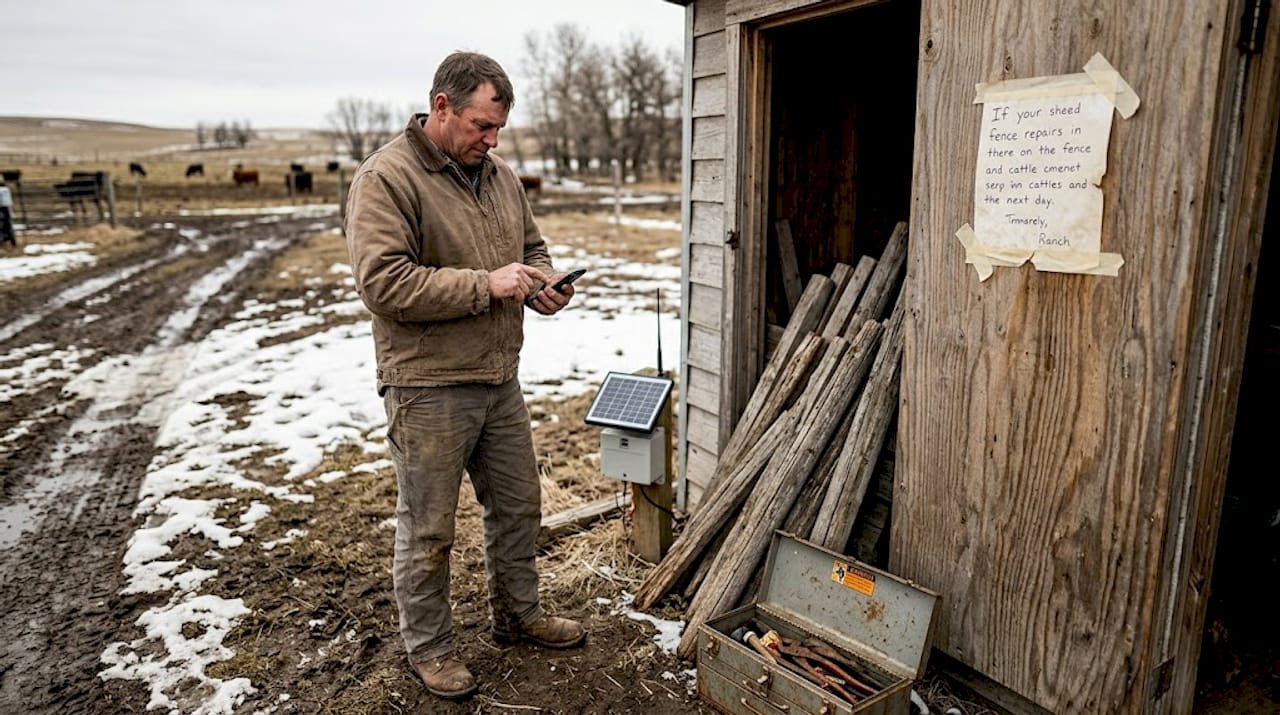
Here’s how virtual fencing compares to manual fence management in a bale grazing setup:
| Task | Manual fencing | Virtual fencing |
|---|---|---|
| Moving fence to new bale strip | 1 to 2 hours daily | Under 5 minutes via app |
| Working in extreme cold | Required | Optional check-ins only |
| Remote access and monitoring | Not possible | Full app control |
| Training new animals | Same | Faster with audio cues |
| Winter reliability | Weather dependent | Proven in Canadian winters |
The Gallagher eShepherd system, which we carry at FenceFast, is built specifically for this kind of application. It includes solar-powered neckbands, a base station, and a cloud-connected app. BC ranches using virtual fencing have reported that the technology held up well through challenging mountain winters.
Key components in a typical virtual fencing setup:
- GPS collar/neckband worn by each animal, solar-powered
- Base station that communicates boundaries to collars
- Smartphone app for drawing zones, monitoring animal locations, and adjusting rotations
- Cloud data logging for herd behavior analysis over time
Pro Tip: Train your herd to the virtual fence system in late fall before the worst weather hits. Use a smaller, manageable group of calmer animals first. Once they understand the audio cue, the rest of the herd tends to follow their lead naturally.
For more on how the eShepherd virtual fencing system works in detail, it’s worth reviewing the full breakdown of the technology before your first winter season.
Real-world results: Evidence from Canadian ranches
But how does this play out in the field? Here’s what Canadian producers are actually seeing. The results from BC, Saskatchewan, Alberta, and Ontario are consistent: virtual fencing is reliable in winter and extends the grazing season while improving pasture health across all four regions studied.
Let’s break down what the numbers look like in practice. A producer running 150 cows who switches from drylot to bale grazing with virtual fencing can expect:
- $0.65 to $0.68 saved per cow per day on feed and handling costs
- 4 to 5 fewer labor hours daily spent on fence moving and feed delivery
- Measurable pasture yield improvements the following spring from distributed manure
- Reduced veterinary costs linked to better herd movement and less mud-related foot problems
A typical implementation calendar for a Canadian winter looks like this:
- August to September: Bales placed in grid pattern across designated pasture areas
- October: Virtual fence system installed, base station positioned, collars fitted and charged
- Late October: Animal training period begins with smaller groups before full herd integration
- November to March: Active winter grazing with remote strip rotations managed via app
- April: System reviewed, collar maintenance completed, pasture recovery monitored
“The biggest surprise was how quickly our herd adapted. Within a week, they responded consistently to the tone. We haven’t moved a physical fence wire all winter.” — Saskatchewan rancher
Riparian zone protection is another benefit that often goes undiscussed. With virtual fencing, you can draw an exclusion zone around any creek, dugout, or sensitive area with a few taps on your phone. No physical fence posts required. For operations near waterways, this alone can have real regulatory and environmental value.
For a detailed look at what virtual fencing costs in Canada, including setup expenses versus long-term returns, there’s a thorough cost analysis available to help you build your business case.
Essential steps and tips for confident adoption
Now that we’ve seen real-world outcomes, here’s how you can ensure the best results and avoid frustrating mistakes. Getting started with bale grazing and virtual fencing doesn’t require being a tech expert. It requires good planning and a willingness to follow a logical sequence.
- Map your bale placement before freeze-up. Decide how many bales you need, where they’ll sit, and how you’ll divide the pasture into strips. Leave enough space between rows for cattle to access each section cleanly.
- Set up and test your base station early. Install your base station in a location with good coverage across the grazing area. Test collar connectivity before animals are involved.
- Fit and charge all collars before training begins. A poorly fitted collar is one of the most common problems producers encounter. Check for proper weight distribution and confirm each unit holds a charge.
- Start training with younger or calmer animals. As noted, train naive animals first and monitor their response carefully before expanding to the full herd.
- Program your first strips conservatively. Give cattle more space than you think they need at first. Tighten the rotation once the herd is comfortable with the system.
- Monitor daily via the app for the first two weeks. Check animal locations, look for any collar alerts, and adjust zones if cattle are consistently pressing the boundary.
Pro Tip: Larger herd sizes make the per-animal technology cost much more manageable. If you’re running fewer than 50 cows, consider whether a shared adoption with a neighbor could reduce your upfront investment while you evaluate the system’s fit for your operation.
Common pitfalls to avoid include ignoring collar battery alerts in cold weather (battery performance can drop in extreme cold, so check charge levels more frequently below minus 20), and failing to account for snow depth when planning strip widths. Deep snow can limit bale access, so build that into your rotation spacing.
For a deeper look at training herds for virtual fencing or to understand what misconceptions might be holding you back, reviewing virtual fencing myths is a practical starting point before your first season.
Why most producers underestimate the power of combining bale grazing and virtual fencing
Stepping back, what does experience teach us about what really enables success with these systems? And why do so many producers still hesitate despite strong data?
The honest answer is that tradition carries a lot of weight in agriculture. When you’ve fed cattle the same way for 30 years, changing the system feels risky even when the math clearly supports the change. Technology skepticism adds another layer. Many ranchers assume virtual fencing is fragile, complicated, or unreliable in cold weather. The data from Canadian operations says otherwise.
What most articles miss is that the real barrier isn’t technical. It’s a management mindset shift. Bale grazing with virtual fencing asks you to plan more upfront and intervene less daily. That’s uncomfortable for producers used to being hands-on every morning. But the producers who commit to this approach consistently report that the first winter is the hardest adjustment, and every winter after that feels easier and more profitable.
The opportunity right now is real. Feed costs are high, labor is expensive, and the technology has matured to the point where Canadian winters are no longer a limiting factor. Waiting another decade to adopt this combination means leaving substantial savings on the table every single year.
Ready to cut your winter feeding costs?
If the numbers in this article resonate with your operation, you don’t have to figure out the next steps alone. FenceFast has spent over 26 years helping Canadian ranchers find fencing and livestock management solutions that actually work in our climate.
As an authorized Gallagher dealer, we carry the full eShepherd virtual fencing system along with everything you need for bale grazing setup and winter management. Our team can walk you through system sizing, collar requirements, and base station placement specific to your operation. Canadian virtual fencing experts are ready to help you build a plan that fits your herd and your budget. For more on how virtual fencing for cattle fits into a winter feeding strategy, explore our full resource library.
Frequently asked questions
How much can I realistically save by switching to bale grazing in winter?
On average, bale grazing saves Canadian producers $0.65 to $0.68 per cow per day compared to drylot feeding, with bigger savings where machinery use drops most significantly.
Does virtual fencing really work in harsh Canadian winter conditions?
Yes. Canadian ranchers confirm winter reliability across BC, Saskatchewan, Alberta, and Ontario, with the technology supporting labor-saving rotations through full winter seasons.
What’s the best way to get a herd started with virtual fencing?
Start by training younger or calmer cattle first, verify collar fit carefully, and expand gradually as animals acclimate to the audio cue and boundary system.
Can I still apply for funding or cost-share programs for virtual fencing in Canada?
Yes. Several OFCAF and BMP funding options are available for eligible Canadian farmers to help offset the upfront cost of virtual fencing adoption.

