

TL;DR:
- Virtual fencing provides over 99.5% cattle containment even in extreme Canadian winter conditions.
- It offers a flexible, cost-effective alternative to permanent fencing for riparian and challenging terrains.
- Canadian field trials confirm virtual fencing’s effectiveness and benign impact on livestock welfare.
Canadian ranchers have long wrestled with one stubborn problem: keeping cattle out of creeks, wetlands, and sensitive streambanks without spending a fortune on permanent fencing. The good news is that virtual fencing has changed the math entirely. Canadian field trials show over 99.5% containment rates even at minus 40 degrees Celsius, meaning the technology works exactly when and where you need it most. This article breaks down how virtual fencing protects riparian areas, what the evidence says, what funding is available, and how to get started on your operation.
Table of Contents
- What are riparian areas and why are they critical?
- Virtual fencing technology: How it works and key features
- Canadian field evidence: Performance and adoption trends
- Getting started: Funding and practical implementation in Canada
- Our take: Why virtual fencing is the future for riparian protection
- Ready to protect your riparian zones? Upgrade with FenceFast
- Frequently asked questions
Key Takeaways
| Point | Details |
|---|---|
| Rapid containment | Virtual fencing achieves over 99% containment and protects riparian zones quickly. |
| Flexible zoning | Farmers can draw and adapt exclusion zones in minutes without physical fencing. |
| Funding support | Canadian programs provide up to $75,000, covering 70-85% of costs for virtual fencing adoption. |
| Minimal welfare impact | Canadian studies find virtual fencing is safe and does not harm livestock productivity. |
| Easy adoption | Step-by-step implementation and practical tips make the transition manageable for most ranchers. |
What are riparian areas and why are they critical?
Riparian areas are the strips of land directly bordering rivers, creeks, ponds, wetlands, and other bodies of water. They are among the most productive and ecologically sensitive pieces of land on any farm or ranch. Vegetation in these zones holds soil in place, filters runoff before it enters waterways, and provides habitat for hundreds of bird, fish, and insect species. In Canada, riparian zones are especially important for coldwater fisheries, including trout and sturgeon populations that depend on stable, shaded streambanks to survive.
The problem is that cattle love riparian areas too, and not in a gentle way. Livestock trample streambanks, break down vegetation, and stir up sediment that clouds water downstream. Overgrazing in these zones removes the deep-rooted plants that anchor soil and filter nutrients. Once those plants are gone, erosion accelerates quickly. A single heavily grazed creek crossing can deposit enough sediment and nutrients to degrade water quality across several kilometers of waterway.
Here is a quick look at what healthy riparian zones provide to your operation and your watershed:
- Water filtration: Riparian vegetation captures nitrates, phosphates, and sediment before they enter waterways.
- Streambank stability: Deep-rooted grasses and shrubs hold soil during spring runoff and heavy rain events.
- Biodiversity support: These zones act as wildlife corridors and nesting areas for dozens of species.
- Shade and temperature regulation: Overhanging vegetation keeps water cool enough for coldwater fish populations.
- Carbon storage: Healthy riparian soils sequester significant amounts of organic carbon over time.
Traditional methods for protecting these areas rely almost entirely on permanent fencing, and that creates its own set of problems. Installing woven wire or barbed wire along creek margins is expensive, time-consuming, and inflexible. Fences built in flood zones get washed out regularly. Terrain along steep riverfronts or coulees can make physical installation nearly impossible or prohibitively costly. And once a permanent fence is up, moving it to adjust grazing rotations or accommodate seasonal changes is a major undertaking.
“Virtual fencing lets ranchers draw exclusion zones around creeks and wetlands in minutes, supporting BC compliance on Crown land while protecting sturgeon spawning habitat and fragile steep riverfronts.” Riverview Ranch in British Columbia is one real-world example of how quickly this protection can be established.
That flexibility is the key shift. With rotational grazing benefits already well documented, adding virtual fencing as the tool to enforce exclusion zones makes riparian protection practical and financially achievable for operations of almost any size.
Virtual fencing technology: How it works and key features
Virtual fencing replaces physical wire and posts with GPS-enabled collars worn by individual animals, combined with software that defines boundaries electronically. Each collar communicates with a base station, and the boundary is set through an app or web-based platform. When an animal approaches a defined exclusion zone, it first receives an audio warning tone. If it continues moving toward the boundary, a mild electrical pulse is delivered through the collar. Cattle learn the audio cue quickly, typically within a few days, and begin turning back before the pulse is ever needed.
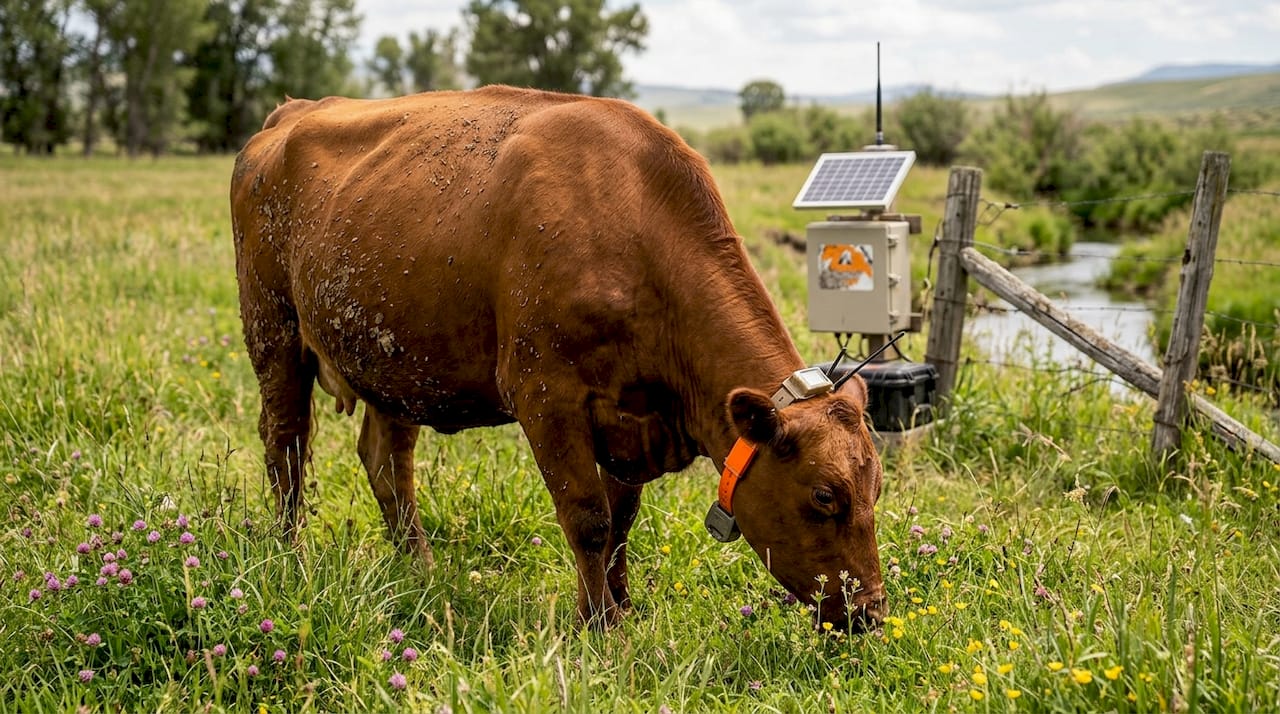
Understanding virtual fencing explained at a technical level helps ranchers set realistic expectations. The Gallagher eShepherd system, for example, uses solar-powered neckbands that communicate over a cellular or LoRa network. No posts, no wire, no heavy equipment needed for setup. You draw your riparian exclusion zone on a tablet or phone screen, and the system enforces it across the herd within hours.
Here is how the setup process works in practical terms:
- Install base stations at strategic points on your property to ensure collar connectivity across the grazing area.
- Fit GPS collars onto individual cattle before moving them to the relevant paddock.
- Define exclusion zones on the app by drawing a boundary around the creek, wetland, or sensitive area you want protected.
- Monitor movement data through the platform to confirm the herd is respecting the virtual boundary.
- Adjust boundaries remotely as pasture conditions change, seasons shift, or new grazing rotations are implemented.
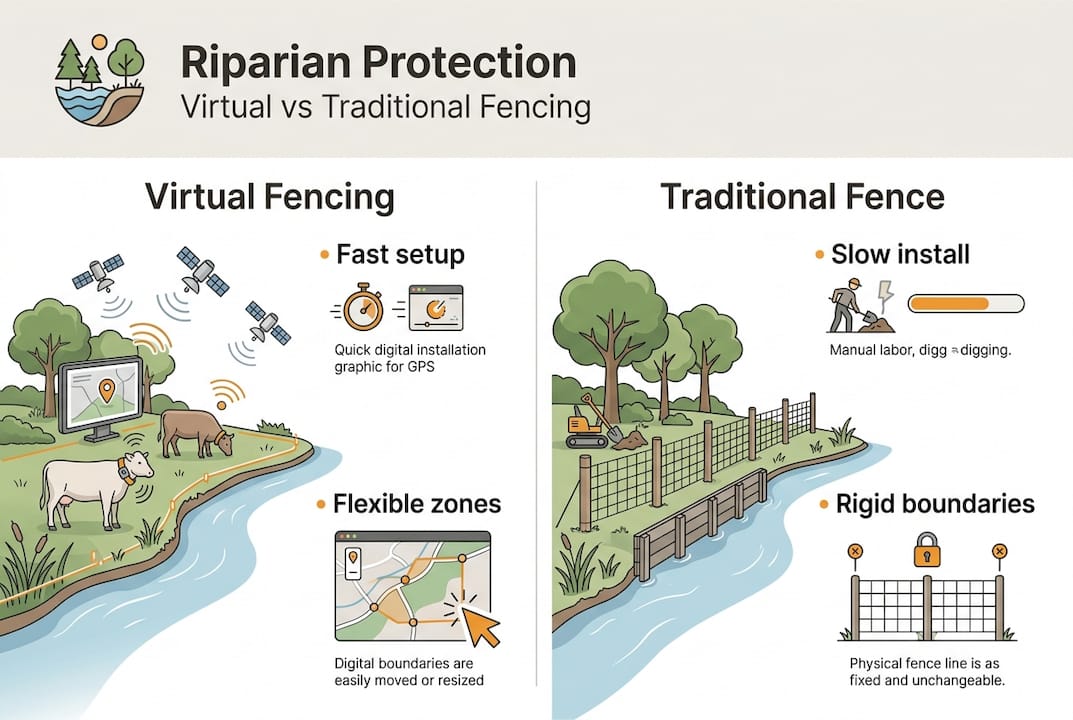
The comparison between virtual fencing and traditional fencing reveals significant differences when applied specifically to riparian protection:
| Feature | Virtual fencing | Traditional fencing |
|---|---|---|
| Setup time for riparian zone | Minutes (app-based) | Days to weeks |
| Cost to protect 1 km of creek | Lower (no materials) | High (wire, posts, labor) |
| Flood resilience | Not affected by floods | Fences wash out |
| Flexibility to change zones | Instant via app | Requires physical work |
| Containment rate (Canada) | Over 99.5% | Dependent on maintenance |
| Terrain adaptability | Works on steep slopes | Difficult on rough terrain |
Unlike permanent fencing, virtual systems do not require you to tear everything out and start over when grazing priorities change. If a riparian zone needs an extended rest period, you simply extend the exclusion zone on your screen. This kind of flexibility matters enormously when you are managing grazing across Crown land or shared range with complex boundary requirements.
When choosing durable fencing for perimeter or permanent structures, physical fencing still plays an important role. But for internal riparian protection and rotational management, virtual fencing is now a legitimate primary tool rather than a niche experiment.
Pro Tip: Use virtual fencing to protect sensitive slopes, coulees, and fragile riverfronts where physical fencing is too costly or impractical to install. The terrain limitations that once made protection impossible are no longer barriers.
Canadian field evidence: Performance and adoption trends
Canadian ranchers are not working on faith here. Multiple field trials conducted across Alberta and British Columbia have produced concrete data on how virtual fencing performs under real prairie and mountain conditions, including the brutal winters that make any equipment questionable.
The numbers are striking. Over 99.5% containment was recorded in a University of Alberta study run across both summer and winter seasons, with temperatures dropping to minus 40 degrees Celsius. The eShepherd system achieved 98% containment within just 72 hours of cattle being introduced to the virtual boundaries. Even battery performance held up, with Nofence collars maintaining over 96% battery reliability through winter months, a concern many ranchers initially had about solar-powered devices in low-light conditions.
Here is a summary of key performance metrics from Canadian virtual fencing trials:
| Metric | Result | System/Source |
|---|---|---|
| Overall containment rate | Over 99.5% | UAlberta study |
| Containment within 72 hours | 98% | eShepherd (Gallagher) |
| Winter battery reliability | Over 96% | Nofence system |
| Animal welfare classification | Benign | UAlberta assessment |
| Production impact | None detected | UAlberta study |
The welfare findings deserve particular attention. The UAlberta research classified virtual fencing as “benign” on animal health and found no measurable impact on production metrics like weight gain or feed conversion. This matters because welfare concerns are one of the most common objections ranchers raise when considering this technology. The evidence is now clear that when systems are set up correctly and cattle are given adequate training time, there is no meaningful downside for the animals.
Adoption is spreading fastest on operations dealing with difficult terrain. In BC, ranches with steep riverfront access have found virtual fencing especially valuable because permanent fencing on those slopes was never economically viable in the first place. In Alberta, ranches managing large grazing blocks on Crown land have adopted the technology to meet environmental compliance requirements without the cost and disruption of physical infrastructure installation.
Key benefits ranchers in these trials observed include:
- Rapid adaptation of grazing patterns without moving wire or posts
- Reduced labor costs associated with fence checks and repairs
- Improved riparian health visible within a single grazing season
- Real-time herd location data that eliminated guesswork about where cattle were grazing
- Easier compliance documentation for environmental monitoring requirements
The honest picture on virtual fencing costs also includes upfront collar and base station investment, along with subscription fees for the management platform. These are real considerations. But when weighed against the long-term cost of building and maintaining permanent riparian fencing across difficult terrain, the economics often favor virtual fencing, especially once available funding programs are factored in.
Statistic callout: Over 99% containment and more than 96% battery reliability through Canadian winters. Virtual fencing outperformed expectations set by trials conducted in milder climates overseas.
Getting started: Funding and practical implementation in Canada
The funding landscape for virtual fencing adoption in Canada has improved substantially in recent years, making it much more accessible for average-sized operations. In Alberta, the RDAR (Results Driven Agriculture Research) program and OFCAF (On-Farm Climate Action Fund) both support virtual fencing adoption. Funding of up to $75,000 is available, with coverage reaching 85% of eligible costs in some programs. British Columbia offers similar support through OFCAF and BMP (Beneficial Management Practices) funding streams, also reaching up to 85% cost coverage for rotational grazing and riparian protection projects.
That 85% coverage figure is significant. If your virtual fencing system costs $30,000, you may only pay $4,500 out of pocket. That changes the conversation around upfront investment entirely.
Here is a step-by-step implementation plan to guide your transition:
- Assess your riparian zones. Walk your property and identify the creek margins, wetlands, and sensitive slopes that need protection. Map these areas using satellite imagery or a GIS tool before making any system decisions.
- Select your virtual fencing system. Compare systems based on your herd size, property size, terrain, and connectivity options. The Gallagher eShepherd system is a strong choice for Canadian conditions given its documented performance in cold-weather trials.
- Apply for available funding. Contact your provincial OFCAF administrator or RDAR office to start a funding application before purchasing equipment. Many programs require pre-approval, so this step must come early. Learn more about virtual fencing funding options to understand exactly what you qualify for.
- Install base stations and fit collars. Work with your supplier to plan base station placement for maximum coverage across your grazing area.
- Train your herd. Allow a dedicated training period of 3 to 7 days where cattle learn to associate the audio warning with the boundary. Rushing this step reduces containment effectiveness.
- Define and activate exclusion zones. Draw your riparian protection boundaries in the app and begin monitoring herd behavior through the platform’s real-time tracking tools.
- Review and adjust seasonally. Virtual boundaries can be updated as pasture conditions, water levels, and rotational grazing schedules change throughout the year.
Practical tips for a smooth rollout:
- Map your exclusion zone boundaries before fitting collars so they are active from day one
- Start with a smaller training paddock before moving cattle to the full grazing area with the virtual boundary in place
- Keep records of herd location data for environmental compliance reporting
- Check battery levels and connectivity during the first two weeks to catch any equipment issues early
- Document riparian zone recovery with photos at the start of each season to measure improvement over time
Pro Tip: Partner with local conservation groups like Ducks Unlimited Canada or your regional watershed stewardship organization. They often provide technical support, mapping assistance, and can strengthen your funding applications.
Our take: Why virtual fencing is the future for riparian protection
Conventional wisdom in the farming community has long held that physical fencing is the only reliable way to protect sensitive areas from livestock. Steel, wire, and posts feel permanent. They feel dependable. Virtual fencing, by contrast, has been treated as a premium novelty, interesting in theory but unproven where it counts.
The Canadian evidence now says otherwise. Systems are performing at containment levels that exceed many physical fence installations, they work through brutal winters, and the welfare impacts are classified as benign by independent researchers. The flexibility advantage alone would justify adoption, but the containment data makes it a straightforward choice for riparian protection on challenging terrain.
That said, the challenges around durability and long-term cost are real and should not be dismissed. Collar hardware exposed to years of range conditions will face wear and tear. Software subscriptions add ongoing costs that do not exist with wire fencing. A thorough fencing cost analysis for your specific operation is essential before committing.
The real lesson from Canadian adoption is that virtual fencing works best when ranchers invest in proper livestock training and commit to learning the management platform. Operations that rushed the training phase saw lower initial containment and frustrated expectations. Those that followed the protocol saw near-perfect results within days.
Pro Tip: Focus on technology integration and dedicated livestock training as your two non-negotiable priorities. Everything else is adjustable.
Ready to protect your riparian zones? Upgrade with FenceFast
Protecting your riparian areas does not have to mean weeks of physical fence installation or budget-breaking infrastructure costs.
At FenceFast, we carry the complete lineup of Gallagher eShepherd virtual fencing technology, including GPS solar neckbands, base stations, and app-based herd management tools built specifically for Canadian conditions. Whether you need a Gallagher LiveLite for your paddock setup or a durable Hayes fencing tool for traditional perimeter work, we have you covered. Our team has 26 years of Gallagher partnership experience, and we can walk you through funding applications, system design, and implementation from start to finish. Nationwide shipping available across Canada.
Frequently asked questions
How quickly can virtual fencing protect riparian zones?
Exclusion zones for creeks and wetlands can be drawn in minutes through the app, and cattle containment reaches 98% within 72 hours of introduction to the virtual boundary.
What funding is available for virtual fencing in Canada?
Programs like RDAR and OFCAF provide up to $75,000 in support, with some programs covering up to 85% of eligible costs in both Alberta and British Columbia.
Does virtual fencing impact livestock welfare?
UAlberta research classified virtual fencing as “benign,” finding no negative effects on animal health, behavior, or production metrics like weight gain.
How does virtual fencing compare to traditional fencing for riparian zones?
Virtual fencing for riparian protection offers instant, flexible exclusion zones without permanent infrastructure, making it far more adaptable than wire fencing on steep slopes, floodplains, and Crown land grazing areas.

