

TL;DR:
- Virtual fencing provides effective, customizable grazing control using GPS collars without physical infrastructure.
- It significantly reduces labor and costs, especially on large, remote, or fire-affected BC Crown land areas.
- Funding programs in BC can cover up to 85% of costs, making virtual fencing accessible for ranchers.
Managing cattle on BC Crown land has always been a grind. Aging wire, wildfire-damaged corridors, patchy roads, and the sheer size of grazing allotments make rotational grazing and compliance feel like a full-time job on top of your full-time job. Labor shortages only make it worse. The good news is that virtual fencing is not just a future promise. It is already proven on Canadian ranches with over 99% containment effectiveness and cattle that adapt in under a week. This article covers how the technology works, what it delivers for Crown land permit holders, which systems fit BC operations, and where to find serious funding support.
Table of Contents
- How virtual fencing works for BC Crown land
- Key benefits for Crown land grazing permit holders
- System options, cost breakdown, and funding in BC
- Limitations, field experiences, and practical tips
- The real impact: Why virtual fencing won’t replace all wires — yet
- Ready to optimize your grazing with virtual fencing?
- Frequently asked questions
Key Takeaways
| Point | Details |
|---|---|
| Proven technology | Virtual fencing is over 99% effective in training and containing cattle on BC Crown land. |
| Major BC funding available | Eligible producers can secure up to 85% equipment cost coverage when they apply for grants. |
| Ideal for remote, tough terrain | Virtual fencing is especially valuable where physical fences are aging, burned, or hard to maintain. |
| Physical fences still required | Producers should use virtual fencing with perimeter fences for full compliance and best livestock security. |
How virtual fencing works for BC Crown land
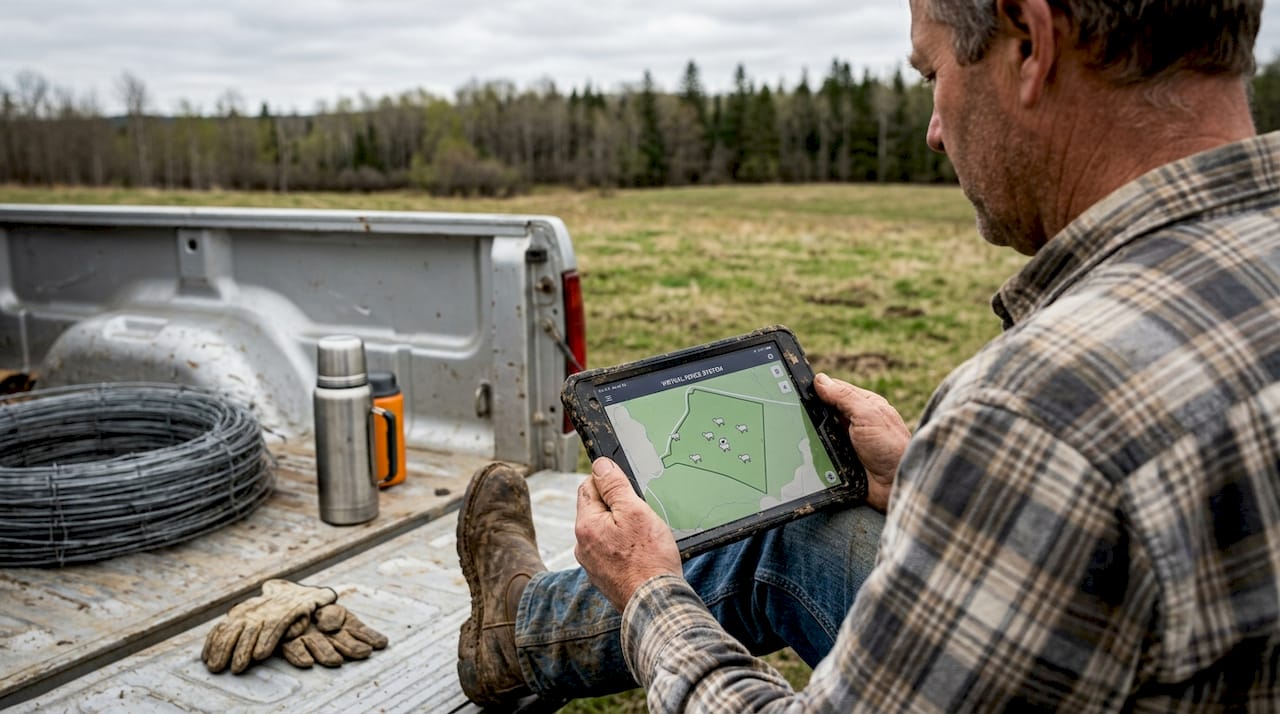
Understanding the basics is the fastest way to judge whether this fits your operation. Virtual fencing uses GPS-enabled solar-powered collars worn by each animal. You define a boundary in an app, and the system enforces it automatically. No posts, no wire, no work crews.
When a cow approaches your defined line, the collar emits an audio cue. If the animal keeps moving toward the boundary, it receives a brief, mild electric pulse. That pulse is similar in intensity to a standard electric fence contact, and it only happens when the animal ignores the audio warning. In practice, most cattle quickly learn that the beep means stop, and the pulse becomes rare. Understanding virtual fencing basics gives you a strong foundation before committing to a system.
Here is what the training and containment process typically looks like:
- Day 1 to 2: Cattle explore the boundary and receive occasional pulses while learning the audio cue
- Day 3 to 4: Most animals respond consistently to audio alone
- Day 5 to 7: Herd behavior stabilizes; animals treat the virtual line like a real fence
- Ongoing: Monitoring via app; boundary adjustments take seconds from your phone
Field data from Canadian operations backs this up. Cattle adapt in 4 to 7 days with containment exceeding 99% in trials across varied terrain.
“Virtual fencing allows us to rotate pastures on remote Crown land that we could never practically fence with wire. The cattle figured it out faster than we expected.” — BC rancher, as reported by Canadian Cattlemen
For BC producers, the terrain advantage is real. LoRa-based base stations extend coverage even where cellular service fails, making virtual fencing for BC ranches viable across rugged mountain ranges and dense timber areas where you would never string wire economically.
Key benefits for Crown land grazing permit holders
Now that the system is clear, here is what it actually delivers for producers holding Crown land grazing permits in BC.
- Precision rotational grazing without the labor: You move your herd’s boundary from a phone app. No ATV, no crew, no lost afternoon. This matters enormously on large allotments where physically herding cattle between paddocks takes hours.
- Lower infrastructure cost on remote terrain: Stringing wire in steep, rocky, or burned terrain is expensive and sometimes impossible. Virtual fencing cuts that cost significantly.
- Wildfire recovery support: Post-fire landscapes are often impassable for fencing crews. Virtual fencing lets you manage grazing on recovering range immediately, supporting faster pasture regeneration without waiting for physical fence rebuilds.
- Compliance with rotational grazing plans: BC range use plans often require documented rotation. App-based systems log every boundary move automatically, giving you a compliance record without extra paperwork.
- Sensitive area protection: Keep cattle out of riparian zones, reseeded areas, or wildlife corridors by adjusting boundaries digitally, no exclusion fencing required.
For wildfire-affected operations, pairing virtual fencing with thoughtful wildlife friendly fencing after wildfire creates a resilient, multi-layered approach to land recovery.
Pro Tip: If your grazing plan requires you to document rotational moves, the app logs from systems like Gallagher eShepherd can serve as your compliance record. Screenshot and save those logs each season.
The BCCA fencing resources confirm what producers on the ground already know: aging fences, remote access challenges, wildfire-damaged infrastructure, and the need for efficient grazing plan compliance are the top pain points driving interest in virtual fencing across BC. The technology addresses all four directly.
Statistic to note: BC cattle producers managing allotments over 500 hectares report that rotational boundary moves alone can consume two to three staff days per week with traditional methods. Virtual fencing compresses that to under 30 minutes.
System options, cost breakdown, and funding in BC
To maximize your investment, knowing system specifics and funding programs before you buy is critical.
Leading systems compared
| Feature | Gallagher eShepherd | Nofence | |—|—|—|
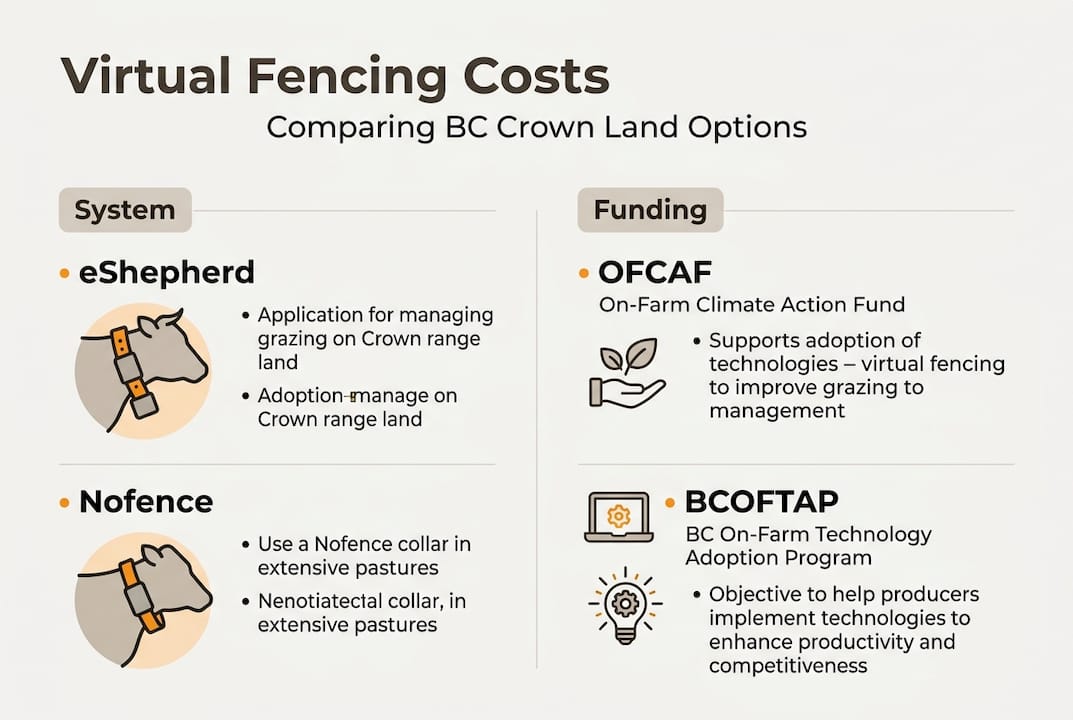
| Connectivity | LoRa base stations | Cellular (LTE) | | Collar cost | $350 to $415 per unit | Similar range | | Subscription | $2.25 to $2.50/month per collar | Per animal monthly fee | | Remote terrain fit | Excellent (LoRa works off-grid) | Depends on cell coverage | | Solar powered | Yes | Yes | | BC Crown land suitability | High | Moderate to high |
For most BC Crown land situations, eShepherd has a clear advantage because LoRa base stations create your own local network. Cellular-dependent systems work well in regions with reliable coverage but can struggle on remote allotments.
Funding programs available in 2026
This is where BC producers have a real edge right now. Multiple programs stack together:
- OFCAF (On-Farm Climate Action Fund): Covers up to 70% of eligible equipment costs
- BMP (Beneficial Management Practices): Covers up to 60%, and these two programs can stack to 85% coverage of your total cost
- BCOFTAP: The BC On-Farm Technology Adoption Program covers labor-saving agricultural technology like virtual fencing, with budgets up to $800,000 per applicant
For a 100-cattle operation, here is a rough budget example:
| Cost item | Gross cost | After 85% funding |
|---|---|---|
| 100 collars at $385 each | $38,500 | $5,775 |
| Base station setup (2 units) | $4,000 | $600 |
| Annual subscription (100 units) | $2,700/yr | Producer pays in full |
Application timing matters. OFCAF and BMP intakes open on a rolling basis, and BCOFTAP intakes are numbered with specific deadlines. Apply before you purchase equipment, not after. Review your eligibility with a program advisor first, as Crown land permit holders often qualify but need to confirm their range use plan is current.
For a deeper look at what these programs cover year to year, the virtual fencing costs guide breaks it down by program and scenario.
Limitations, field experiences, and practical tips
Despite promising benefits and funding, every tool has its limits and learning curve. Here is the real-world picture from BC and Alberta experience.
The most important thing to understand: virtual fencing is not a full replacement for perimeter fencing. It excels at internal division, flexible paddock creation, and sensitive area exclusion. For your outer perimeter, especially where Crown land policy requires a legal fence, physical wire remains necessary. Poor connectivity in less than 1% of cases was seen even in Alberta winter trials, which is impressive, but a broken collar or a downed base station in a remote area still needs a plan.
Here are practical tips drawn from field experience:
- Check collar fit weekly during the first month, especially on young or growing animals
- Position base stations on high ground or ridgelines for maximum LoRa signal reach
- Pre-train new cattle in a smaller, familiar paddock before moving them to large open allotments
- Back up boundaries in the app so you can quickly restore a working paddock configuration after adjustments
- Monitor daily during peak grazing season using the app’s alert features; boundary breach alerts give you early warning before animals stray far
Pro Tip: When setting up on a new allotment, run the system alongside a temporary electric fence for the first two weeks. It costs little extra and gives you confidence while cattle are still learning the audio cues.
“The collar system held through a cold snap that froze our water lines. We had zero escapes that week even with agitated, thirsty cattle.” — Alberta producer, reported in field research
For BC Crown land, the combination of LoRa connectivity and solar-powered collars addresses the two biggest remote-area concerns: power and signal. Reviewing animal fencing basics alongside your virtual fencing plan ensures your full setup, perimeter included, meets both regulatory and practical standards.
Battery life on solar collars holds up well through BC winters as long as animals are grazing in areas with reasonable daylight exposure. Heavily forested allotments may require periodic manual charging of a small number of collars during the darkest months.
The real impact: Why virtual fencing won’t replace all wires — yet
After working with producers across BC and reviewing field data from Canadian trials, our honest take is this: virtual fencing is one of the most significant tools to reach the range management sector in decades, but it works best when you stop thinking of it as a wire replacement and start treating it as a management layer.
The producers getting the best results in 2026 are using virtual fencing to do things physical fences never could: moving paddocks daily, excluding riparian zones after heavy rain, and managing wildfire recovery areas where no crew can safely go. They are still maintaining perimeter wire. Virtual fence case studies from BC ranches show that the hybrid approach consistently outperforms either method alone in both land recovery rates and labor efficiency.
The technology will keep improving. Collar durability, base station range, and app intelligence are all advancing quickly. For now, the savviest approach is using virtual fencing where it solves a problem that wire cannot, and keeping your physical perimeter solid where compliance and security demand it.
Ready to optimize your grazing with virtual fencing?
If you are managing Crown land in BC and want to reduce labor, improve rotational grazing compliance, and recover faster from wildfire damage, virtual fencing is a practical next step worth serious attention.
At FenceFast, we are an authorized Gallagher dealer with 26 years of partnership experience and direct knowledge of BC funding programs. We can walk you through system selection, collar counts, base station placement, and OFCAF or BMP application timing. Tools like the Gallagher Ag Devices App and the Gallagher i-Series Alarm integrate directly with eShepherd for complete herd oversight. Ready to get started? Contact FenceFast for a no-pressure consultation tailored to your Crown land situation.
Frequently asked questions
How effective is virtual fencing for cattle on BC Crown land?
Trials in Canada show over 99% containment when collars are properly fitted and managed, making it highly reliable even on rugged terrain.
Can I get funding for virtual fencing equipment in BC?
Yes, OFCAF, BMP, and BCOFTAP programs can stack to 85% cost coverage if your grazing plan is current and you apply before purchasing equipment.
Do I still need physical fences if I use virtual fencing?
Perimeter fencing is still recommended for legal compliance and security. Virtual fencing is not a full replacement for all perimeter uses, but it excels at internal division and flexible paddock management.
How long does it take cattle to learn virtual fences?
Most cattle adapt in 4 to 7 days, responding reliably to the audio cue alone after the first few days of training.
What happens if the collar loses connection in remote areas?
LoRa-based systems maintain coverage with minimal downtime. Field research shows less than 1% poor connectivity even in Alberta winter conditions, which reflects well on performance in BC’s remote terrain.
Recommended
- Virtual Fencing for BC Ranches: Boost Grazing, Cut Costs – FenceFast Ltd.
- What is virtual fencing for cattle? Herd control explained – FenceFast Ltd.
- Virtual fencing costs in Canada: What farmers need to know – FenceFast Ltd.
- Fencing for Rotational Grazing: Proven Solutions for Canadian Farmers – FenceFast Ltd.

