

TL;DR:
- Proper insulator choice is critical to prevent voltage loss, fence failure, and livestock escapes.
- Different insulator types and materials suit specific post styles and climate conditions for durability.
- Virtual fencing complements, not replaces, physical perimeter insulators, requiring ongoing fence maintenance.
Choosing fence insulators used to be straightforward: match the product to your post type, pick a durable material, and move on. That calculus is shifting fast. As virtual fencing adoption grows across Canadian ranches, the selection problem now includes connectivity options and management workflows alongside traditional hardware choices. But here’s what gets lost in all the technology talk: your perimeter fence still needs solid physical insulators, and picking the wrong ones still causes fence failures, livestock escapes, and expensive fixes. This guide cuts through the confusion and gives you clear, practical direction on both fronts.
Table of Contents
- Why insulator choice matters for livestock management
- Types of fence insulators: Comparing your options
- Virtual fencing and the shift in insulator priorities
- Practical steps for choosing the right fence insulator
- Why the future of livestock fencing is hybrid—what experts get wrong
- Find the right tools for your fencing system
- Frequently asked questions
Key Takeaways
| Point | Details |
|---|---|
| Insulator quality is critical | Well-chosen insulators prevent power loss and livestock escapes by ensuring durability and reliability even in harsh Canadian conditions. |
| Virtual fencing needs perimeter support | Even with advanced tech, physical perimeter fencing and the right insulators remain essential for total livestock control. |
| Match insulator to fence type | Consider fence material, use case, and species when selecting between post, chain link, and specialty insulators. |
| Hybrid systems offer best results | Combining virtual and traditional systems allows farmers to optimize management and safety. |
| Consult expert resources | Use guides and product expertise to avoid common pitfalls in fence insulator selection. |
Why insulator choice matters for livestock management
Let’s start by laying out what makes insulator selection so important for your operation.
A fence insulator is the component that physically separates your energized wire from the post, preventing electricity from leaking into the ground or the post itself. When an insulator fails, you lose voltage, and your fence stops deterring animals. For high-pressure species like bulls or large beef cattle herds, even a brief drop in fence performance can mean a costly breakout.
The stakes are especially high in Canada, where temperature swings from minus 40°C winters to hot, dry summers put enormous stress on plastic and polymer components. Cheap insulators crack, become brittle, and fail in cold snaps. UV exposure degrades low-quality plastics over a single grazing season. The result is a fence that looks intact but delivers zero deterrence.
Here is what good insulator selection protects against:
- Energy loss: Cracked or poorly fitted insulators bleed voltage into posts and soil, reducing fence effectiveness well below the minimum needed to train livestock
- Accidental grounding: A grounded wire delivers no shock and gives animals a free pass through your boundary
- Physical fence failure: Insulators that cannot handle wire tension or animal pressure snap, leaving bare wire in contact with the post
- Increased maintenance labor: Failed insulators discovered only after a breakout cost you far more time than a proper upfront selection
Pro Tip: Walk your fence line after the first hard freeze of the season. Cold weather reveals cracked insulators that look fine in summer. Replace anything showing stress fractures before the next grazing season starts.
The fence insulator safety fundamentals behind proper selection go beyond just picking a sturdy piece of plastic. Voltage loss compounds across your entire fence circuit, so even one or two bad insulators in a long run can drop system performance enough to matter.
“The practical selection problem with virtual fencing shifts from physical components to connectivity and management workflow.” This matters because it tells you where to put your attention when adopting new technology, but it does not mean physical insulators become unimportant. They remain the backbone of your outer boundary.
If you are new to building or upgrading a system, our electric fence setup guide covers the full sequence from energizer selection through wire installation, giving you the complete picture before you start buying hardware.
Types of fence insulators: Comparing your options
Understanding why insulators matter sets us up to compare the available options on the market.
Insulators come in several main types, each designed for a specific post style or fencing application. Using the wrong type for your situation creates gaps in your fence circuit and mechanical weak points.
Common insulator types at a glance
| Insulator type | Best use | Material options | Notes |
|---|---|---|---|
| Line post | Standard T-posts and wood posts along straight runs | Plastic, polymer | Most common; choose UV-stabilized for durability |
| Corner | High-tension corners and end posts | Heavy-duty plastic or porcelain | Must handle directional wire pull |
| Offset | Converting existing non-electric fences to electric | Plastic | Extends wire away from the existing fence |
| Chain link | Adding electric deterrent to chain link barriers | Specialized plastic clips | Prevents grounding through metal mesh |
| Pigtail/step-in | Temporary paddock division and rotational grazing | Plastic, fiberglass | Quick to move; lower load capacity |
Material performance summary:
- Porcelain: Outstanding durability and UV resistance, handles extreme cold without cracking, best for permanent high-voltage installations, heavier and more expensive
- UV-stabilized polymer: Good balance of cost and performance, rated for outdoor use, degrades faster than porcelain but outperforms basic plastics in Canadian conditions
- Standard plastic: Fine for low-stress applications and short-term setups, but avoid it on permanent, high-tension lines in harsh climates
Chain link fence insulators deserve specific attention because the metal mesh creates an instant grounding risk if a standard insulator fails or if the wire contacts the fence at any point. The specialized clips for chain link create a physical gap between the energized wire and the metal structure, which is non-negotiable for safety and effectiveness.
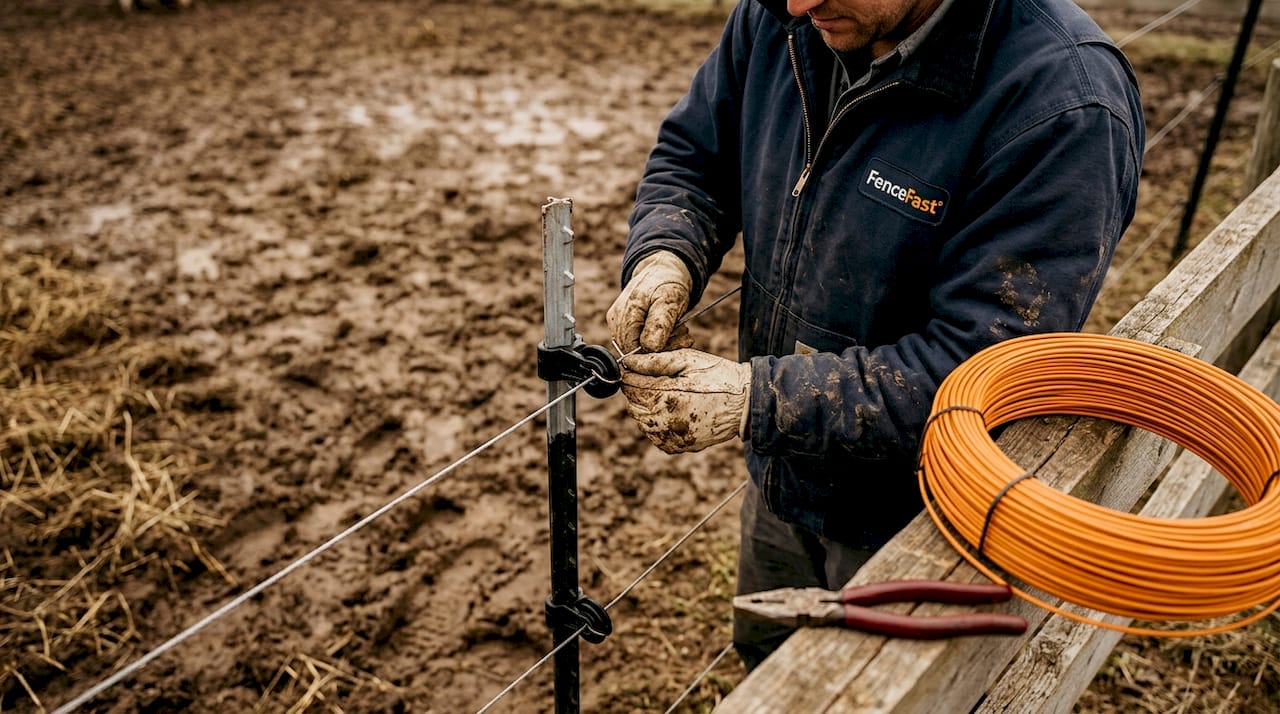
For T-post electric fence insulators, look for designs that clip firmly over the post flange rather than relying on friction alone. In high-wind areas of the Prairies, loose-fitting insulators work free over time, letting wire drop against the post.
Virtual fencing is positioned as internal paddock management paired with a physical perimeter, which means your outer fence insulators still carry the full load of containment. Choose them accordingly.
Virtual fencing and the shift in insulator priorities
With a grasp of insulator types, it is important to explore how new technologies like virtual fencing are shifting what matters in your setup.
Virtual fencing systems like Gallagher eShepherd use GPS-enabled neckbands that deliver audio cues and mild electrical stimulation to direct cattle movement without physical wires inside the paddock. This changes how you think about internal cross-fencing entirely. Instead of stringing wire every time you want to rotate cattle to a new paddock, you adjust a boundary on an app. That is a genuine labor savings.
But virtual fencing requires cellular coverage or a LoRa base station, and it does not replace perimeter fencing. This is where many producers get the picture wrong. They assume adopting virtual fencing means they can step back from physical fence maintenance. In practice, the opposite is true: your perimeter fence needs to be in better shape than ever, because it is the last line of defense when an animal tests the virtual boundary or a neckband malfunctions.
Research supports the reliability of virtual containment itself. Stocking density and forage quantity did not influence measured effectiveness and cue predictability across tested ranges of 2 to 8 animals per hectare. That means you do not need to recalibrate your physical fence insulator setup based on herd density when using virtual systems. Focus your insulator choices on fence type, wire tension, and animal species pressure instead.
Here is how to approach your setup when integrating virtual fencing:
- Confirm connectivity first. Check cellular signal strength across your entire operation, or plan for a LoRa base station to cover dead zones. No connectivity means no virtual boundary, which throws all the load back onto your physical fence.
- Upgrade perimeter insulators before launch. Before you shift internal fencing to virtual management, do a full inspection of your outer boundary and replace any aging or cracked insulators.
- Maintain temporary internal fencing capability. Keep a supply of step-in pigtail insulators and polywire for situations where a physical backup is needed inside a paddock during system outages or training phases.
- Plan your training workflow. Cattle need two to three days of proper training before they respond reliably to virtual cues. During this period, temporary physical barriers may still be needed.
Pro Tip: When evaluating virtual fencing for cattle on your operation, map your cellular coverage using a phone signal test at multiple points across your property before investing in hardware. Dead zones in remote pastures are the single most common reason early adopters run into trouble.
The rotational grazing fencing model that many Canadian ranchers already use pairs naturally with virtual fencing because the paddock rotation logic translates directly to the app-based boundary management interface. The physical infrastructure you built for rotational grazing becomes the perimeter, and the virtual system handles the internal divisions.
Practical steps for choosing the right fence insulator
Equipped with this context on new technologies, let’s move into actionable steps to select the ideal insulators for your farm.
The right insulator is never a one-size-fits-all decision. Fence material, animal species, climate zone, and whether you plan to integrate virtual fencing all affect what you should buy.
Step 1: Identify your fence material and post type. Wood posts, T-posts, and fiberglass posts each require different insulator mounting styles. Mixing post types across your property means you may need two or three different insulator models on the same fence run. Catalog your posts before ordering.
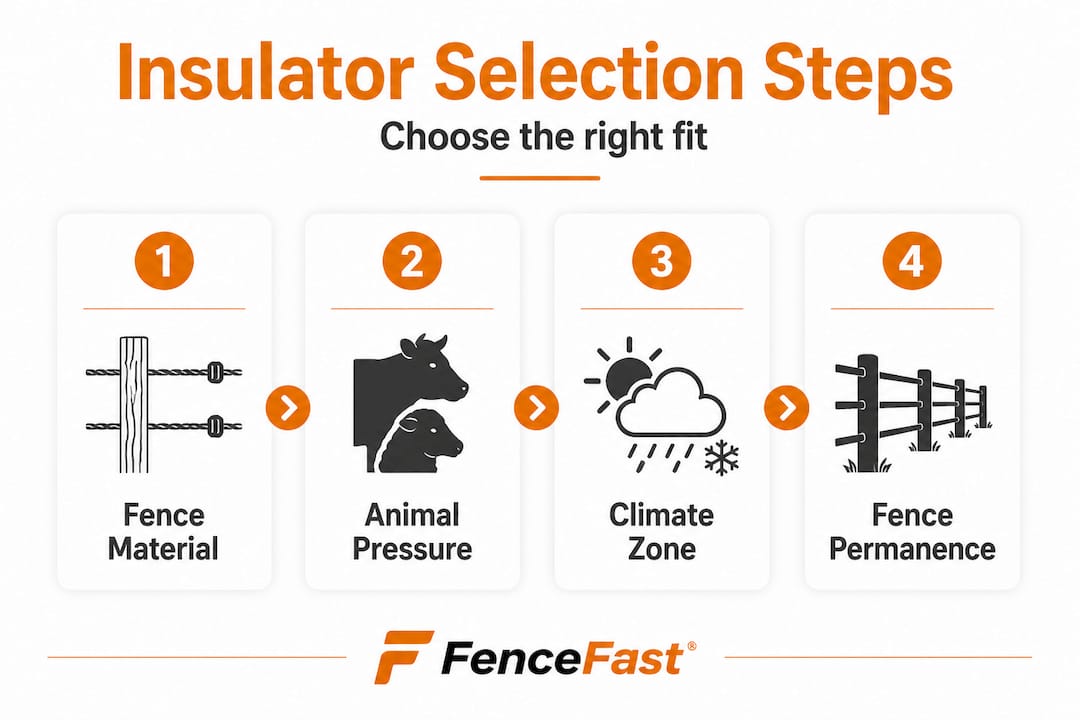
Step 2: Match the insulator to your animal and pressure level. Horses and cattle push against fences differently. Horses are more likely to test fences with their chests and legs, requiring insulators that hold wire at a height that discourages this. Cattle pressure is often more direct. High-pressure animals need insulators with robust locking mechanisms, not simple friction clips.
Step 3: Factor in your climate zone. In Alberta, Saskatchewan, and Manitoba, you are regularly dealing with freeze-thaw cycles that crack standard plastics. Stocking density research reminds us that animal pressure is relatively predictable, but climate stress is not. Invest in porcelain or high-grade UV-stabilized polymers for permanent installations in these regions.
Step 4: Determine permanence. Permanent fences justify higher-cost, longer-life insulators. Temporary rotational systems benefit from quick-clip step-in designs. Our temporary fencing guide walks through the specific products that make temporary setups fast and reliable without sacrificing safety.
Step 5: Plan for future upgrades. If you are considering virtual fencing in the next one to two seasons, install solid perimeter insulators now. You do not want to be replacing your outer fence the same year you are onboarding a new technology. Our rotational grazing fencing benefits resource shows how a properly built perimeter sets up your entire grazing management strategy for long-term success.
Common insulator selection mistakes to avoid:
- Buying the cheapest option and replacing it every season rather than investing once in a quality product
- Using line post insulators at corners where wire tension pulls them off the post
- Skipping insulators entirely on metal T-posts, assuming contact is acceptable (it never is on an electric fence)
- Choosing standard plastic in northern climates where freeze-thaw cycles destroy them within two to three seasons
- Forgetting to inspect insulators seasonally, especially after hail or ice storms
Why the future of livestock fencing is hybrid—what experts get wrong
There is a narrative spreading through the virtual fencing world that physical fences are essentially obsolete infrastructure. Technology companies sometimes reinforce this by marketing their products as fence replacements. That framing is inaccurate, and acting on it creates real risk for your operation.
Virtual fencing does not replace perimeter fencing; instead, it is positioned as internal paddock management paired with perimeter fencing. This is not a limitation to be engineered around. It is a logical division of function. Physical fences handle the hard boundary. Virtual systems handle the flexible internal management. Trying to force virtual fencing into the perimeter role is like removing the walls of your barn because you have a good herding dog.
The best-run operations we see are not choosing between physical and virtual. They are using both deliberately. Their outer perimeter is built with quality insulators, properly tensioned wire, and a well-maintained energizer. Inside that boundary, virtual fencing handles rotational grazing with minimal labor. The result is a system that is both flexible and resilient.
The real expert mistake is treating this as an either-or technology decision. Insulator selection remains critical because no virtual system compensates for a perimeter fence that lets cattle walk through it. Our fence setup tips cover the physical side of this equation in practical detail, and they apply whether you are running a purely traditional system or building the perimeter for a virtual-assisted operation.
Hybrid systems also give you fallback options. When a base station goes offline during a storm or a neckband battery depletes, your physical outer fence holds. That redundancy is worth every dollar you spend on quality perimeter insulators.
Find the right tools for your fencing system
Building a reliable fencing system means having the right hardware at every stage, from crimping wire connections to powering your fence energizer in remote pastures.
At FenceFast.ca, we stock everything you need to build and maintain both traditional and virtual-assisted systems. Whether you are setting up a new perimeter or upgrading your rotational grazing setup, the Hayes fencing and crimping tool gives you solid, professional wire connections that hold under pressure. For operations moving toward app-managed boundaries, the Gallagher Live Lite energizer delivers reliable, consistent power for your electric fence perimeter. As an authorized Gallagher dealer with over 26 years of experience serving Canadian ranchers, we can help you match the right insulator, energizer, and virtual fencing technology to your specific operation. Contact our team or browse our full product catalog at FenceFast.ca.
Frequently asked questions
Do virtual fences eliminate the need for physical fence insulators?
No, virtual fencing is paired with perimeter fencing for internal paddock management, meaning effective physical insulators remain essential for your outer boundary.
Does animal density affect which fence insulator to choose?
Research confirms that stocking density did not influence virtual fencing effectiveness across tested ranges, so base your insulator choice on fence type, post material, and animal species pressure rather than herd size.
What are the most durable fence insulator materials for Canadian weather?
Porcelain and UV-stabilized polymer insulators handle the extreme cold and freeze-thaw cycles of Canadian winters best, outperforming standard plastics by several seasons on permanent installations.
Can one type of insulator work for both permanent and temporary fencing?
Most insulators are optimized for either permanent or temporary use; offset and step-in designs work well for temporary setups, while corner and line post insulators with locking mechanisms are better suited for permanent installations.
Do I need special insulators for electric fences on chain link?
Yes, standard insulators do not work safely on chain link because the metal mesh creates a grounding risk; purpose-built chain link insulators are required to maintain the electrical separation needed for your fence to function.
Recommended
- Electric Fencing Insulator: Securing Livestock Safely – FenceFast Ltd.
- Basic Electric Fence Setup Guide for Secure Livestock Control – FenceFast Ltd.
- Electric Fence Insulators for Chain Link – Secure Livestock Safely – FenceFast Ltd.
- How to Install Electric Fence for Effective Livestock Control – FenceFast Ltd.

