

A pole fence is any fencing system built around vertical posts (poles) as its structural backbone, with rails, wire, or panels spanning between them to contain livestock or define a boundary. For most landowners, the short answer is this: use pressure-treated wood for rustic livestock and boundary work, galvanized steel T-posts where you need strength and economy with wire, and vinyl or composite posts where low maintenance and clean aesthetics matter most.
Three things to know before you buy:
- Best use match: Wood suits corrals, pastures, and ornamental gateways; T-posts carry high-tensile or woven wire for large livestock perimeters; vinyl fits residential boundaries and privacy screens.
- Lifespan range: Pressure-treated wood typically lasts a couple of decades in ground contact; galvanized steel posts can last several decades; vinyl holds decades with minimal upkeep.
- Permit check: Most jurisdictions require a permit for permanent fencing near roads, waterways, or property lines. Confirm local setback rules before you dig.
Key Takeaways
The single most important decision in any pole fence project is post quality at the end, corner, and gate positions, because those posts carry the load of every rail and wire in the system.
| Point | Details |
|---|---|
| Match material to use | Wood suits livestock and ornamental work; galvanized T-posts carry wire perimeters; vinyl fits low-maintenance boundaries. |
| Prioritize end and brace posts | End, corner, and gate posts need to be one size heavier than line posts and always properly braced. |
| Treatment is non-negotiable | Use ground-contact-rated pressure-treated wood (UC4A/UC4B) or hot-dip galvanized steel at every below-grade connection. |
| Cold climate changes the plan | Below 50°F, concrete curing fails; use driven posts, fast-setting mixes, or insulated blankets in winter installations. |
| Fencefast for materials and consulting | Fencefast supplies pole fence hardware, components, and design consulting for Canadian agricultural and rural properties. |
Table of Contents
- What kinds of pole fences are there, and which is right for you?
- What hardware and components does a pole fence actually need?
- How do you install a pole fence correctly?
- How do you protect pole fence posts from rot and corrosion?
- What does a pole fence cost, and how long will it last?
- What do you need to know about fencing for livestock?
- How does cold weather change the way you build a pole fence?
- How do you choose the right pole fence for your property?
- Fencefast has the materials, hardware, and expertise you need
- Sources
What kinds of pole fences are there, and which is right for you?
The broad category of pole fencing covers several distinct systems, each built around a different post material and rail style. Matching the right type to your use case saves money and prevents the frustration of replacing a fence that was wrong for the job from the start.
Wooden pole fences
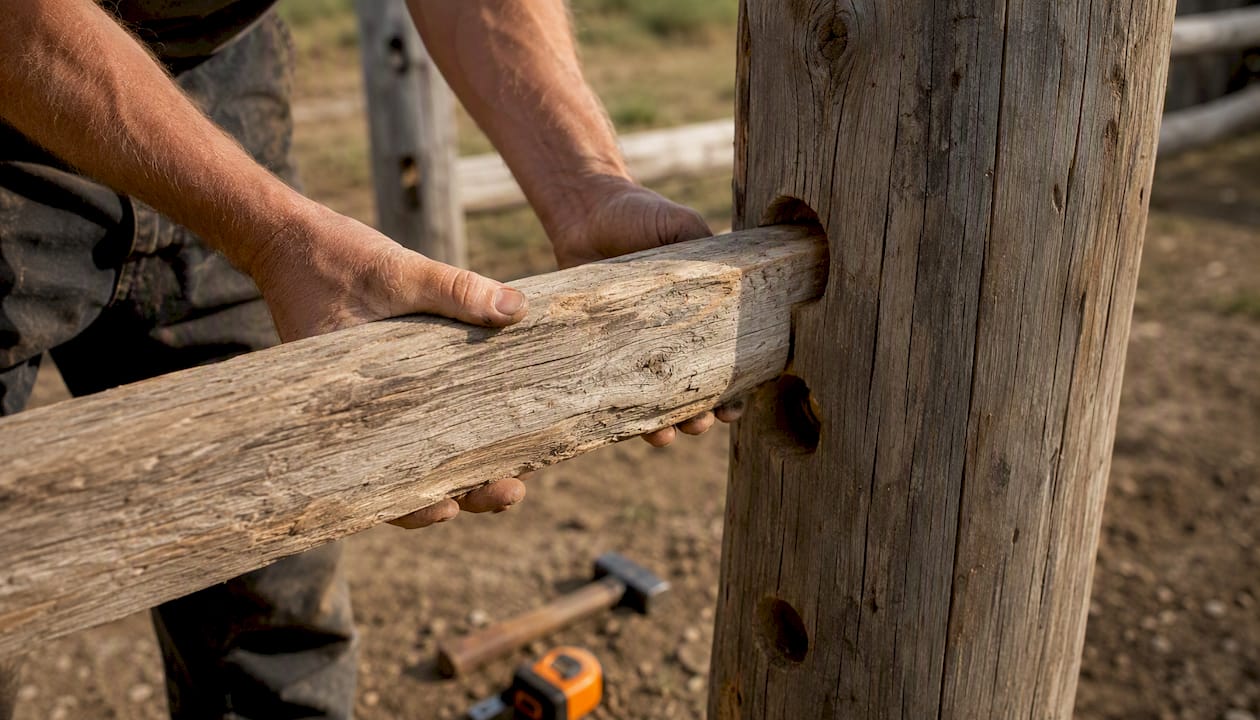
Wood is the oldest and most versatile option. Roundpole fences (called gärdesgård or skigard in Scandinavia) use paired upright posts with horizontal or diagonal rails made from young, straight trees. Historically, they were built to contain animals rather than simply mark a line, and that functional priority still holds today. Split-rail fences use half-round or rough-sawn rails slotted into drilled or routed posts, giving a classic ranch look at a modest cost. Lodge-pole (round-rail) fencing uses peeled, round poles for both posts and rails, making it economical, easy to assemble, and well-suited to corrals and pasture boundaries.
Jackleg fences take a different approach entirely: no holes, no concrete. Two poles cross at an X near the ground to form a self-supporting leg, with horizontal rails stacked between pairs of legs. They are inexpensive when timber is available locally, easy to repair after a windstorm, and practical in remote or wooded situations. The trade-off is a larger footprint and more labor per linear foot than a driven or set-post system.
A 2023 academic study on wooden pole fence building techniques found an average lifespan of roughly 20 years for traditional ground-contact wooden pole fences in Scandinavian literature, which aligns with what most North American builders see from untreated or minimally treated wood in wet climates.
Metal post systems
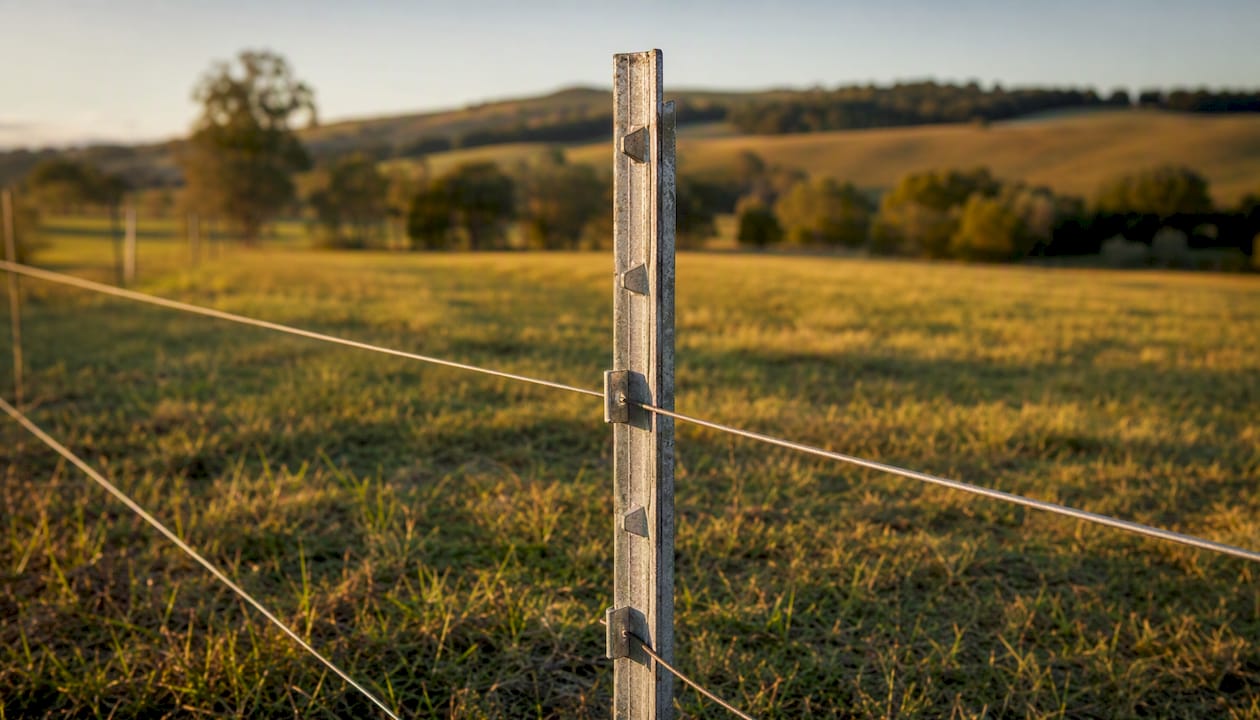
Galvanized steel T-posts are the workhorse of large-scale livestock fencing. They are driven into the ground without concrete, cost less per post than wood, and carry woven wire, high-tensile wire, or barbed wire with clip-on insulators. Round and square steel posts serve corner and end-post positions where T-posts lack the rigidity to anchor tensioned wire. For high-traffic gates or heavy bracing, square steel tube posts are the standard choice among commercial fencing contractors.
Vinyl and composite options
Vinyl post-and-rail systems look clean, never need painting, and resist rot and insects. They work well for residential boundaries, horse paddocks where a visible top rail matters for safety, and decorative gateways. Composite posts (wood fiber and plastic) offer a middle ground: they look like wood, accept fasteners like wood, and outlast untreated lumber in ground contact. Neither vinyl nor composite handles the tension loads of high-tensile wire well, so they are not the right choice for large cattle or perimeter wire fences.
| Material | Durability | Relative Cost | Maintenance | Typical Lifespan | Best Uses |
|---|---|---|---|---|---|
| Pressure-treated wood | Good | Low–moderate | Moderate (seal, inspect) | 20 years | Livestock, boundary, ornamental |
| Galvanized steel T-post | Very good | Low | Low (check clips) | several decades | Wire-fence perimeters, livestock |
| Round/square steel | Excellent | Moderate–high | Low | several decades | End/corner/gate posts |
| Vinyl/composite | Good | Moderate–high | Very low | decades | Residential, horse paddock, privacy |
| Untreated wood | Fair | Low | High | 10–20 years | Temporary, remote, jackleg |
Post shapes and sizing: round, square, and T-post compared
Shape affects how you attach rails, how the post drives into the ground, and how it looks once installed.
Round posts are the traditional choice for wooden pole fencing. They are strong along their full cross-section, shed water well at the top, and accept wire staples cleanly. Common diameters run from 3" for light rail fences up to 6"–8" for gate and corner posts. Lodge-pole systems typically use 4"–5" diameter posts for line posts and 5"–6" for corners.
Square posts (4x4, 6x6 nominal lumber) make rail attachment straightforward because you have a flat face to nail or screw into. A 4x4 post works for most residential rail fences; jump to 6x6 for gate posts, end posts, and any post carrying significant lateral load. Square steel tube posts follow similar logic: a 2"x2" or 3"x3" tube is common for residential applications, while 4"x4" tube is standard for farm gate posts.
T-posts are pressed steel with a flat web and a series of tabs (clips) that hold wire at fixed heights. They come in lengths from 5’ to 8’, with 6’ being the most common for cattle and horse fencing. The gauge (thickness) matters: heavier-gauge T-posts resist bending from animal pressure and wire tension far better than light-gauge versions.
Length rule of thumb: plan for one-third of the post length to go underground. A 6’ finished fence height needs a 9’ post. In frost-prone areas, add depth to get below the frost line.
When to go heavier:
- Gate posts: always one size up from line posts
- End and corner posts: at least 6x6 wood or 3"x3" steel tube
- High-wind areas: increase post diameter and reduce spacing
- Brace assemblies: use the same size as end posts, never lighter
What hardware and components does a pole fence actually need?
The posts get all the attention, but the hardware determines how long a fence actually performs. End and brace posts with undersized or corroded hardware are the most common reason a fence fails years before the posts themselves rot.
Post caps keep water out of the end grain on wooden posts. An uncapped post can absorb enough moisture through the top to rot from the inside out within a few seasons, even if the wood is pressure-treated. Metal post caps are inexpensive and worth fitting on every wooden post.
Anchors and footings come in two main forms: driven (the post is hammered or hydraulically pressed into the ground) or concrete-set (the post sits in a poured collar). Driven posts work well in stable soils and are faster to install. Concrete collars add holding power in loose or sandy soils but create a moisture trap at the soil line if not sloped to shed water.
Brace assemblies are the structural backbone of any tensioned wire fence. A proper brace uses a horizontal brace rail between the end post and the first line post, with a diagonal wire or rod running from the bottom of the end post to the top of the line post. Skipping the diagonal is one of the most common DIY mistakes. Without it, the end post leans inward under wire tension within a season or two.
Fasteners and wire attachments vary by fence type. Smooth-shank staples hold wire to wooden posts; ring-shank or spiral staples hold better in softer wood species. Screws outperform staples for rail-to-post connections. For electrified fences, plastic or porcelain insulators keep the wire from grounding against the post.
Pro tip for joinery: when building mortise-and-tenon post-and-rail fences, using dry tenons into green posts causes the post to shrink around the tenon as it seasons, tightening the joint over time rather than loosening it.
Pro Tip: Always call your local utility-locate service (811 in the US, 1-800-400-2255 in Canada) before digging any post hole. Hitting a buried line is dangerous and expensive.
How do you install a pole fence correctly?
Spacing and depth are the two decisions that most affect long-term performance. Get them right before you buy materials.
Standard rules: line posts go 8’–12’ apart for rail fences and 10’–16’ apart for wire fences. End, corner, and gate posts need to be set deeper and braced regardless of soil type. Post depth should be at least one-third of total post length, and always below the local frost line.
Standard post-in-ground installation:
- Mark the fence line with stakes and string; confirm property lines and utility locates first.
- Dig or auger holes to the required depth (frost line plus 6" for drainage gravel at the base).
- Add 4"–6" of gravel at the bottom of each hole for drainage.
- Set the post plumb, brace it temporarily, and backfill with concrete or compacted native soil.
- Slope the concrete collar above grade to shed water away from the post.
- Allow concrete to cure fully before attaching rails or wire (minimum 24–48 hours in warm weather; longer in cold).
- Install brace assemblies at all end, corner, and gate posts before tensioning wire.
- Attach rails, wire, or panels working from end posts toward the center.
For agricultural fencing on Canadian farms, frost-line depth is a non-negotiable starting point, not a suggestion.
Driven posts skip the hole entirely. A hydraulic post driver or a manual driver cap on a tractor three-point hitch drives T-posts and round wood posts cleanly in stable soils. This is faster than augering and avoids the concrete-curing wait, which matters a great deal in cold weather (more on that below).
Foam post-setting products (expanding polyurethane foam) are a third option: pour two components into the hole, set the post, and the foam expands and cures in minutes. They work well in moderate climates and loose soils but are not a substitute for concrete in high-load applications like gate posts.
How do you protect pole fence posts from rot and corrosion?
The ground-contact zone is where posts fail. Everything above grade can be repaired or replaced; a rotted post base means pulling and resetting the whole post.
For wooden posts, pressure treatment (CCA, ACQ, or copper azole to the appropriate retention level for ground contact) is the baseline. Look for posts rated for ground contact (UC4A or UC4B in the US), not just above-ground use. Untreated or light-treatment posts in wet soil can fail in under a decade.
For steel posts, hot-dip galvanization is the equivalent protection. Electro-galvanized coatings are thinner and wear faster; hot-dip zinc coatings last far longer in soil contact and in wet agricultural environments. Powder-coated steel adds corrosion resistance above grade but is not a substitute for galvanization at the base.
Sealers and paint extend the life of above-grade wood surfaces. A penetrating oil-based sealer applied every 3–5 years slows moisture absorption and UV degradation. Pay particular attention to the top cut of each post (where end grain is exposed) and any field cuts made during installation. Brush-applied copper naphthenate on field-cut ends is a practical field treatment.
Maintenance schedule:
- Annually: walk the fence line; check post plumb, hardware tightness, wire tension, and staple/clip condition.
- Every 3–5 years: re-seal or re-paint wooden posts above grade; inspect ground-contact zones for soft spots.
- After major weather events: check brace assemblies, re-tension wire, replace bent or leaning posts promptly.
On weatherproofing farm fencing, the consistent message from field experience is that early intervention on a loose post costs a fraction of what a full reset costs after the post has failed and pulled adjacent rails or wire with it.
A note on sustainability: reclaimed barn wood and salvaged timber make attractive split-rail and jackleg fences, and locally sourced round poles from thinning operations reduce transportation costs. The caveat is treatment history — never use reclaimed wood with unknown chemical treatment near livestock or water sources.
Pro Tip: Brush copper naphthenate onto any field-cut post end before setting it. The factory treatment stops at the factory cut; your field cut is raw, untreated wood going straight into the ground.
What does a pole fence cost, and how long will it last?
Labor and post treatment together typically account for more of the total installed cost than the raw material price of the posts. A cheap untreated post that needs replacing in 8 years costs more over 25 years than a treated post set correctly the first time.
The table below shows typical installed cost ranges per linear foot and expected lifespans by material. These are ranges, not guarantees — climate, soil type, maintenance, and installation quality all shift the outcome.
| Material | Installed Cost (per linear foot) | Expected Lifespan | Key Cost Drivers |
|---|---|---|---|
| Pressure-treated wood rail | $8–$20 | 20 years | Post treatment grade, rail count, labor |
| Galvanized T-post + wire | $3–$10 | several decades | Wire type, post gauge, brace hardware |
| Round/square steel post | $20–$30 | several decades | Post size, concrete, gate hardware |
| Vinyl/composite rail | $20–$40 | decades | Panel style, post spacing, hardware |
| Untreated wood (jackleg/roundpole) | $4–$12 | 10–20 years | Labor intensity, local timber availability |
Where to spend and where to save: put your budget into end posts, corner posts, and brace hardware. Line posts are replaceable; a failed end post takes the whole brace assembly with it. Buy the best treatment grade you can find for ground-contact posts, and do not substitute lighter-gauge T-posts to save a few dollars per post on a large perimeter.
Climate shortens lifespan estimates significantly. In wet coastal climates or areas with heavy freeze-thaw cycling, even pressure-treated wood at the low end of the lifespan range is realistic. In dry inland climates with stable soils, the high end is achievable. Fence post material selection for Canadian farms specifically accounts for these regional differences.
What do you need to know about fencing for livestock?
Species determines everything: fence height, wire type, post spacing, and whether electrification is worth adding.
Match fence type to animal:
- Cattle: woven wire (4" x 4" or 6" x 6" mesh) or high-tensile wire (5–7 strands) at 48"–54" height; T-posts at 10’–12’ spacing work well for perimeter.
- Horses: smooth wire or board rail at 54"–60" height; visibility matters, so a top board rail or highly visible wire reduces injury risk; avoid barbed wire.
- Sheep and goats: woven wire with smaller mesh (2" x 4" or field fence) at 48" height; goats require tighter mesh and often a hot wire at nose height to prevent testing.
- Pigs: woven wire or hog panels at 36"–42" with a hot wire at snout height; pigs root under fences, so a buried apron or bottom hot wire is standard.
- Poultry: hardware cloth or welded wire at 6’ height with a buried apron to prevent digging predators.
Wire choices: woven wire is the most versatile for mixed livestock. High-tensile wire (12.5 gauge) covers large perimeters economically but requires proper tensioning equipment and end-post bracing. Barbed wire deters cattle but is not appropriate for horses or small animals. Electrified wire adds a behavioral deterrent that reduces fence pressure and extends hardware life.
Predator control adds another layer. For sheep and goats, a perimeter of woven wire with a hot wire at 6" above the ground and another at 12" stops most coyotes. Livestock guardian dogs work alongside fencing, not instead of it.
For rural property livestock fencing, the consistent recommendation is to inspect fence lines after every significant weather event and after any animal disturbance, because a small breach becomes a large one quickly when animals find it.
How do style and aesthetics affect your fence choice?
Choose function first, then style. A fence that looks great but fails to contain animals or collapses under snow load is an expensive mistake.
That said, wooden pole fences offer more design range than any other system. Lodge-pole ranch rail gives a clean, Western look with round poles and minimal hardware. Split-rail fencing suits property boundaries and garden perimeters where a rustic, open look is the goal. Post-and-panel privacy fencing uses solid boards between posts to block sightlines and reduce wind, but solid panels catch wind load aggressively — a fence that works fine in calm conditions can fail in a windstorm if the posts are not sized and spaced for the panel area.
Gate style is where aesthetics and function collide most visibly. A heavy timber gateway with a swinging wood gate looks impressive but requires oversized gate posts (at least 8x8 or 6" round steel) and heavy-duty hinges rated for the gate weight. Undersized gate hardware is one of the most common and most avoidable fence failures.
Color and finish choices for vinyl and steel posts are largely a matter of preference, but darker colors absorb more heat in summer, which can cause minor expansion and contraction cycling in vinyl systems over time.
How does cold weather change the way you build a pole fence?
Cold climate changes several key decisions: post depth, concrete curing strategy, and whether to drive or set posts at all.
Concrete curing slows significantly below 50°F and can fail entirely in freezing conditions, leaving posts that appear set but have no real holding strength until the concrete cures properly in spring. Common mitigations include using accelerated or fast-setting concrete mixes, mixing with warm water, covering fresh pours with insulated blankets, and avoiding pours when overnight temperatures will drop below freezing within the curing window.
Cold-climate callout: Concrete that freezes before it reaches adequate strength can lose up to 50% of its design strength permanently. In a winter fence installation, the curing strategy matters as much as the post material itself.
Driven posts are often the preferred winter solution because they bypass the curing problem entirely. A hydraulic post driver works in frozen ground that would require a ground-thaw unit to auger. Weighted-base temporary systems are another option for seasonal or rotational fencing that does not need to be permanent.
Pro Tip: Set permanent posts in fall before the ground freezes, or wait until spring thaw is complete and the soil has restabilized. Installing in the brief window between freeze and full thaw risks heaving as the ground moves.
Frost heave is the other cold-climate threat. A post set above the frost line will be pushed upward by expanding frozen soil, loosening the footing and tilting the post. The fix is simple: always set below the local frost line, and use a gravel base at the bottom of the hole to allow drainage and reduce ice formation around the post base. For Canadian farm fence installations, frost-line depth varies from 18" in mild coastal regions to 60"+ in northern prairie areas.
How do you choose the right pole fence for your property?
Work through these questions before you call a supplier or contractor. The answers narrow the field quickly.
Primary decision checklist:
- What is the primary use? (livestock containment, property boundary, privacy, wind/snow control, ornamental)
- Which animals need to be contained, and what are their specific fence height and mesh requirements?
- What is your target lifespan, and how much annual maintenance are you willing to do?
- What is your climate? (frost depth, snow load, wind exposure, soil moisture)
- What is your budget per linear foot, installed?
- Are there local permit requirements, setback rules, or HOA restrictions?
Questions to ask your supplier or contractor:
- What treatment grade are the posts rated for (ground contact vs. above-ground only)?
- Are the T-posts or steel components hot-dip galvanized or electro-galvanized?
- What warranty applies to posts, rails, and hardware?
- Does the quote include brace assemblies at all end, corner, and gate posts?
- What is the delivery lead time, and is installation included or quoted separately?
When to call a professional: if your perimeter exceeds 1,000 linear feet, involves significant grade changes, requires multiple gate openings, or needs to meet livestock-specific regulatory standards (some jurisdictions regulate livestock fence specifications), a professional installer or design consultant will save time and prevent costly mistakes. Before the site visit, complete your utility locate, identify all gate locations, and know your property lines.
For a step-by-step field fence build or a full perimeter installation checklist, Fencefast’s resource library covers both in practical detail.
A practical perspective on what actually matters
Most fence failures come down to three decisions made early: the end-post size, the treatment grade, and whether the brace assembly was built correctly. Everything else, the rail profile, the wire gauge, the post color, is secondary.
The temptation is to save money on the posts themselves and spend it on visible elements like rails or gates. That is backwards. A gate that swings perfectly on a leaning end post is still a failed fence. Pressure-treated posts rated for ground contact, properly braced end assemblies, and galvanized hardware at every connection point are where the budget should go first.
For livestock operations, the fence also needs to be repairable quickly. A jackleg or roundpole system that can be rebuilt with on-site timber after a blowdown has real operational value that a tensioned high-tensile system does not. Match the fence system to your maintenance capacity, not just your installation budget.
Fencefast has the materials, hardware, and expertise you need
Choosing the right pole fence system is straightforward when you have the right products and someone who can answer a specific question about your site. Fencefast supplies a full range of fencing components and livestock management hardware for Canadian agricultural and rural properties, from pressure-treated post hardware and galvanized T-posts to electric fence systems and woven wire.
Beyond the product catalog, Fencefast offers design consulting to help you match post sizing, spacing, and treatment to your specific use case, whether that is a horse paddock, a cattle perimeter, or a property boundary in a frost-heavy climate. Nationwide shipping (excluding PO Boxes) means the materials reach your site regardless of location. Browse the product range or request a design consultation directly at Fencefast to get a quote tailored to your fence line.
Sources
- Formakademisk (2023) — study on wooden pole fence building technique
- Roundpole fence — Wikipedia
- Build an inexpensive but durable jackleg fence — Backwoods Home Magazine
- Winter fence installation: pros, cons & what contractors need to know — FenceCalc
- Winter fence installation: Can you install a fence in the winter? — ASAP Marketplace

