

TL;DR:
- Virtual fencing now achieves over 99% containment in Canadian trials, with cattle adapting in just a few days. Understanding provincial fencing laws and combining traditional and virtual systems can improve land management, safety, and compliance. A hybrid approach leverages the strengths of both methods to optimize grazing, protect land, and reduce labor costs across diverse Canadian terrains.
Protecting your livestock and land in rural Canada takes more than hammering posts and stringing wire. Virtual fencing now achieves over 99% containment in Canadian field trials across Alberta and British Columbia, with cattle adapting in as little as four to seven days — a result that surprises even experienced ranchers who wrote off the technology as a city idea. Between evolving tech options, province-specific legal requirements, and the real cost of getting it wrong, many farmers are unsure where to start. This article gives you field-tested best practices, clear technology comparisons, and the compliance essentials you need to make a confident decision.
Table of Contents
- Understanding fencing laws and compliance in Canada
- Traditional fencing methods: Pros, cons, and best practices
- Virtual fencing: Cutting-edge technology for Canadian ranches
- Choosing your fencing solution: Factors that matter most
- Why a hybrid approach to rural fencing is the future
- Find trusted fencing solutions for your Canadian farm or ranch
- Frequently asked questions
Key Takeaways
| Point | Details |
|---|---|
| Compliance is critical | Canadian fencing laws require specific heights and cost-sharing to avoid legal trouble. |
| Traditional fences have limits | Physical fencing methods are effective but face challenges in harsh Canadian environments. |
| Virtual fencing now proven | Canadian field trials show virtual fencing exceeds 99% livestock containment with quick adaptation. |
| Choose the right fit | Evaluate both technology and tradition for your land, livestock type, and comfort with new tools. |
| Hybrid systems lead the way | Combining physical and virtual fences is emerging as the best solution for many Canadian farms. |
Understanding fencing laws and compliance in Canada
Fencing disputes between neighbors are more common than most people admit. They tie up time, damage relationships, and can result in real financial losses when livestock escape onto a neighbor’s property or onto a public road. Understanding what the law actually requires is the foundation for every smart fencing decision.
A solid starting point is learning about fencing laws in Canada and how provincial acts shape your obligations. The Ontario Line Fences Act is one of the most detailed provincial frameworks in the country, and similar statutes exist across the other provinces.
Here is what Ontario’s law specifically requires:
- Cost sharing: The Ontario Line Fences Act requires neighbors to share the cost of constructing and maintaining boundary fences, with the minimum standard set at 4 feet in height for cattle enclosures.
- Dispute resolution: When neighbors cannot agree, the Act provides for fence-viewers, who are appointed local officials with authority to make binding decisions about fence type, placement, and cost division.
- Construction standards: Fences must meet minimum material and height requirements based on the livestock involved. Cattle require taller, sturdier fencing than, say, sheep or poultry.
The spirit of these laws is mutual responsibility. If your cattle get out and damage a neighbor’s crop because the shared fence was below standard, you carry legal exposure. Reviewing Canadian fencing requirements for your province before you build will save you from expensive surprises.
“The most common mistake we see is farmers assuming verbal agreements with neighbors are enough. Put the fence type, cost split, and maintenance responsibilities in writing — every time.”
Common mistakes that lead to legal and financial headaches include:
- Building entirely on your own side of the property line to avoid cost sharing, then losing the legal protection of a shared fence
- Installing a fence that meets your needs but falls below minimum legal specifications for the livestock it’s meant to contain
- Ignoring maintenance requirements that accumulate over years until the fence is no longer legally compliant
Getting up to speed on livestock fencing regulations in your province protects your animals, your property value, and your neighbor relationships all at once.
Traditional fencing methods: Pros, cons, and best practices
With the legal framework clear, it’s time to weigh the actual fencing tools at your disposal. Physical fences are still the standard, so here’s how each stands up in the field.
Canadian ranchers deal with conditions that most fencing guides ignore: freeze-thaw cycles that heave posts out of the ground, deep snow that collapses wire panels, and wildlife pressure from deer, moose, and predators. Your material choice has to account for all of it.
| Fence type | Best use | Key strength | Main weakness | Avg. cost per meter |
|---|---|---|---|---|
| Barbed wire | Cattle perimeter, large acreage | Low cost, durable | Not safe for horses | $1.50–$2.50 |
| Page wire (woven wire) | Sheep, goats, hogs | Strong animal containment | Higher install cost | $3.00–$5.00 |
| Electric | Rotational grazing, temporary | Flexible, low install cost | Needs power source | $0.80–$2.00 |
| Wood rail/board | Horses, arena perimeter | Highly visible, safe | Rot, high cost | $6.00–$12.00 |
Understanding animal fencing basics helps you match materials to species and terrain. Here are field-tested guidelines for each type:
Barbed wire works well for cattle on large acreages where cost per meter matters. Use a minimum of four strands with posts spaced no more than 3 meters apart in heavy snow areas. Barbed wire is not recommended for horses, which can panic and suffer severe lacerations from contact.
Page wire (woven wire) is the go-to for smaller livestock like sheep and goats. It prevents animals from pushing their heads through the fence and getting trapped. In Canada, galvanized steel page wire holds up far better to moisture and frost than painted alternatives.
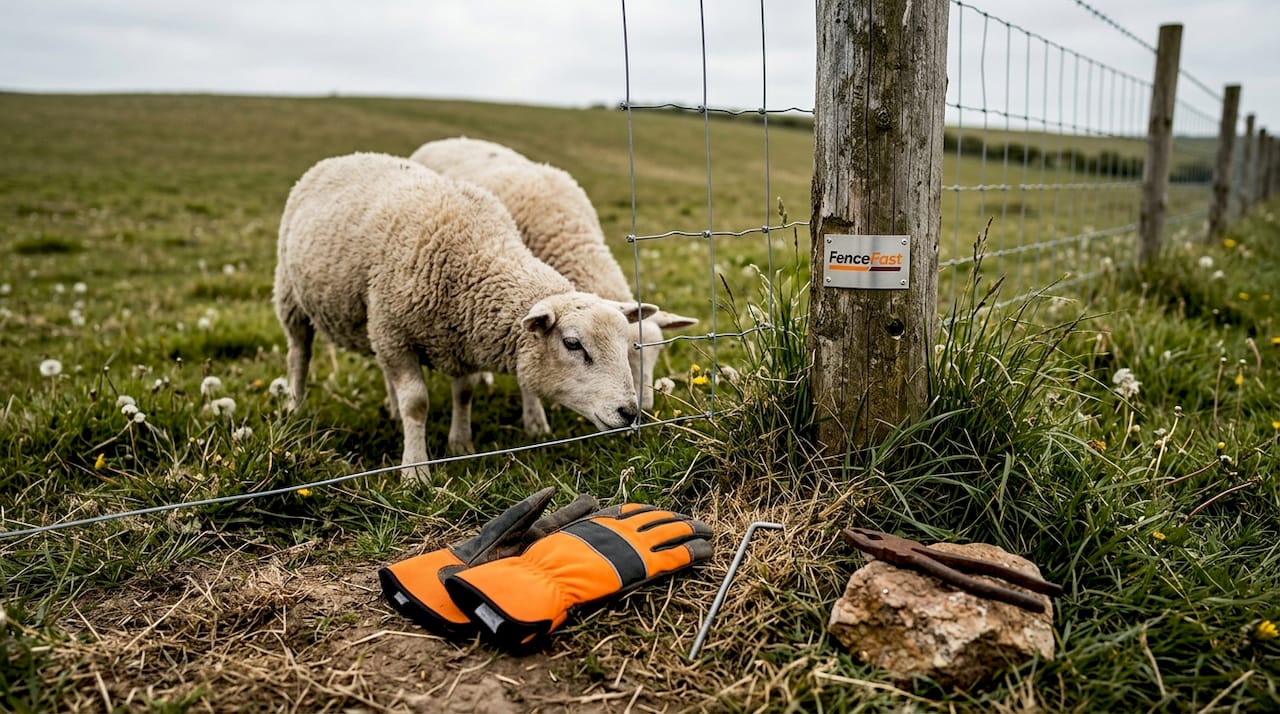
Electric fencing has transformed rotational grazing on Canadian farms. It is affordable to install and easy to move as you shift paddocks. The key is reliable power. Solar energizers work well in most of Canada from April through October, but winter often requires a mains connection or battery backup. Check wire tension twice a year after freeze-thaw cycles.
Wood rail fencing is the safest visual barrier for horses and the most expensive option per meter. Pressure-treated lumber rated for ground contact is essential in Canadian climates. Cedar is a popular choice in western Canada for its natural rot resistance.
Pro Tip: Always install a ground-level kick board or bottom rail on any fence where horses are present. Horses that paw or kick at fences during feeding time will eventually find a loose post and push through.
For creative approaches that work across mixed operations, browsing livestock fencing ideas can open up options you may not have considered for your specific terrain.
Virtual fencing: Cutting-edge technology for Canadian ranches
Physical fences have their strong points but also clear limitations. Technology is rewriting the rules with virtual fences, and here’s how they actually perform in Canada.
Virtual fencing works through GPS-enabled collars worn by individual animals. Each collar communicates with a base station and receives boundaries set through a smartphone or desktop app. When an animal approaches a virtual boundary, the collar delivers an audio warning first, then a mild electrical pulse if the animal keeps moving. Animals learn to respond to the audio cue alone within days.
The containment data from Canadian trials is striking. Trials in Alberta and British Columbia recorded over 99% containment rates. Cattle adapted to the system in 4 to 7 days on average, collar battery levels stayed above 96% even through winter conditions, and connectivity failures affected less than 1% of recorded time. These are not lab numbers — they come from working ranches facing real Canadian winters.
Here is a step-by-step view of how implementation typically works:
- Base station setup: Install the cellular base station on your property. It needs good cellular coverage and a clear line of sight across the intended grazing area.
- Collar fitting: GPS neckbands are fitted to each animal. Proper fit is critical; too loose and the pulse is inconsistent, too tight and it causes discomfort.
- Training period: Set a wide initial boundary and let cattle learn the audio and pulse cues with low stakes. Supervision during this phase matters.
- Boundary adjustment: Once animals are trained, you can adjust paddock boundaries digitally from anywhere, enabling precision rotational grazing without moving a single strand of wire.
- Ongoing monitoring: The app gives you real-time location data for each animal, battery status, and alert notifications if any animal approaches the boundary repeatedly.
Understanding how virtual fencing works in detail helps you set realistic expectations before you invest. The technology excels in several specific scenarios:
- Riparian zone exclusion: Keeping cattle away from waterways without physical fencing is one of the strongest use cases. Protecting riparian zones with virtual fencing is often more effective and less expensive than installing physical barriers along creek beds.
- Remote pastures: Large acreages in Alberta and BC that would cost tens of thousands to fence physically can be managed with collars and a base station.
- Rotational grazing: Moving paddock boundaries every few days without labor-intensive fence relocation is a genuine game-changer for pasture management.
Before committing, review a detailed breakdown of virtual fencing costs for Canadian operations. The upfront collar and base station investment is significant, but government funding programs like OFCAF (Ontario Farmland Care and Agriculture Fund) and BMP (Beneficial Management Practices) grants can offset a substantial portion of the cost.
Pro Tip: If you run cattle in British Columbia’s rangeland, read about virtual fencing in BC before making a decision. The terrain and cellular coverage challenges there have produced specific lessons that apply broadly to any rough-country operation in Canada.
Choosing your fencing solution: Factors that matter most
With both established and new solutions on the table, let’s zero in on exactly how to choose and what can make or break your results.
The right choice depends on factors that are specific to your operation. No single fencing method wins across all scenarios. Here are the key decision points:
- Terrain: Rocky, hilly, or heavily wooded land dramatically increases the cost and difficulty of physical fencing. Virtual fencing has no terrain limitation beyond cellular signal coverage.
- Animal type: Virtual fencing is currently proven and commercially available for cattle. Horses, sheep, and goats have different behavioral and physiological profiles that affect collar suitability. Traditional fencing remains the safest choice for these species right now.
- Herd size: A small hobby farm with 10 cattle may not generate enough ROI from virtual fencing to justify the hardware cost. Operations with 50 or more head start seeing compelling numbers.
- Technology comfort: Virtual fencing requires confidence with apps and cellular connectivity. If you don’t have reliable cell service across your grazing land, the system won’t deliver the over 99% reliability the trials demonstrated.
- Budget and funding: Compare total cost of ownership over 10 years, not just installation cost. Include maintenance, post replacement, wire, and labor for physical fences. Include collar replacement cycles and subscription fees for virtual systems.
Reviewing fencing ideas for ranchers that address mixed operations can help you visualize hybrid approaches before finalizing your plan.
A best-practices checklist for setup and management:
- Complete a property survey and mark all legal boundary lines before any installation begins.
- Get written cost-sharing agreements with neighbors for all shared fence lines.
- Confirm legal compliance for your province and livestock species.
- Choose materials rated for your specific climate zone and wildlife pressure.
- Schedule a bi-annual inspection of all physical fences, especially after the spring thaw.
- For virtual systems, run a pilot on a small paddock before converting your entire operation.
- Document all virtual fence boundary settings and keep backups in case of system resets.
- Train all farm employees or family members on how to respond to collar or system alerts.
Why a hybrid approach to rural fencing is the future
After working through the strengths and weaknesses of each system, here is a candid take from the front lines: the either-or framing is wrong.
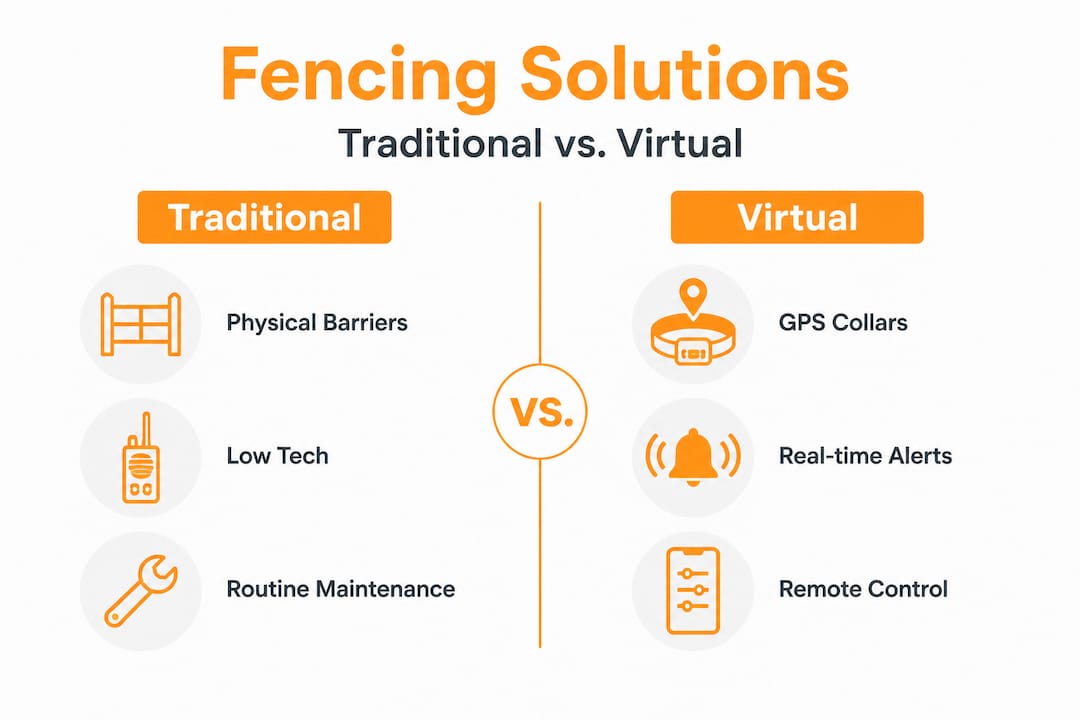
Ranchers who treat traditional and virtual fencing as competitors are leaving money on the table. The smarter play is treating physical fences as your permanent legal and security perimeter, while using virtual fencing as a dynamic management layer on top of it. Think of the physical fence as your non-negotiable compliance infrastructure. It satisfies the law, protects against total system failure, and handles species like horses that aren’t yet suited to collar-based systems. The virtual layer handles rotational grazing, temporary exclusion zones, and remote pasture management with a flexibility that wire simply can’t match.
The ranches that adopt this model aren’t doing it because it’s trendy. They’re doing it because it solves a specific problem they couldn’t solve any other way: managing large, irregular acreages without the labor cost of constant fence moves. One base station and a set of Gallagher eShepherd collars can manage thousands of acres of grazing rotation that would otherwise require a full-time crew just to move electric fence stakes.
The transition doesn’t need to happen overnight. Start by identifying one pasture where you’re spending the most labor on rotational grazing. Put a physical perimeter around it, learn how virtual fencing works inside that perimeter, and measure your labor savings against the system cost. That single comparison will tell you everything you need to know about scaling the approach.
The technology will keep improving. Battery life, collar durability, and cellular coverage across rural Canada are all getting better every year. Operators who build the skills and infrastructure now will have a real competitive advantage as the technology matures. Those who wait for perfection before starting will find themselves years behind.
Find trusted fencing solutions for your Canadian farm or ranch
If you’re ready to move from research to action, the right products and expert guidance make all the difference.
At FenceFast, we supply everything from traditional barbed wire, page wire, and electric fence systems to Gallagher eShepherd virtual fencing technology — all backed by 26 years of agricultural fencing experience. Whether you need a complete rural fencing solution for a new cattle operation, a replacement component for an aging electric system, or help understanding OFCAF and BMP grant eligibility for virtual fencing adoption, our team is ready to help. We offer design consulting, virtual fencing setup guidance, and nationwide shipping to farms and ranches across Canada. Start your order online or reach out directly for expert advice tailored to your operation.
Frequently asked questions
What is the minimum legal fence height for cattle in Ontario?
The minimum height under Ontario’s Line Fences Act is 4 feet for cattle fences. Fences below this standard may not provide the legal protection you need in a dispute.
How effective is virtual fencing for livestock in Canada?
Canadian field trials show virtual fencing achieves over 99% containment rates, with cattle typically adapting to the system within 4 to 7 days. Winter performance remains strong, with collar batteries staying above 96% charge.
Do both farm owners have to pay for a boundary fence in Canada?
Yes, most provincial statutes including the Ontario Line Fences Act require neighbors to share the cost of constructing and maintaining boundary fences. The exact split can be determined by agreement or through appointed fence-viewers if a dispute arises.
How long does it take cattle to adapt to virtual fencing?
Cattle adapt in 4 to 7 days on average according to Canadian research conducted in Alberta and British Columbia. Most animals learn to respond to the audio warning alone well before the training period ends.
Recommended
- How to Repair Fences: Practical Steps for Farmers and Landowners 2025 – FenceFast Ltd.
- Animal fencing basics: Essential solutions for Canadian farms – FenceFast Ltd.
- 10 Tips for Choosing the Best Livestock Fence – FenceFast Ltd.
- 7 Essential Livestock Fence Safety Tips for Rural Properties – FenceFast Ltd.

