

TL;DR:
- Urban farm fencing must comply with municipal regulations, wildlife considerations, and animal containment needs.
- Proper planning involves understanding city permits, choosing adaptable materials, and designing wildlife-friendly barriers.
Most urban farmers assume that what works on a rural acreage will work just fine squeezed into a city lot. That assumption gets expensive fast. Canadian cities layer permit requirements, zoning restrictions, animal bylaws, and ecological considerations on top of every fencing decision you make. Whether you’re managing a small backyard flock of hens, running rotational paddocks on a community farm, or protecting market garden crops from deer and rabbits that have moved comfortably into city greenbelts, your fencing system has to satisfy regulators, contain animals reliably, and coexist with urban wildlife all at the same time.
Table of Contents
- Navigating urban agriculture fencing regulations
- Choosing the right fencing types for urban environments
- Wildlife-friendly fencing: Integrating habitat considerations
- Best practices for fence maintenance and adaptability
- A fresh perspective: It’s not just about containment
- Find your urban ag fencing solutions
- Frequently asked questions
Key Takeaways
| Point | Details |
|---|---|
| Check city permits first | Local zoning rules can dictate fence type, dimension, and permit needs for livestock and crops. |
| Hybrid fencing works best | Permanent boundaries plus temporary internal fences offer flexibility for urban livestock management. |
| Design for wildlife safety | Smooth bottom wires and visibility enhancements protect habitat and reduce collision risks. |
| Inspect and adapt frequently | Routine maintenance and flexibility help keep urban ag fences effective and compliant. |
| Fencing is stewardship | Urban ag fencing balances animal control, regulatory compliance, and ecological health. |
Navigating urban agriculture fencing regulations
Before you buy a single post or strand of wire, you need to know what your municipality will actually allow. This is the step most urban farmers skip, and it’s the one that causes the most costly problems down the road.
Canadian cities regulate urban agriculture through zoning bylaws and development permits, and the specifics vary enormously from one city to the next. In Edmonton, for example, you may need an Urban Agriculture Development Permit simply for building a hen enclosure or for growing and selling produce in certain zones. That’s a permit trigger that catches a lot of new urban farmers off guard because they assumed a small chicken coop was no different from a garden shed.
Permit triggers in most Canadian cities typically include:
- Livestock enclosures of any kind, including coops, hutches, and small pens
- Fence height over a specified limit (commonly 1.8 meters along property lines)
- Electrified wire installations, which may require additional safety review
- Specialty or exotic animal licenses for species beyond standard poultry or rabbits
- Commercial growing or selling of produce from a residential zone
Zoning variances are common in urban agriculture. A zone classified for residential use may allow backyard hens under a specific bylaw but prohibit larger livestock entirely. An agricultural overlay zone or a community garden designation may unlock more options but still impose fence material restrictions. Some cities specifically ban barbed wire within city limits regardless of the application.
Key takeaway: Never assume a fence that’s legal on a rural property is legal in your city zone. Reach out to your municipal planning department and ask specifically about urban agriculture uses before breaking ground.
Electrified fencing adds another layer of complexity. Most Canadian cities allow low-power electric fence energizers for livestock containment, but they may require visible warning signs at regular intervals, prohibit bare wire along public sidewalks, or mandate a minimum setback from property lines. Some municipalities require written approval before energizing any fence. Specialty animal licenses, such as those sometimes required for miniature goats or ducks in urban zones, may also dictate fence specifications as a condition of approval.
To research your city’s requirements efficiently, start with your municipality’s online zoning map and bylaw database. Search for terms like “urban agriculture,” “backyard livestock,” and “accessory structure.” Then follow up with a direct call or email to the planning department. Reviewing the urban ag fencing guide alongside your city’s rules gives you a strong working knowledge base before your first consultation.
Choosing the right fencing types for urban environments
Once you understand what city rules allow, the next step is selecting appropriate fence types to match your unique urban farm setup.
The core principle that experienced Canadian urban farmers apply is this: match fence type to the animal and terrain, use permanent perimeter fencing for the hard boundary, and use temporary or internal fencing for flexible management. This fencing approach pays off by keeping infrastructure costs manageable while still giving you the control you need for rotational grazing paddocks and seasonal exclusions.
Here’s how common fence types stack up for urban agriculture contexts:
| Fence type | Best use | Urban advantages | Limitations |
|---|---|---|---|
| Welded wire panel | Poultry, small livestock perimeter | Durable, predator-resistant, clean appearance | Higher cost, less flexible |
| Electric polytape or polywire | Rotational grazing, temporary paddocks | Easy to move and reconfigure | Requires reliable energizer, visible to neighbors |
| Chain link | Perimeter security, dog runs, pig containment | Familiar to city planners, widely permitted | Expensive, not wildlife-friendly |
| High-tensile wire | Cattle and horse perimeter | Long spans, low maintenance | Requires skilled installation, less visible |
| Wood post and board | Horse paddocks, aesthetic requirements | Visually acceptable in urban settings | High material cost, regular maintenance |
| Temporary electric netting | Poultry on pasture, seasonal crops | Portable, highly effective predator barrier | Must be moved regularly |
For most urban operations, a hybrid setup delivers the best results. A permanent welded wire or high-tensile perimeter provides the secure outer boundary that satisfies city bylaws and keeps animals in and predators out. Inside that perimeter, lightweight electric polytape or polywire divides the space into rotational paddocks for chickens, ducks, miniature cattle, or goats. This setup, which you can explore further through our overview of rotational grazing fences, lets you intensively manage forage, reduce parasite loads, and rest sections of your growing area without rebuilding any infrastructure.
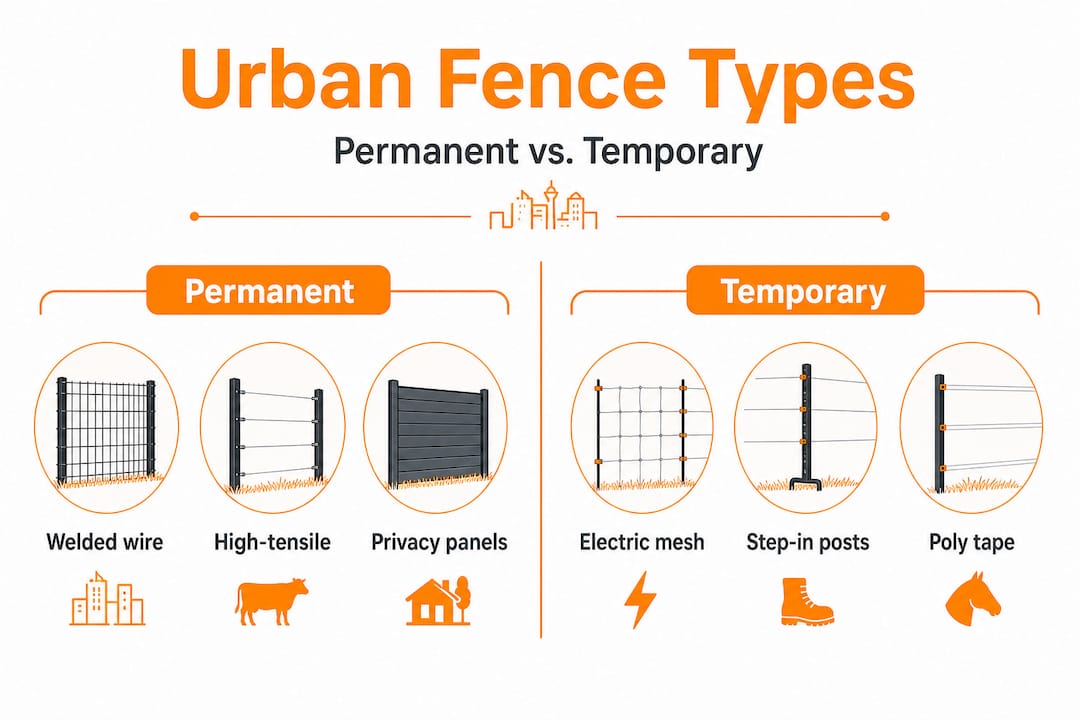
Pro Tip: When designing your permanent perimeter for an urban site, factor in sightlines from your neighbors and the street. A welded wire fence with wooden posts and a simple top rail looks intentional and professionally installed, which reduces friction with neighbors and city bylaw officers alike.
Understanding the full range of available options through resources like types of livestock fencing and practical livestock fence tips helps you build a shortlist that fits your species, your space, and your budget before you price out materials.
Wildlife-friendly fencing: Integrating habitat considerations
In urban agriculture, protecting your crops and animals also means factoring in the surrounding ecology, especially wildlife habitats.
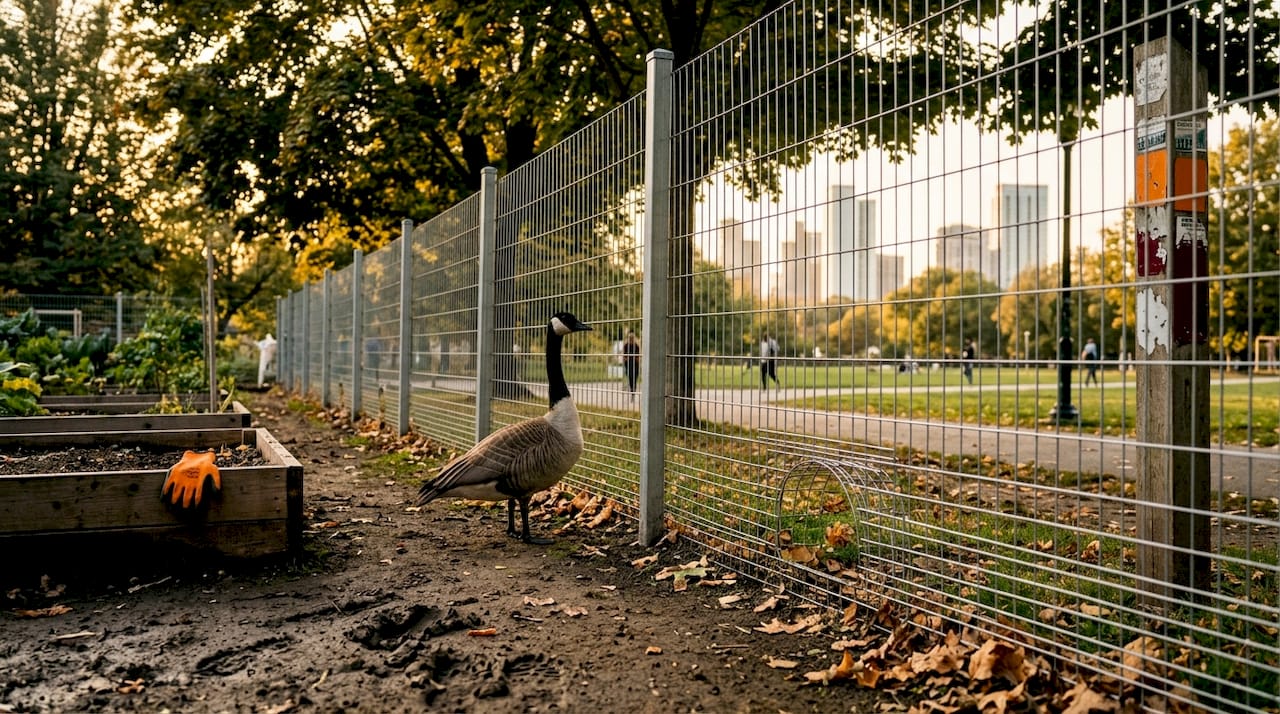
Urban farms across Canada increasingly sit adjacent to river valleys, ravines, park greenbelts, and stormwater corridors that double as wildlife movement routes. Deer, foxes, coyotes, rabbits, raccoons, and many bird species move through these corridors daily. Your fence doesn’t just interact with your livestock. It intersects with the local ecosystem, and poor design choices can harm that ecosystem even when you don’t intend them to.
The Burrowing Owl Alliance provides a clear example of why this matters. Their guidance recommends wildlife-friendly perimeter fencing with smooth bottom wires for cattle pastures and visibility-enhanced fencing for crop fields near owl habitat to reduce bird collision risks. While burrowing owls may not be your primary concern on a city farm, the principle applies broadly: fence design should protect your operation without creating collision hazards or movement barriers for the surrounding wildlife community.
Practical design features that support both livestock containment and wildlife coexistence include:
- Smooth bottom wire: At least one smooth wire at the base rather than barbed wire, allowing small wildlife to pass under without injury
- Visibility enhancements: Flagging, reflective tape, or bright fence line markers that help birds detect and avoid fences in low-light conditions
- Adequate bottom clearance: Leaving 30 to 40 centimeters of clearance between the ground and the lowest wire in areas where deer or other large wildlife need passage corridors
- Avoiding barbed wire at mid-heights: The 50 to 80 centimeter height range is where many migratory birds, owls, and raptors are most likely to collide with fence lines
Here’s a quick reference for wildlife-friendly adjustments by species concern:
| Wildlife concern | Recommended design feature | Location priority |
|---|---|---|
| Ground-nesting birds | Smooth bottom wire, no ground-level barbs | Crop field perimeter |
| Owls and raptors | Visibility markers every 10 to 15 meters | Open field fence lines |
| Deer | 1.2 meter clearance for movement, or full exclusion fence | Habitat corridor edges |
| Small mammals | 30 to 40 cm smooth bottom gap | Pasture perimeter |
| Rabbits | Fine mesh or electric netting at base | Vegetable garden perimeter |
Design principle: Treat habitat adjacency as a core design requirement, not an afterthought. A fence that coexists with local wildlife builds goodwill with neighbors, supports local biodiversity, and reduces the risk of bylaw complaints or conservation authority scrutiny.
For more on how Canadian farms approach this balance, the resources on wildlife-friendly fencing options, fencing for habitat conservation, and wildlife fence protection offer practical starting points tailored to Canadian growing conditions.
Best practices for fence maintenance and adaptability
Building the right fence is only the beginning; ongoing maintenance and adaptability keep your urban ag operation secure and efficient.
Urban farms face maintenance challenges that rural operations don’t always encounter. Foot traffic near fences is higher. Vandalism is a real possibility. Soil conditions in urban areas often include buried debris, old fill material, or compacted surfaces that affect post stability over time. And because urban farms frequently evolve, adding new species, expanding crop areas, or changing layouts, your fencing system needs to be as adaptable as your operation.
Here are the core maintenance practices that keep urban agricultural fences functioning reliably:
- Monthly visual inspections: Walk the full perimeter and interior fence lines once a month. Look for leaning posts, broken wires, loose staples, corroded connectors, and any signs of digging or pressure from animals on either side of the fence.
- Seasonal tightening: Wire and polytape loosen in temperature swings. After each major seasonal change, check tension on all wire runs and retighten as needed. High-tensile systems have in-line strainers that make this fast.
- Energizer output checks: If you run electric fencing, test your energizer output monthly with a fence tester. Voltage below the effective threshold for your target species means your fence isn’t working even if it looks intact.
- Post integrity checks: Push and pull each post in the line once per season. Frost heave is common in Canadian urban soils and can loosen posts that appeared solid when installed.
- Ground rod inspection: Poor grounding kills electric fence performance. Check that ground rods are firmly installed and that connections are clean and corrosion-free every spring.
- Documentation and mapping: Keep a simple sketch or digital map of your fence layout, including post locations, gate positions, and energizer connections. This makes troubleshooting and future modifications far faster.
Pro Tip: For urban farms using temporary internal fencing for rotational grazing, designate a “move day” on a regular schedule and inspect each temporary section before redeployment. Polytape and polywire develop weak points at connection sites, and it’s much easier to catch a problem before you move the fence than after livestock have pushed through it.
The temporary fencing guide and temporary cattle fencing solutions provide hands-on advice for maintaining flexible fence systems that evolve alongside your operation. The most effective hybrid setups treat the perimeter as a fixed long-term investment and the interior fencing as a working tool that requires regular evaluation and adjustment.
A fresh perspective: It’s not just about containment
Here’s the part most fencing guides skip entirely. Urban agriculture fencing is not primarily a containment problem. It’s a compliance and ecological design problem that happens to involve physical barriers.
The conventional framing treats fencing as the thing you install after you decide what animals you’re keeping. In urban agriculture, that sequence is backwards. The right starting point is your city’s development and zoning rules because those rules define what materials, heights, energizer types, and species you’re actually permitted to manage. A farmer who spends two weeks researching livestock fence wire gauges before spending two hours reading local bylaws is setting themselves up for an expensive rework.
The ecological dimension is equally underestimated. Urban farms that sit near ravines, parks, or natural corridors are not isolated agricultural operations. They are embedded in a living system. Wildlife-friendly fencing design isn’t just a conservation nicety; it’s a signal to your municipality, your neighbors, and any adjacent conservation authority that your operation is a responsible participant in the urban ecosystem, not an intrusion on it. That goodwill has practical value when you apply for permits, request variances, or expand your operation.
The urban farms that grow most successfully over time are those that treat every fencing decision as a three-part question: Is it permitted? Does it contain what it needs to contain? And does it coexist with what surrounds it? Those three filters, applied together, produce fencing systems that are genuinely durable because they’re built to last in the full context of a city farm environment. Thinking through smart urban fencing ideas with that three-part lens will take your operation further than simply copying what works on a rural property 200 kilometers away.
Find your urban ag fencing solutions
Urban agriculture fencing in Canada demands more than off-the-shelf rural products. You need materials matched to city permit conditions, animal species, site dimensions, and wildlife considerations specific to your location.

At FenceFast, we supply everything Canadian urban farmers need to build fencing systems that actually work in city environments. Our catalog covers permanent perimeter solutions, electric fence energizers and components, temporary and rotational grazing systems, wildlife-friendly fencing configurations, and Gallagher eShepherd virtual fencing technology for farms ready to move beyond physical barriers. We’ve partnered with Gallagher for over 26 years, and our team understands the specific demands of Canadian agricultural environments from coastal urban farms to prairie city lots. Explore our full product selection and get design guidance tailored to your urban ag setup at FenceFast.ca.
Frequently asked questions
Do I need a permit for livestock fencing in my Canadian city?
You likely need a development permit and possibly a specialty animal license, especially for hen enclosures or selling produce; always verify with your local planning department before installing any enclosure.
What fencing types are best for rotational grazing in urban areas?
Hybrid approaches using permanent perimeter fencing and temporary internal electric fencing offer the most flexibility; this fencing mechanics approach lets you rotate livestock through paddocks without rebuilding permanent infrastructure.
How can urban farms make fencing wildlife-friendly?
Adding smooth bottom wires and visibility markers to perimeter fences reduces wildlife collision risks and allows safe movement near city habitat corridors without compromising livestock containment.
How often should urban agricultural fences be inspected?
Monthly visual inspections and seasonal tightening are the baseline; effective hybrid setups treat regular inspection as a built-in part of the rotational grazing and exclusion management routine.
Recommended
- Agricultural fencing in Canada: choosing durable solutions – FenceFast Ltd.
- Animal fencing basics: Essential solutions for Canadian farms – FenceFast Ltd.
- Portable outdoor fencing guide for Canadian farmers 2026 – FenceFast Ltd.
- 7 Eco-Friendly Fencing Materials for Sustainable Farms – FenceFast Ltd.

