

Choosing the right electric fencing accessories can mean the difference between a reliable livestock barrier and costly fence failures. 50% of Canadian farmers report fence failures from inadequate insulators alone, leading to escaped animals, damaged crops, and emergency repairs in harsh weather. With dozens of accessory types available, from insulators and tensioners to specialized tools and testers, the selection process feels overwhelming. This guide cuts through the confusion with practical examples, expert criteria, and real-world recommendations tailored specifically for Canadian farming conditions, helping you build fences that perform reliably year after year.
Table of Contents
- How to choose the right electric fencing accessories
- Essential electric fencing accessories and real-world examples
- Accessory comparison table: Features, pros, and cons
- Accessory selection for different livestock and situations
- Trusted sources for your electric fencing accessories
- Frequently asked questions
Key Takeaways
| Point | Details |
|---|---|
| Choose weather-resistant accessories | Canadian farms need UV-stable and durable materials for fences to last. |
| Insulator quality is critical | Faulty or incompatible insulators are the biggest cause of fence failures. |
| Right tools simplify installation | Specialized tools like crimpers and spinning jennies ensure strong, efficient builds. |
| Match accessories to livestock | Select accessory types based on the specific needs and behaviors of your animals. |
How to choose the right electric fencing accessories
Now that you know the high stakes of accessory selection, let’s look at the key criteria that matter most on Canadian farms. Making smart choices starts with understanding what separates farm-tested accessories from products that fail after one winter.
Weather resistance tops the list for Canadian operations. Your accessories face UV exposure during long summer days, heavy snow loads in winter, and brutal freeze-thaw cycles that crack inferior materials. Polymer insulators outperform ceramic options for UV and weather resistance, maintaining their integrity through temperature swings that would shatter traditional materials.
Material durability determines how long your investment lasts. High-quality polymers flex without breaking, while cheap plastics become brittle and fail. Ceramic insulators offer excellent electrical properties but crack under impact or thermal stress. Stainless steel components resist corrosion better than galvanized alternatives in wet climates.
Compatibility with your wire type and tension prevents premature failures. Each insulator has a load rating that must match your fence’s tension requirements. Installing a low-rated insulator on high-tensile wire guarantees failure. Similarly, gate handles and tensioners must suit your specific wire gauge and material.
Ease of installation and maintenance saves countless hours over a fence’s lifetime. Accessories requiring special tools or complex procedures slow down initial construction and make repairs frustrating. The best products install quickly with basic equipment and allow fast replacement when needed.
Cost-effectiveness for large acreage means balancing upfront price against longevity. Spending an extra dollar per insulator seems expensive when you need 500 units, but replacing failed cheap insulators every two years costs far more in labor and downtime. Calculate total cost of ownership, not just purchase price.
Pro Tip: Before buying accessories in bulk, test a small quantity on a short fence section for one full season. This reveals performance issues before you commit to large orders.
For comprehensive guidance on system design, check out our electric fence setup guide that walks through planning and component selection.
Essential electric fencing accessories and real-world examples
With a clear set of criteria, here are the accessory types that make the biggest impact and examples that work in practice on Canadian farms. Understanding these categories helps you build a complete, functional system.
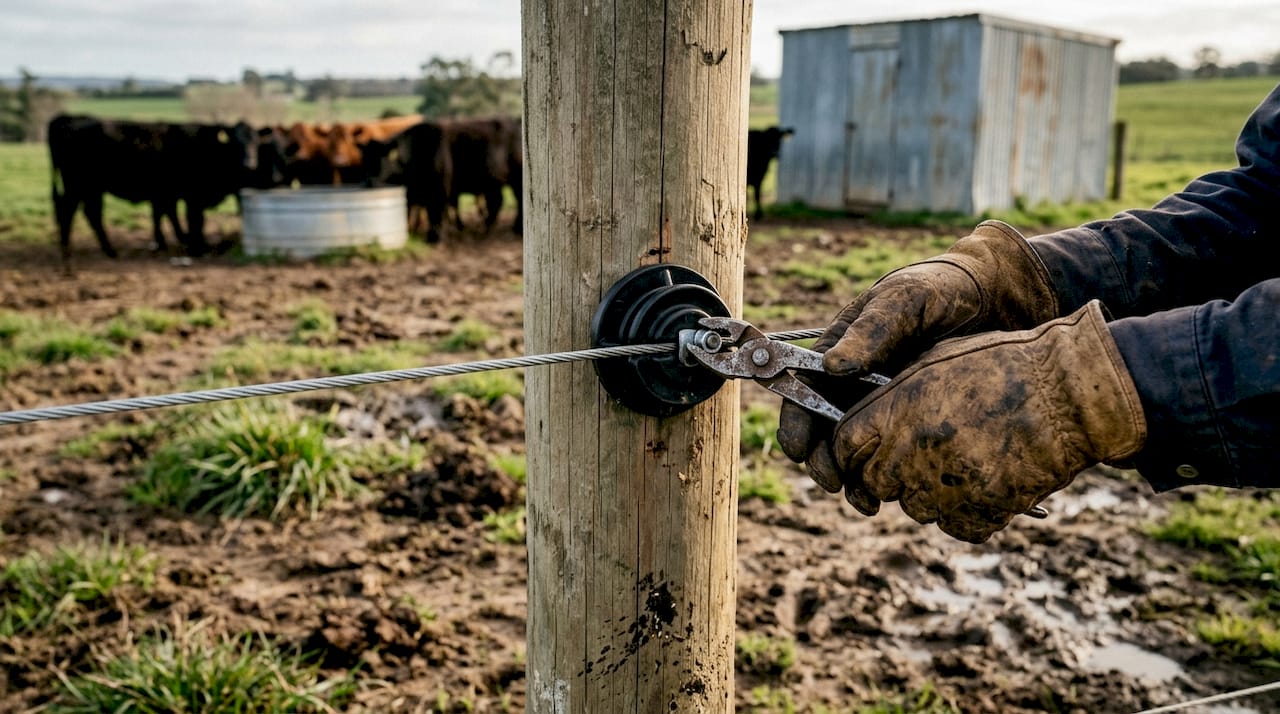
Insulators form the foundation of any electric fence system. Insulators prevent current from grounding through posts, maintaining voltage throughout your fence line. Several types serve different applications:
- Wood post insulators screw directly into wooden posts, ideal for permanent perimeter fencing
- Steel post insulators clip onto T-posts and metal stakes for quick installation
- Offset insulators hold wire away from existing fences, perfect for adding electric to barbed wire
- Plastic insulators offer excellent value and weather resistance for most applications
- Ceramic insulators provide superior electrical properties for high-voltage systems
Tensioners and springs maintain proper wire tension despite temperature changes. Wire contracts in cold weather and expands in heat. Quality tensioners automatically adjust, preventing sagging or over-tightening that stresses insulators and posts.
Gates and handles provide safe access points without compromising fence integrity. Spring-loaded gate handles maintain tension when closed and ground the wire safely when opened. Insulated handles protect you from shocks during operation.
Fence testers diagnose problems quickly, showing voltage levels at any point along your fence. Digital testers provide precise readings, while simple neon testers offer quick go/no-go checks. Regular testing catches issues before they become failures.
Warning signs meet legal requirements and prevent liability. Clearly visible signs alert people and neighboring property owners to electrified fences, reducing accident risk and potential lawsuits.
Installation tools streamline construction and ensure professional results. Tools like spinning jenny and crimp tools ensure strong connections that withstand years of tension and weather. A spinning jenny dispenses wire smoothly, preventing kinks and tangles. Wire cutters designed for high-tensile wire make clean cuts without fraying. Crimp tools create permanent connections stronger than the wire itself.
“The difference between a fence that lasts 20 years and one that fails in five often comes down to the quality of accessories and installation tools used during construction.”
Pro Tip: Invest in a quality 4-slot crimp tool rather than cheaper alternatives. Proper crimps eliminate weak points that cause most wire breaks, and the tool pays for itself by preventing repairs.
Explore specific insulator options for livestock applications and review our installation tips for step-by-step guidance on proper techniques.
Accessory comparison table: Features, pros, and cons
Sometimes it helps to see your options side by side. This comparison clarifies the right choice for your needs based on real-world performance in Canadian conditions.
Types include wood post, steel post, offset, plastic, and ceramic insulators for high-tensile wire, each with distinct advantages and limitations.
| Accessory Type | Material | Weather Suitability | Wire Compatibility | Installation Ease | Cost Range | Best For |
|---|---|---|---|---|---|---|
| Wood Post Insulators | UV-resistant polymer | Excellent in all seasons | High-tensile, poly wire | Moderate (requires drilling) | $0.50-$1.50 | Permanent perimeter fences |
| Steel Post Insulators | Reinforced plastic | Excellent freeze-thaw resistance | All wire types | Very easy (clip-on) | $0.40-$1.00 | Temporary and permanent fencing |
| Offset Insulators | Heavy-duty polymer | Good (exposed to more weather) | High-tensile wire | Easy (mounts to existing fence) | $1.00-$2.00 | Adding electric to barbed wire |
| Ceramic Insulators | Porcelain/ceramic | Poor (cracks in freeze-thaw) | High-voltage applications | Difficult (fragile) | $2.00-$4.00 | High-voltage specialty uses |
| Spring Tensioners | Galvanized steel | Excellent corrosion resistance | High-tensile wire only | Moderate | $3.00-$6.00 | Maintaining tension year-round |
| Gate Handles | Insulated polymer | Excellent UV resistance | All wire types | Very easy | $5.00-$12.00 | Safe fence access points |
Key takeaways from this comparison:
- Polymer-based accessories consistently outperform ceramic and basic plastic in Canadian weather
- Clip-on steel post insulators offer the best balance of ease and durability for most farms
- Investing in quality tensioners prevents the most common fence failures
- Gate handles with proper insulation protect both livestock and handlers
For detailed guidance on system testing and troubleshooting, visit our resource on building and testing electric fences.
Accessory selection for different livestock and situations
Armed with an understanding of the options, let’s break down which accessories to prioritize based on your particular livestock and land. Different animals and farm layouts demand specific accessory combinations for optimal results.
Cattle fencing requires robust accessories that withstand significant pressure. Large animals test fences regularly, leaning against posts and rubbing on wires. Use heavy-duty wood post insulators rated for high tension, spring tensioners every 100 feet to maintain consistent voltage, and reinforced gate handles that survive daily use. Cattle respect a properly charged fence but will exploit any weak point, so failures from improper installation or materials cause 50% of fence issues.
Sheep and goat operations need accessories that accommodate multiple wire heights and tighter spacing. These agile animals find gaps easily, requiring more insulators per post. Steel post clip-on insulators work well because you can adjust wire heights quickly as lambs grow. Offset insulators add electric protection to existing woven wire, preventing animals from pushing through or climbing.
Horse fencing prioritizes visibility and safety alongside containment. Horses panic when surprised by electric fences, potentially injuring themselves. Use highly visible wire or tape, supported by white or brightly colored insulators. Gate handles should be extra-long for easy operation while leading horses through. Avoid sharp edges or protruding hardware that could cause injury.
Mixed livestock operations benefit from modular accessory systems. Choose insulators that accept multiple wire types, allowing you to run different fence configurations for various pastures. Portable gate handles and temporary posts with clip-on insulators let you reconfigure paddocks as grazing needs change.
High-exposure fence lines along roads, property boundaries, or wildlife corridors need premium accessories. These sections face maximum weather exposure, potential vandalism, and interaction with deer or other wildlife. Install extra tensioners to prevent sagging, use the most UV-resistant insulators available, and add additional warning signs. Wildlife pressure can damage fences, so build these sections with durability as the top priority.
Mobile and temporary fencing for rotational grazing demands quick-install accessories. Clip-on steel post insulators, portable reels for wire storage, and step-in posts with integrated insulators allow you to move fence lines in minutes rather than hours. Spring-loaded gate handles that don’t require tools make daily moves practical.
Large acreage farms (over 100 acres) should buy accessories in bulk to reduce per-unit costs. Standardize on one or two insulator types to simplify inventory and repairs. Invest in professional-grade tools because the labor savings multiply across hundreds of posts. Consider solar-powered fence chargers with remote monitoring to reduce maintenance trips.
Small farms and hobby operations (under 20 acres) can focus on versatility over bulk pricing. Multi-purpose accessories that work for different applications provide better value than specialized products. A good quality basic toolkit serves most needs without the investment required for commercial operations.
- Assess your primary livestock type and choose insulators rated for their size and behavior
- Evaluate your climate exposure and select weather-resistant materials accordingly
- Calculate total fence length to determine bulk buying opportunities
- Match accessory quality to fence permanence (premium for permanent, economy for temporary)
- Test new accessory types on small sections before committing to large purchases
Pro Tip: Keep a repair kit with spare insulators, wire, and basic tools in your truck or ATV. Quick fixes prevent small problems from becoming fence failures that let livestock escape.
For species-specific guidance, review our detailed article on fencing for sheep and essential safety tips for Canadian farmers.
Trusted sources for your electric fencing accessories
Ready to equip your fence for long-term success? Finding the right accessories means working with suppliers who understand Canadian agricultural needs and stock products proven in real farm conditions.
Complete accessory kits eliminate guesswork by bundling compatible components. The Patriot fence accessory kit includes insulators, wire, gate handles, and warning signs designed to work together seamlessly. These curated bundles ensure compatibility and often cost less than buying components separately.
Beyond individual products, partnering with a knowledgeable supplier provides access to expert guidance for custom applications. Whether you’re fencing 10 acres or 1,000, professional advice helps you avoid costly mistakes and build systems that perform reliably for decades. Design consulting services can optimize your accessory selection based on terrain, livestock type, and budget constraints.
Browse the full accessory selection to explore options for every application, from basic insulators to specialized tools and testing equipment. Nationwide shipping (excluding PO Boxes) brings professional-grade accessories to your farm, backed by expertise in agricultural fencing and livestock management specific to Canadian conditions.
Frequently asked questions
What is the most important electric fencing accessory for Canadian farms?
Insulators made from UV-resistant polymers are critical because they prevent grounding, especially in harsh weather. Without quality insulators, your entire fence system fails regardless of wire quality or charger power.
How can I prevent fence failures from accessories?
Match accessory ratings to your fence setup, and always choose proven materials installed following manufacturer guidance. Improper installation or materials cause 50% of fence issues, so investing time in correct techniques pays long-term dividends.
Do I need specialized tools to install electric fencing accessories?
Yes, tools like a spinning jenny and crimp tool make installation faster and result in stronger, longer-lasting connections. While basic fences can be built with minimal equipment, professional tools dramatically improve quality and reduce labor time.
Are there different accessories for different livestock types?
Absolutely, matching accessories to livestock like cattle, sheep, or horses ensures safety and effectiveness. Each species has unique behaviors, sizes, and fence interaction patterns that demand specific accessory configurations for reliable containment.
How often should electric fencing accessories be maintained or replaced?
Check accessories at least once a season for wear, breaks, and weathering, and replace damaged components immediately. Regular inspection catches small problems before they cascade into complete fence failures that allow livestock to escape.
Recommended
- Electric fence safety tips for Canadian farmers in 2026 – FenceFast Ltd.
- Agricultural fencing in Canada: choosing durable solutions – FenceFast Ltd.
- Portable outdoor fencing guide for Canadian farmers 2026 – FenceFast Ltd.
- Solar powered electric fence guide for Canadian farmers 2026 – FenceFast Ltd.

